How to jump-start a car with cables
Jump-starting a car can be done safely with jumper cables and a good battery. Follow the correct order to avoid sparks, damage, or injury.
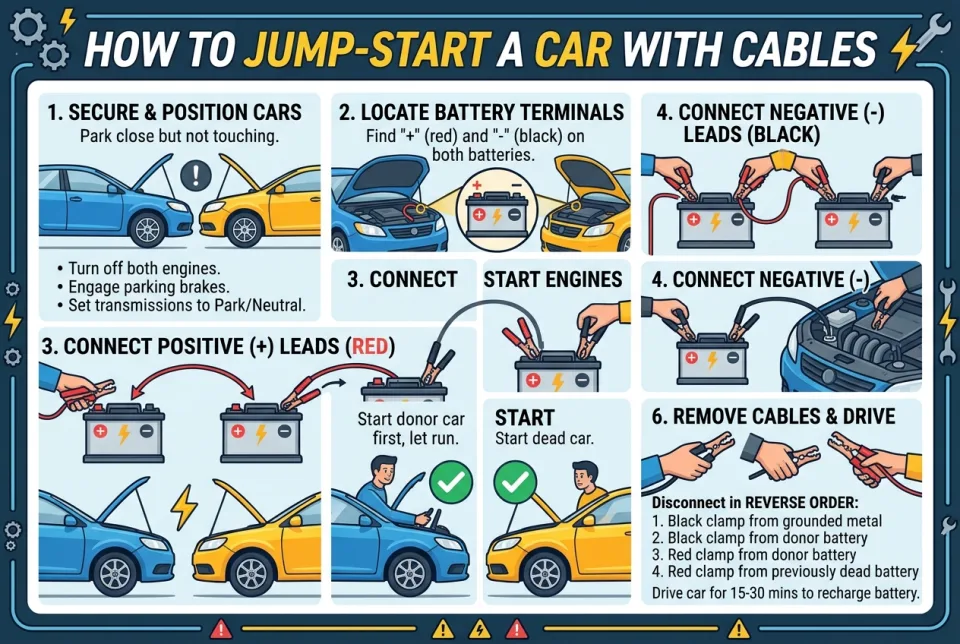
Quick answer
5 steps — read this before anything else
-
1
Park the two cars close but not touching, and turn both engines off.
-
2
Connect the red cable to the dead battery's positive terminal, then to the good battery's positive terminal.
-
3
Connect the black cable to the good battery's negative terminal, then to a bare metal ground on the dead car (not the negative terminal).
-
4
Start the good car, let it run a few minutes, then start the dead car.
-
5
Remove the cables in reverse order and drive the revived car for at least 20 minutes to recharge.
Warning
Batteries can release explosive hydrogen gas. Never smoke or create sparks near a battery, and never connect the final black cable to the dead battery's negative terminal. If the battery is cracked, leaking, or frozen, do not jump-start it.
Jump-starting a car is a common roadside fix, but doing it in the wrong order can cause sparks, damage electronics, or even explode a battery. This guide explains the safe, standard procedure using jumper cables and a second vehicle with a charged battery.
What you need
- Jumper cables with clean, undamaged clamps (red for positive, black for negative).
- A second vehicle with a good battery and matching voltage (almost always 12V).
- Safety glasses and gloves if available.
- Both vehicles parked close enough for the cables to reach, but not touching.
Before you start
Check both batteries for cracks, leaks, or corrosion. If the dead battery is cracked, leaking, or frozen, do not attempt a jump-start: call a professional. Make sure both cars are in Park (or Neutral with the parking brake on), engines off, and all lights and accessories are turned off.
Step-by-step jump-start
- Park safely: Position the cars so the batteries are as close as possible without touching. Turn off both engines and remove the keys.
- Identify the terminals: The positive terminal is marked with a plus (+) and is usually red. The negative is marked with a minus (-) and is usually black. Clean any corrosion with a wire brush if needed.
- Connect the red cable: Clamp one end of the red cable to the dead battery's positive (+) terminal. Clamp the other end to the good battery's positive (+) terminal.
- Connect the black cable: Clamp one end of the black cable to the good battery's negative (-) terminal. Clamp the other end to a bare metal ground on the dead car, such as an unpainted engine bracket or bolt, away from the battery. Do not connect it to the dead battery's negative terminal.
- Start the good car: Let it run for a few minutes to send charge to the dead battery.
- Start the dead car: If it does not start after a few tries, stop and seek help. Do not crank continuously.
- Remove the cables in reverse order: Disconnect the black cable from the ground point, then from the good battery's negative. Then disconnect the red cable from the good battery's positive, then from the dead battery's positive.
- Recharge: Drive the revived car for at least 20-30 minutes, or let it idle with accessories off, to recharge the battery.
What NOT to do
- Do not connect the black cable to the dead battery's negative terminal. The final connection should be to bare metal to reduce spark risk near the battery.
- Do not let the cable clamps touch each other or any metal while connected.
- Do not smoke, use open flames, or create sparks near the battery. Batteries can release explosive hydrogen gas.
- Do not attempt to jump-start a battery that is cracked, leaking, or frozen.
- Do not jump-start a vehicle if you are unsure about the voltage or the procedure. Call a professional.
When to call for help
If the dead car still does not start after a few attempts, if you see smoke or smell burning, or if the battery is damaged, stop and call a roadside assistance service or a mechanic. Repeated jump-start attempts can damage the starter or electronics.
How to prevent a dead battery
- Turn off lights and accessories when you park.
- Have the battery and charging system checked regularly, especially before winter.
- Drive the car regularly to keep the battery charged.
- Replace batteries that are old or showing weakness.
Jump-starting is a temporary fix. If your battery keeps dying, have the charging system and battery tested by a qualified mechanic.
Spotted an error? Report it — we correct factual mistakes promptly.
Read next
Car clicks but will not start: what to do?
A single click or rapid clicking when you turn the key often points to a weak battery or bad connection. Learn safe steps to diagnose and jump-start, and when to call for help.
How to change a car tyre step by step
A safe, step-by-step guide to changing a flat tyre on the side of the road, including essential safety precautions and when to call for professional help.
Lost house keys: what to do?
Losing your house keys is stressful. Act quickly to secure your home, decide whether to rekey or replace locks, and avoid common mistakes that could put your safety at risk.
How to test and replace a smoke alarm battery
Regular testing and timely battery replacement keep your smoke alarm working. Learn how to test your alarm and replace the battery safely.
Related handy tools
Checklists, decision guides, scenarios and quizzes for the same situation.