How to treat a minor burn at home
Learn the safe, evidence-based steps to care for a small, superficial burn at home, and know when to seek medical help.
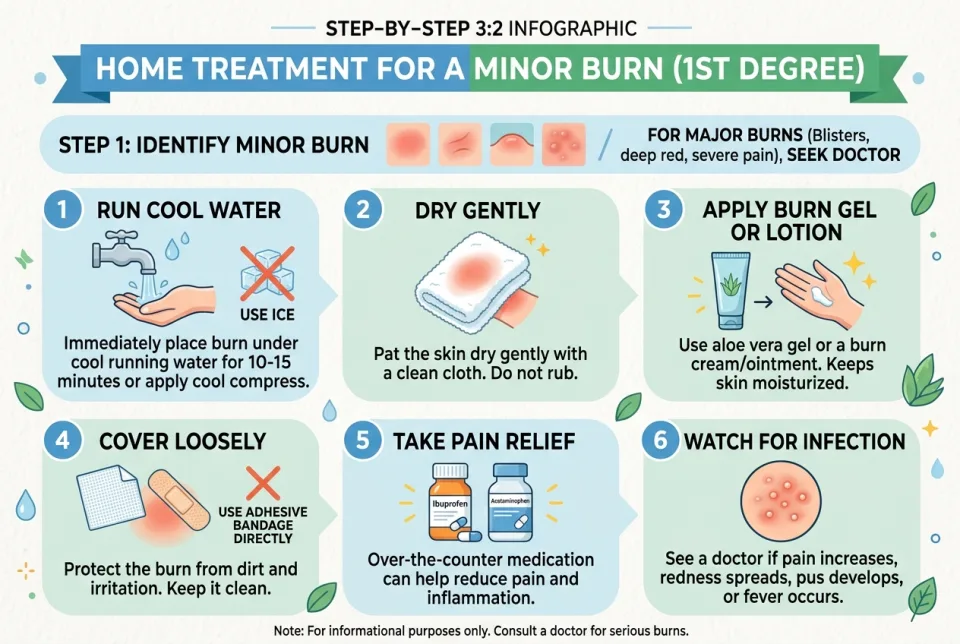
Quick answer
5 steps — read this before anything else
-
1
Cool the burn under cool (not cold) running water for 20 minutes.
-
2
Remove rings or tight items near the burn before swelling starts.
-
3
Cover the burn loosely with a sterile non-stick dressing or clean cloth.
-
4
Do not apply ice, butter, toothpaste, or ointments.
-
5
Seek medical care if the burn is larger than 3 inches, on the face, hands, feet, or joints, or looks deep.
Warning
Call emergency services immediately for large, deep, or charred burns, or burns on the face, hands, feet, genitals, or joints. Do not apply ice or home remedies to a burn.
Important — please read
This content is general educational and informational only, and is not a substitute for professional medical advice, diagnosis or treatment. Always seek the advice of a qualified health provider with any questions you may have about a medical condition. Never disregard or delay seeking professional medical care because of something you read here. In an emergency or life-threatening situation, call your local emergency services (police, fire or ambulance) immediately.
A minor burn is a common household injury. Most small, superficial burns can be safely treated at home with simple first aid. This guide covers the steps to take, what to avoid, and when to get professional help.
What is a minor burn?
A minor burn typically involves only the outer layer of skin (first-degree) or slightly deeper (second-degree) but is small (less than 3 inches in diameter), not on sensitive areas, and not causing severe pain or blistering over a large area. If the burn is larger, deeper, or on the face, hands, feet, genitals, or over a joint, it needs medical attention.
Emergency warning
Call your local emergency services immediately if the burn is large, deep, charred, or white, or if it involves the face, hands, feet, genitals, or a major joint. Also call if the person is a young child or elderly, or if there is difficulty breathing, or the burn was caused by chemicals or electricity.
What to do first (step by step)
- Stop the burning process. Remove the person from the heat source and remove any smoldering clothing or jewelry near the burn, unless it is stuck to the skin.
- Cool the burn. Hold the burned area under cool (not cold) running water for 20 minutes. If running water is not available, apply a cool, wet cloth. Do not use ice.
- Remove tight items. Gently remove rings, watches, or tight clothing from the area before swelling occurs.
- Protect the burn. Cover the burn loosely with a sterile, non-stick dressing or a clean, dry cloth. Do not wrap tightly.
- Manage pain. Over-the-counter pain relievers can help, but follow the label instructions and check with a pharmacist if you are unsure.
What NOT to do
- Do not apply ice, iced water, or very cold compresses; this can further damage the skin.
- Do not apply butter, oil, toothpaste, or home remedies; they trap heat and increase infection risk.
- Do not break blisters; they protect against infection.
- Do not use adhesive bandages directly on the burn; they can stick.
- Do not use cotton wool or fluffy dressings; fibers can stick to the wound.
When to seek professional care
Seek medical attention if:
- The burn is larger than 3 inches (about 7.5 cm) in diameter.
- The burn is on the face, hands, feet, genitals, or over a joint.
- The burn looks deep (white, charred, or leathery) or is painless (which can indicate a severe burn).
- There are signs of infection: increasing pain, redness, swelling, pus, or fever.
- The burn does not heal within a few days or worsens.
- The person has a medical condition that affects healing, such as diabetes.
What to monitor
Check the burn daily for signs of infection. Keep the area clean and dry. Change the dressing as needed or as directed by a healthcare professional. Mild redness and discomfort are normal, but worsening symptoms should prompt a medical visit.
How to prevent burns
Prevent burns by setting your water heater to a safe temperature, keeping hot liquids away from the edges of counters, using oven mitts, and supervising children in the kitchen and bathroom. Install smoke alarms and test them regularly.
This is general information and not a substitute for professional medical advice. In an emergency, call your local emergency services.
Sources & references
Spotted an error? Report it — we correct factual mistakes promptly.
Read next
How to perform the Heimlich manoeuvre on an adult
The Heimlich manoeuvre (abdominal thrusts) is a first-aid technique to clear a severe airway obstruction in a conscious adult. Learn the correct steps and when to use it.
How to stop a nosebleed quickly
Most nosebleeds stop with simple first aid. Learn the correct steps to stop a nosebleed fast and when to get medical help.
Bed bugs suspected at home: what to do?
If you think you have bed bugs, act quickly to confirm the problem and prevent them from spreading. Learn the safe steps to take and what to avoid.
How to treat an insect bite
Most insect bites are mild and improve with simple home care. Learn how to clean the area, ease itching, spot signs of infection, and know when to get medical help.
Related handy tools
Checklists, decision guides, scenarios and quizzes for the same situation.