How to perform the Heimlich manoeuvre on an adult
The Heimlich manoeuvre (abdominal thrusts) is a first-aid technique to clear a severe airway obstruction in a conscious adult. Learn the correct steps and when to use it.
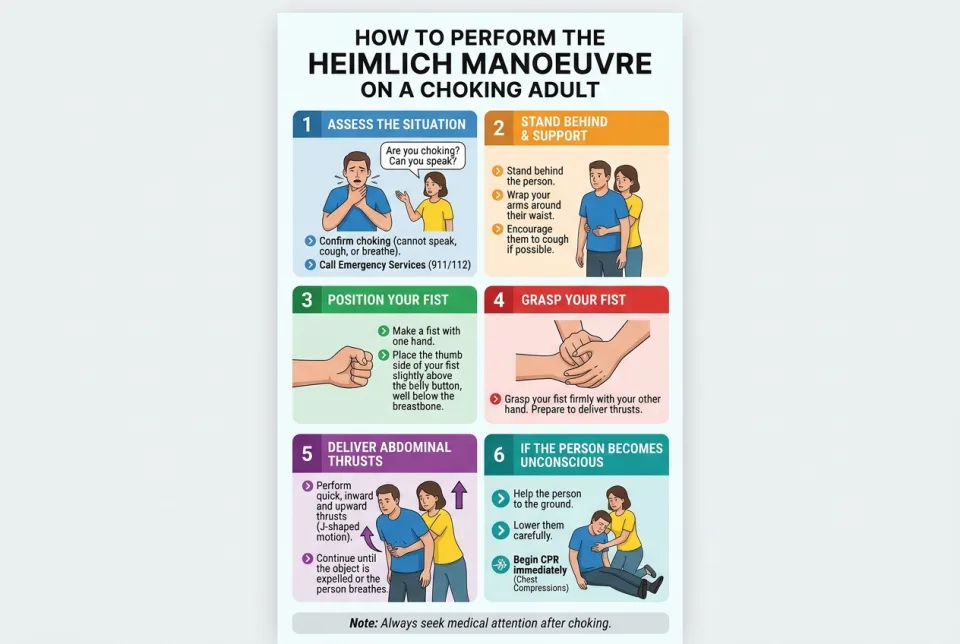
Quick answer
5 steps — read this before anything else
-
1
Ask the person if they are choking and if you can help.
-
2
If they cannot speak, cough, or breathe, call emergency services immediately.
-
3
Stand behind them, make a fist, and place it just above the navel.
-
4
Perform quick, upward abdominal thrusts until the object is expelled or they become unresponsive.
-
5
If they become unresponsive, start CPR.
Warning
Choking is a life-threatening emergency. Call emergency services immediately if the person cannot breathe, speak, or cough.
Important — please read
This content is general educational and informational only, and is not a substitute for professional medical advice, diagnosis or treatment. Always seek the advice of a qualified health provider with any questions you may have about a medical condition. Never disregard or delay seeking professional medical care because of something you read here. In an emergency or life-threatening situation, call your local emergency services (police, fire or ambulance) immediately.
Choking is a medical emergency. If an adult is choking and cannot breathe, speak, or cough effectively, immediate action is needed. The Heimlich manoeuvre, also called abdominal thrusts, is a first-aid technique to expel a foreign object from the airway.
Emergency warning
Call your local emergency services immediately if the person is choking and cannot breathe, speak, or cough. If you are alone, call for help before starting first aid. If the person becomes unresponsive, begin CPR.
What to do first
- Assess the situation. Ask, "Are you choking? Can you speak?" If they can cough forcefully, encourage them to keep coughing. If they cannot breathe, speak, or cough, act immediately.
- Call for help. Ask someone to call emergency services. If you are alone, call yourself on speakerphone.
- Give abdominal thrusts. Stand behind the person and wrap your arms around their waist. Make a fist with one hand and place the thumb side against the middle of their abdomen, just above the navel and well below the breastbone. Grasp your fist with your other hand and give quick, inward and upward thrusts. Repeat until the object is expelled or the person becomes unresponsive.
- If the person becomes unresponsive, lower them to the ground and start CPR. Continue until help arrives.
What NOT to do
- Do not perform abdominal thrusts on someone who is coughing effectively or can speak; encourage coughing instead.
- Do not give abdominal thrusts to pregnant women or obese individuals; use chest thrusts instead (place hands on the lower half of the breastbone and pull straight back).
- Do not put your fingers in the person's mouth unless you can see the object; blind finger sweeps can push it deeper.
- Do not delay calling for emergency help.
When to seek professional care
Anyone who has received abdominal thrusts should be evaluated by a healthcare professional, even if the object is expelled, to check for internal injuries. If the person continues to have difficulty breathing or swallowing after the object is removed, seek medical attention immediately.
How to prevent choking
- Cut food into small pieces and chew thoroughly.
- Avoid talking or laughing with a mouth full of food.
- Keep small objects away from young children.
- Be cautious with foods that are common choking hazards, such as whole grapes, nuts, and hard candies.
Remember: this is general information and not a substitute for professional medical advice. In an emergency, call your local emergency services immediately.
Sources & references
Spotted an error? Report it — we correct factual mistakes promptly.
Read next
What to Do If Someone Is Choking? Essential Life-Saving Steps to Take Immediately
Learn how to respond rapidly when someone is choking to clear their airway and save a life using proven emergency first-aid techniques.
Ants invading the kitchen counter: what to do?
Ants on your kitchen counter are a common nuisance that you can manage with simple sanitation and targeted baiting. Learn the safe, effective steps to eliminate them and prevent their return.
How to treat an insect bite
Most insect bites are mild and improve with simple home care. Learn how to clean the area, ease itching, spot signs of infection, and know when to get medical help.
Mold on bathroom walls: what to do?
Mold on bathroom walls is common and usually manageable. Learn how to clean it safely, prevent it from returning, and when to call a professional.
Related handy tools
Checklists, decision guides, scenarios and quizzes for the same situation.