Car clicks but will not start: what to do?
A single click or rapid clicking when you turn the key often points to a weak battery or bad connection. Learn safe steps to diagnose and jump-start, and when to call for help.
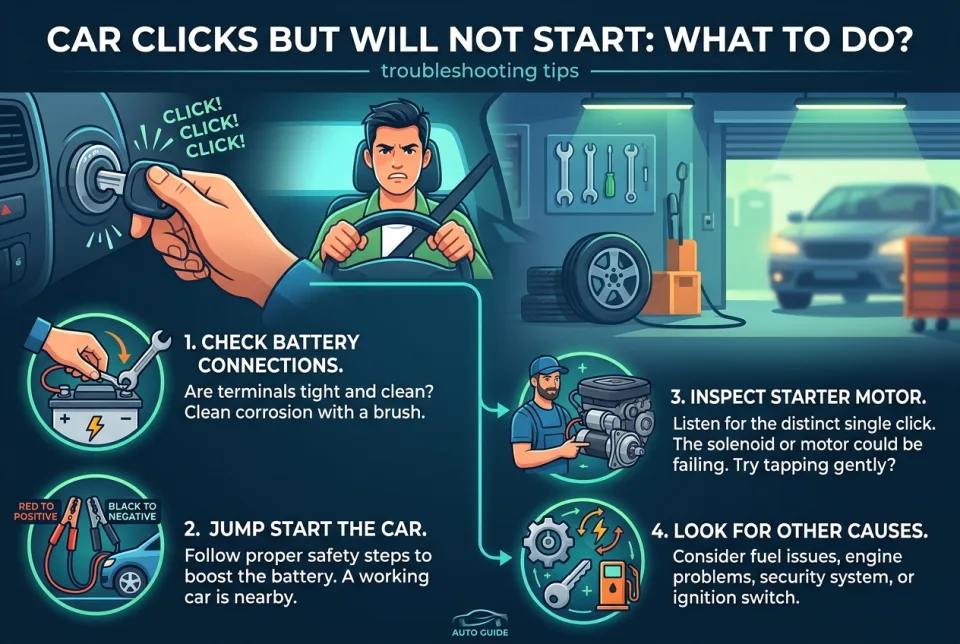
Quick answer
5 steps — read this before anything else
-
1
Turn off all accessories (lights, radio, A/C) and try starting again.
-
2
Check battery terminals for loose or corroded connections; clean if needed.
-
3
If lights are dim or horn is weak, the battery is likely low: jump-start safely or charge it.
-
4
If lights are bright but you hear only a click, suspect the starter or relay; tap the starter gently with a hammer (if accessible) as a temporary test.
-
5
If the car still will not start, call a roadside service or mechanic.
Warning
Batteries can produce explosive hydrogen gas. Do not smoke or create sparks near the battery, and wear eye protection when working with battery terminals.
When you turn the key and hear a click but the engine does not crank, it usually means the battery does not have enough power to turn the starter, or the starter circuit has a fault. This guide covers safe checks you can do yourself and when to get professional help.
What is happening?
A clicking sound is often the starter solenoid engaging but not enough current reaching the starter motor. Common causes include a weak or dead battery, corroded or loose battery terminals, a failing starter motor, a bad ignition switch, or a faulty relay. A single loud click can also indicate a seized engine or a broken starter drive, but start with the simplest checks first.
Emergency warning
If you smell fuel, see smoke, or notice flames, do not attempt to start the car. Move away and call emergency services immediately. If the car is in a dangerous location (such as a busy road), turn on hazard lights and get to safety before troubleshooting.
Step by step
- Turn off all accessories. Switch off lights, radio, air conditioning, and any phone chargers. Sometimes a weak battery can recover just enough to start if the load is reduced.
- Check the battery terminals. Look for loose cables or white/green corrosion. A loose terminal can cause clicking. With the ignition off, gently wiggle the cables; if loose, tighten the clamp. For corrosion, pour a little baking soda solution and scrub with a brush, then rinse with water and dry. Wear eye protection.
- Test the battery condition. Turn on the headlights. If they are dim or the horn sounds weak, the battery is likely low. If they are bright, the battery may be fine and the problem is elsewhere.
- Jump-start safely. If the battery is low, use jumper cables and a donor vehicle. Connect positive to positive first, then negative on the donor to a bare metal ground on your car (not the battery negative). Start the donor, then try your car. Once started, remove cables in reverse order. Do not jump-start if the battery is cracked, leaking, or frozen.
- If lights are bright but you hear only a click, suspect the starter. Locate the starter (consult your manual) and, if accessible, gently tap the starter body with a hammer or wrench while someone turns the key. If it starts, the starter is likely failing and needs replacement soon.
- Check the battery age and charge. If the battery is more than 3-5 years old, it may need replacement. A slow charger can restore a low battery, but a dead battery that will not hold a charge should be replaced.
What NOT to do
- Do not lean over the battery while jump-starting; batteries can explode.
- Do not connect the negative jumper cable to the dead battery's negative terminal; use a ground point instead.
- Do not keep cranking the engine repeatedly; you can overheat the starter.
- Do not touch the starter or ignition components with the engine running or ignition on.
- Do not use a hammer on modern sensitive electronics; only tap the starter body gently if you know where it is.
When to call for help
Call a roadside service or mechanic if: you cannot jump-start safely, the car still clicks after a jump, you see smoke or smell burning, the battery is damaged or leaking, or you are unsure about any step. If the car is in traffic, call for assistance and stay safe.
What to monitor
After a successful jump-start, drive the car for at least 20-30 minutes to recharge the battery. If the clicking returns soon after, have the battery and charging system tested by a professional. A recurring click can indicate a failing alternator or a parasitic drain.
How to prevent it
Keep battery terminals clean and tight, test the battery annually after three years, and avoid leaving lights or accessories on when the engine is off. In cold weather, park in a garage if possible and consider a battery maintainer.
If you have followed these steps and the car still will not start, it is time to call a professional. Do not risk further damage or injury.
Spotted an error? Report it — we correct factual mistakes promptly.
Read next
Key locked inside the car: what to do?
Stay calm, check all doors, and call a professional locksmith or roadside service. Avoid breaking windows unless there is an emergency.
Accident in a rental car abroad: what to do?
A step-by-step guide to handling a rental car accident in a foreign country, from securing the scene to notifying the rental company and your insurer.
Brake failure while driving: what to do?
Brake failure at speed is a true emergency. Stay calm, pump the pedal, downshift, and use the handbrake or road friction to slow down safely.
Car overheating: what to do?
When your car overheats, quick action can prevent engine damage and keep you safe. Learn the steps to take and what to avoid.
Related handy tools
Checklists, decision guides, scenarios and quizzes for the same situation.