How to change a car tyre step by step
A safe, step-by-step guide to changing a flat tyre on the side of the road, including essential safety precautions and when to call for professional help.
Quick answer
5 steps — read this before anything else
-
1
Park on a flat, solid surface away from traffic and turn on your hazard lights.
-
2
Apply the parking brake and place wheel wedges (or heavy objects) behind the wheels.
-
3
Loosen the lug nuts slightly before raising the car with the jack.
-
4
Raise the car until the flat tyre is off the ground, then remove the lug nuts and the tyre.
-
5
Mount the spare, hand-tighten the lug nuts, lower the car, and tighten the nuts in a star pattern.
Warning
Never get under a car supported only by a jack. Always use jack stands if you need to work under the vehicle.
A flat tyre can happen anywhere, but changing it safely is a skill every driver should have. This guide walks you through the process step by step, with a focus on safety. If you are on a busy road and feel unsafe, call for professional help instead of attempting the change yourself.
Safety First
Before you start, make sure you are in a safe spot. Pull as far off the road as possible, onto a flat, solid surface. Avoid soft shoulders, grass, or slopes. Turn on your hazard lights and, if you have one, set out a warning triangle behind the car. Apply the parking brake and put the car in gear (manual) or Park (automatic).
What You Will Need
- Spare tyre (check it is inflated and in good condition)
- Jack and jack handle
- Lug wrench (tyre iron)
- Wheel wedges or heavy objects to chock the wheels
- Gloves and a reflective vest for visibility
Step-by-Step Instructions
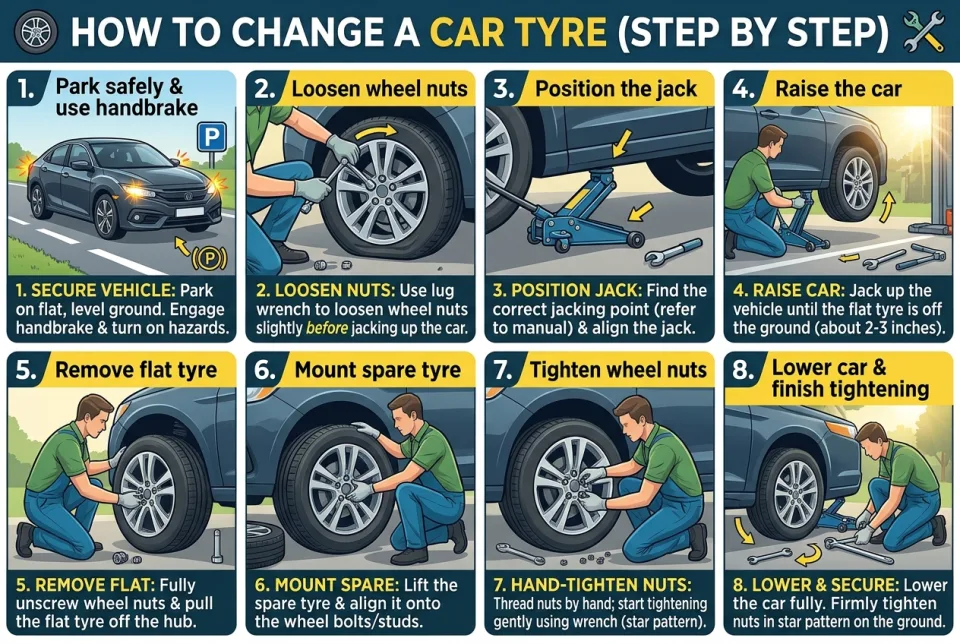
- Secure the vehicle. Apply the parking brake and chock the wheel diagonally opposite the one you are changing. For example, if changing the front left tyre, place a wedge behind the rear right wheel.
- Loosen the lug nuts. Use the lug wrench to loosen each nut about a quarter turn. Do this before raising the car, while the tyre is still on the ground. If a nut is stuck, apply steady pressure; do not use excessive force that could tip the car.
- Raise the car. Position the jack under the vehicle's jacking point (consult your owner's manual for the correct location). Raise the car until the flat tyre is just off the ground.
- Remove the lug nuts and tyre. Fully unscrew the lug nuts and set them aside in a safe place. Pull the tyre straight toward you to remove it.
- Mount the spare tyre. Lift the spare onto the wheel hub, aligning the holes with the studs. Push it on until it sits flush.
- Hand-tighten the lug nuts. Screw the nuts on by hand until snug. Do not tighten them fully yet.
- Lower the car. Use the jack to lower the vehicle until the tyre touches the ground.
- Tighten the lug nuts. Using the lug wrench, tighten the nuts in a star pattern (alternating opposite nuts) to ensure even seating. Tighten firmly, but do not overdo it.
- Check and stow. Make sure the spare is properly inflated and all tools are packed away. Check the lug nuts again after driving a short distance.
What NOT to Do
- Do not change a tyre on a slope or soft ground; the jack could slip.
- Never get under the car while it is supported only by a jack.
- Do not use the lug wrench to tighten nuts with your full body weight; it can damage the studs.
- Do not drive on a space-saver spare tyre at high speeds or for long distances; check the owner's manual for limits.
When to Call for Help
If you are on a busy highway, in a tunnel, or in an unsafe area, do not attempt to change the tyre yourself. Call roadside assistance or emergency services if you are in immediate danger. Also call for help if you cannot loosen the lug nuts or if the spare tyre is flat or damaged.
After the Change
Drive to the nearest service station to have the damaged tyre repaired or replaced, and to have the lug nuts properly torqued. Check the spare tyre's pressure regularly. Remember, this guide is general information; always consult your vehicle's owner's manual for specific instructions.
Spotted an error? Report it — we correct factual mistakes promptly.
Read next
Kitchen smoke alarm goes off while cooking: what to do?
Learn how to safely handle a smoke alarm that activates while you are cooking, including how to silence it, prevent false alarms, and when to treat it as a real emergency.
Burglar alarm false trigger: what to do?
A false alarm is annoying but manageable. Disarm safely, verify no real intrusion, reset the system, and fix the cause so it does not happen again.
Ants invading the kitchen counter: what to do?
Ants on your kitchen counter are a common nuisance that you can manage with simple sanitation and targeted baiting. Learn the safe, effective steps to eliminate them and prevent their return.
Spilled drink on a laptop: what to do?
Liquid and electricity do not mix. Acting in the first 30 seconds, then drying and waiting before you power on, gives your laptop the best chance of surviving a spill.
Related handy tools
Checklists, decision guides, scenarios and quizzes for the same situation.