Well pump losing pressure: what to do?
When your well pump loses pressure, quick checks can often restore it. Learn the safe steps to diagnose and fix the problem without damaging your system.
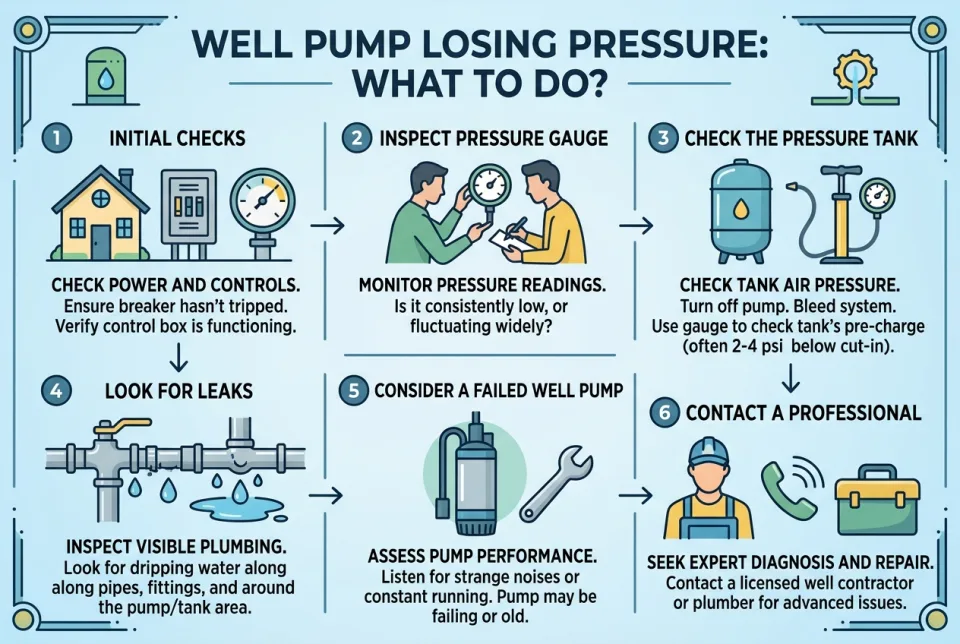
Quick answer
5 steps — read this before anything else
-
1
Check if the power is on and the breaker has tripped.
-
2
Inspect the pressure gauge and pressure switch for obvious damage.
-
3
Look for leaks in pipes, fixtures, and the pressure tank.
-
4
Test the pressure tank's air charge with a tire gauge.
-
5
If the problem persists, call a licensed well pump professional.
Warning
Water and electricity are dangerous together. If the pump area is flooded or you see sparks, do not touch electrical components. Turn off power at the main breaker if safe, and call a professional.
A sudden drop in water pressure from a well pump can be frustrating and disruptive. But before you panic, there are several safe and straightforward steps you can take to diagnose and sometimes fix the issue yourself. This guide walks you through what to check, what to avoid, and when to call a professional.
What Is Happening?
Well pumps maintain water pressure by pushing water from the well into a pressure tank. The tank acts as a buffer, using compressed air to keep pressure steady. When pressure drops, it usually means the pump is not running, there is a leak, the pressure tank has lost its air charge, or the pressure switch has failed.
Emergency Warning
If you see water spraying near electrical components, or if the pump area is flooded, do not touch anything electrical. Turn off power at the main breaker if it is safe to do so, and call a professional immediately. Water and electricity are a dangerous combination.
What to Do First
- Check the power. Ensure the well pump's circuit breaker is on. If it has tripped, reset it once. If it trips again, stop and call an electrician.
- Check the pressure gauge. If the gauge reads zero even when water is running, the gauge may be broken or the pump may not be running.
- Look for leaks. Inspect visible pipes, fixtures, and the pressure tank for drips or pooling water.
- Test the pressure tank. With the pump off and water drained, use a tire gauge to check the air pressure at the tank's air valve. Compare it to the cut-in pressure (often 20-30 psi). If it is low, the tank may need recharging or replacing.
- Inspect the pressure switch. Turn off power first. Remove the switch cover and look for burnt contacts or debris. If it looks damaged, replace it or call a professional.
What NOT to Do
- Do not repeatedly reset a tripping breaker. This can damage the pump motor or cause a fire.
- Do not ignore a flooded pump area. Stay clear and call for help.
- Do not adjust the pressure switch or tank without understanding the settings. Incorrect adjustments can damage the system.
- Do not run the pump dry. If the well is low, running the pump without water can burn out the motor.
When to Call a Professional
Call a licensed well pump technician if:
- The pump does not run even with power.
- You suspect a broken pipe underground.
- The pressure tank is waterlogged or damaged.
- You are uncomfortable working with electrical components.
- The problem persists after basic checks.
What to Monitor
After any fix, monitor the pressure gauge for a few days. It should hold steady and cycle normally when water is used. Watch for frequent cycling (pump turning on and off rapidly), which can indicate a tank issue.
How to Prevent It
- Have your well system inspected annually by a professional.
- Test the pressure tank's air charge yearly.
- Keep the area around the pump dry and free of debris.
- During dry spells, monitor your well's water level and avoid overuse.
By following these steps, you can often identify the cause of pressure loss and take safe action. If in doubt, always call a qualified professional.
Spotted an error? Report it — we correct factual mistakes promptly.
Read next
Toilet keeps running after flushing: what to do?
A running toilet wastes water and money. Learn how to diagnose and fix common causes like a faulty flapper, stuck float, or leaking fill valve.
Water infiltration through the wall: what to do?
Water seeping through a wall can lead to structural damage and mold. Learn how to respond quickly and prevent further issues.
Ceiling water stain appears: what to do?
A new water stain on your ceiling can signal a leak, condensation, or a roof problem. Act quickly to limit damage and prevent mold.
Sump pump not working: what to do?
A failed sump pump can lead to basement flooding fast. Learn the safe, step-by-step actions to take when your sump pump stops working, including how to protect your home and when to call a professional.
Related handy tools
Checklists, decision guides, scenarios and quizzes for the same situation.