Neighbor plays loud music at night: what to do?
A step-by-step guide to handling a noisy neighbor playing loud music at night, from polite conversation to formal complaints, while staying safe and calm.
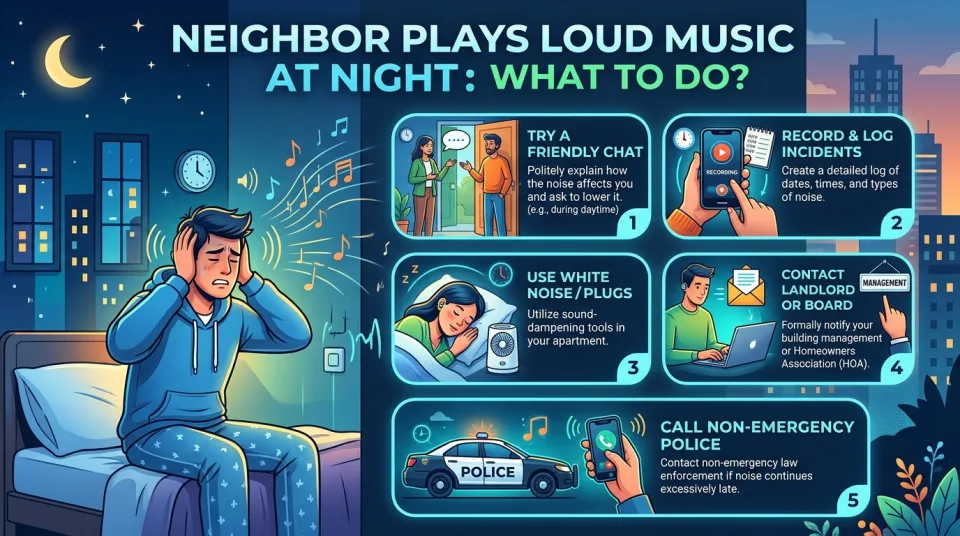
Quick answer
5 steps — read this before anything else
-
1
Check local noise rules to know your rights.
-
2
Wait for a calm moment and talk to your neighbor politely.
-
3
If it continues, document each incident with time, date, and details.
-
4
Contact your landlord, HOA, or local authorities if needed.
-
5
Avoid confrontations when you or others feel unsafe.
Warning
If your neighbor becomes threatening or violent, do not confront them. Call local emergency services immediately.
Loud music late at night can disrupt sleep, raise stress, and strain neighborly relations. Most issues can be resolved calmly and without conflict. This guide outlines practical steps to address the problem while keeping the situation safe and respectful.
What is happening
Your neighbor is playing music at a volume or time that disturbs you. This may be a one-time event or a recurring problem. Noise ordinances vary by location, but many communities have quiet hours (often 10 p.m. to 7 a.m.). Knowing the rules helps you act appropriately.
Step by step: what to do
- Check local noise rules. Look up your city or county noise ordinance online or call the non-emergency police line to ask about quiet hours and decibel limits. This gives you a factual basis for your request.
- Wait for a calm moment. Do not confront your neighbor while the music is blasting or when emotions are high. Approach them the next day or during a quiet time.
- Talk politely and specifically. Knock on the door, introduce yourself, and explain the impact: "The music was very loud last night and kept me awake. Could you turn it down after 10 p.m.?" Avoid accusations; focus on the behavior and its effect.
- Document incidents. If the problem continues, keep a log with date, time, duration, and a description of the noise. Note any attempts you made to resolve it. This record is useful for formal complaints.
- Contact your landlord or HOA. If you rent, inform your landlord. If you live in a managed community, report to the homeowners association. They may have policies and can intervene.
- File a noise complaint. If informal steps fail, contact local authorities (non-emergency police number or noise control office). Provide your log. In many areas, they will issue a warning or citation.
- Consider mediation. Some communities offer free mediation services to help neighbors resolve disputes. This can be less confrontational than legal action.
What NOT to do
- Do not retaliate with your own loud noise or harassment; it escalates conflict and may violate rules yourself.
- Do not confront your neighbor if you feel unsafe or if they are intoxicated or aggressive. Call authorities instead.
- Do not ignore persistent noise; it can affect your health and may worsen over time.
- Do not make threats or use abusive language; stay calm and factual.
When to call for help
Call the non-emergency police line if the noise is ongoing during quiet hours and you have already tried talking. Call emergency services (e.g., 911 in the US) only if there is an immediate threat to safety, such as violence or a medical emergency.
What to monitor
Keep track of how often the noise occurs and whether it follows a pattern. Note any health effects (sleep loss, stress) and whether your attempts to resolve it are acknowledged. This information strengthens your case if you need to escalate.
How to prevent it
Build a friendly relationship with your neighbors before problems arise. Exchange contact numbers and agree on quiet hours. Use rugs, curtains, or white noise machines to reduce sound transmission. If you are planning a gathering, inform neighbors in advance.
Start with a polite conversation, document if needed, and use formal channels only as a last resort. Most neighbors are reasonable and will adjust once they understand the impact.
Spotted an error? Report it — we correct factual mistakes promptly.
Read next
Bed bugs suspected at home: what to do?
If you think you have bed bugs, act quickly to confirm the problem and prevent them from spreading. Learn the safe steps to take and what to avoid.
Bad smell coming from bathroom drains: what to do?
A foul odor from bathroom drains is usually caused by a dry trap, buildup, or a blocked vent. Learn safe steps to find and fix the problem.
Ants invading the kitchen counter: what to do?
Ants on your kitchen counter are a common nuisance that you can manage with simple sanitation and targeted baiting. Learn the safe, effective steps to eliminate them and prevent their return.
How to test and replace a smoke alarm battery
Regular testing and timely battery replacement keep your smoke alarm working. Learn how to test your alarm and replace the battery safely.
Related handy tools
Checklists, decision guides, scenarios and quizzes for the same situation.