Kitchen smoke alarm goes off while cooking: what to do?
Learn how to safely handle a smoke alarm that activates while you are cooking, including how to silence it, prevent false alarms, and when to treat it as a real emergency.
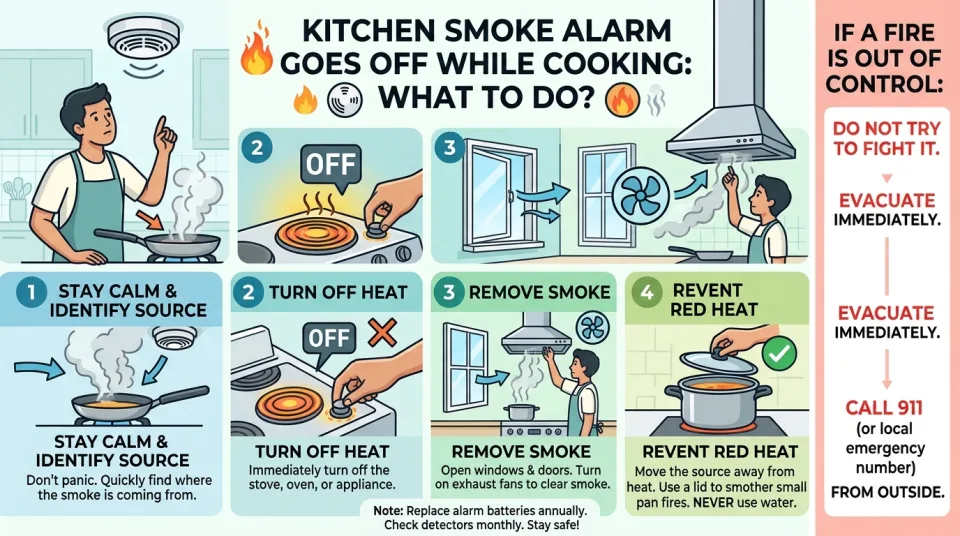
Quick answer
4 steps — read this before anything else
-
1
Turn off the heat source immediately.
-
2
Check for actual fire or smoke; if flames are present, evacuate and call emergency services.
-
3
If it is only cooking smoke, press the hush button or open windows to ventilate.
-
4
Never disable the alarm permanently; use proper ventilation and cooking techniques to prevent future false alarms.
Warning
If you see flames or heavy smoke, evacuate immediately and call emergency services. Never use water on a grease fire.
Important — please read
This content is general educational and informational only, and is not a substitute for professional medical advice, diagnosis or treatment. Always seek the advice of a qualified health provider with any questions you may have about a medical condition. Never disregard or delay seeking professional medical care because of something you read here. In an emergency or life-threatening situation, call your local emergency services (police, fire or ambulance) immediately.
It is a common scenario: you are frying, grilling, or toasting, and suddenly the smoke alarm blares. While often a nuisance, it is important to respond correctly because a real fire can start in seconds. This guide explains what to do when a kitchen smoke alarm goes off while cooking, how to prevent false alarms, and when to treat the situation as an emergency.
What is happening
Smoke alarms detect smoke particles in the air. Cooking activities such as high-heat frying, broiling, or using a toaster can produce enough smoke or steam to trigger the alarm even without a fire. However, the same alarm could also be warning you of a real fire, so never ignore it.
Emergency warning
If you see flames, heavy smoke, or smell burning that is not from food, treat it as a fire emergency. Evacuate everyone immediately and call your local emergency services from a safe location. Do not attempt to fight a large fire yourself.
What to do first
- Turn off the heat source. Switch off the stove, oven, or any appliance that is producing smoke.
- Assess the situation quickly. Look for flames, excessive smoke, or a burning smell that is not just food. If you see fire, evacuate and call emergency services.
- Silence the alarm if it is a false alarm. Most smoke alarms have a hush button. Press it to temporarily silence the alarm while you clear the air. Never remove the battery or disconnect the alarm permanently.
- Ventilate the area. Open windows and turn on exhaust fans to clear smoke. If the alarm does not stop after a few minutes, evacuate and call emergency services.
What NOT to do
- Do not ignore the alarm. Always check for fire before assuming it is a false alarm.
- Do not disable the alarm permanently. Removing batteries or covering the alarm can leave you unprotected.
- Do not use water on a grease fire. Water can cause a grease fire to explode. Instead, smother it with a lid or use a fire extinguisher rated for kitchen fires.
- Do not fan the alarm with a towel. This can spread smoke and make the alarm sound longer.
When to call for help
Call emergency services if:
- You see flames that are not contained to a pan and cannot be quickly smothered.
- The fire has spread to cabinets, walls, or other materials.
- You cannot safely turn off the heat source.
- The smoke alarm continues to sound even after you have ventilated the area and there is no cooking smoke.
- Anyone is injured or experiencing difficulty breathing.
How to prevent false alarms
- Use proper ventilation: Always turn on the range hood or exhaust fan when cooking.
- Keep appliances clean: Clean grease buildup from stovetops, ovens, and toasters regularly.
- Adjust cooking methods: Use lower heat, cover pans, and avoid leaving food unattended under the broiler.
- Consider alarm placement: Install smoke alarms at least 10 feet (3 meters) away from cooking appliances, or use a photoelectric alarm near the kitchen, which is less prone to false alarms from cooking.
- Test alarms monthly and replace batteries according to the manufacturer's instructions.
What to monitor
After a false alarm, monitor the cooking area for any lingering smoke or heat. Ensure that the heat source is completely off and that no food is still burning. If you had to use a fire extinguisher, clean up any residue and check that the appliance is safe to use again.
This information is general and not a substitute for professional advice. In an emergency, always call your local emergency services.
Sources & references
Spotted an error? Report it — we correct factual mistakes promptly.
Read next
How to test and replace a smoke alarm battery
Regular testing and timely battery replacement keep your smoke alarm working. Learn how to test your alarm and replace the battery safely.
Neighbor plays loud music at night: what to do?
A step-by-step guide to handling a noisy neighbor playing loud music at night, from polite conversation to formal complaints, while staying safe and calm.
Spilled drink on a laptop: what to do?
Liquid and electricity do not mix. Acting in the first 30 seconds, then drying and waiting before you power on, gives your laptop the best chance of surviving a spill.
Bee swarm settled in the garden: what to do?
A bee swarm in your garden is usually a temporary stopover. Learn how to stay safe, when to call a beekeeper, and what not to do.
Related handy tools
Checklists, decision guides, scenarios and quizzes for the same situation.