Expired fire extinguisher: what to do?
An expired fire extinguisher may not work when you need it most. Learn how to check its condition, what to do with it, and how to replace it safely.
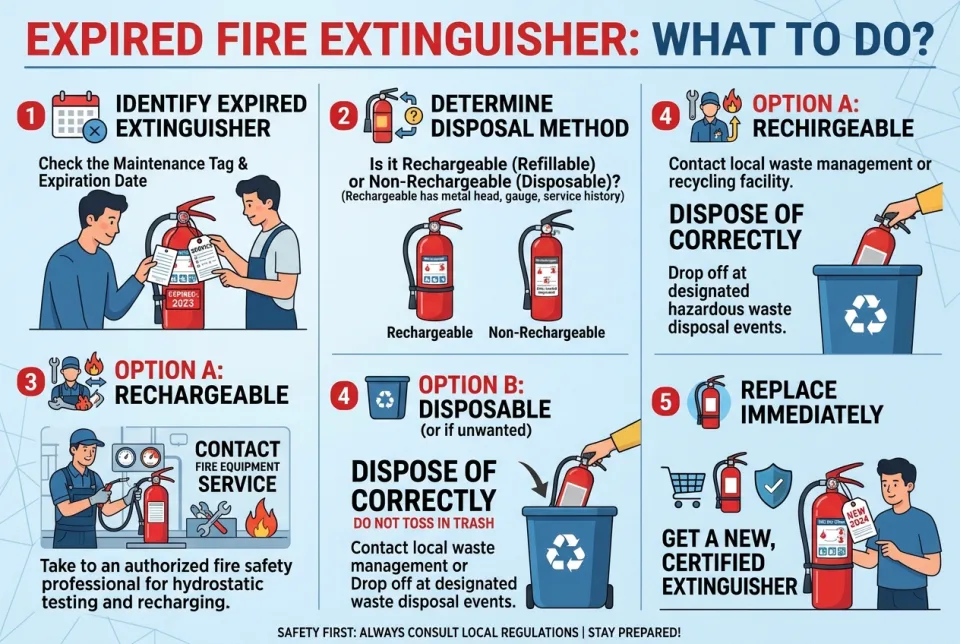
Quick answer
5 steps — read this before anything else
-
1
Check the pressure gauge: if the needle is in the red or the gauge is damaged, the extinguisher is not reliable.
-
2
Look for the date of manufacture or last service tag; most extinguishers need professional maintenance every 6 or 12 years depending on type.
-
3
If expired, do not test it indoors or discharge it randomly; contact your local fire department or a licensed extinguisher service company for disposal or recycling.
-
4
Replace it with a new extinguisher of the correct type and size for your home or vehicle.
-
5
Store the new extinguisher in an accessible place, and check the gauge monthly.
Warning
Never puncture, burn, or dispose of a fire extinguisher in regular trash. Pressurized cylinders can explode. Contact your local fire department or a licensed service company for safe disposal.
Fire extinguishers do not last forever. Over time, the pressure can drop, the extinguishing agent can clump or leak, and the valve or hose can degrade. An expired extinguisher might fail when you need it most. This guide explains how to tell if your extinguisher is past its prime, what to do with it, and how to stay protected.
How to tell if your extinguisher is expired
Fire extinguishers do not have a single expiration date. Instead, they have a manufacture date and a service history. Check these signs:
- Pressure gauge: The needle should point to the green zone. If it is in the red or the gauge is broken, the extinguisher may not discharge properly.
- Service tag: A professional should inspect and tag the extinguisher annually. The tag shows the last service date. Most extinguishers also need a more thorough maintenance every 6 or 12 years, depending on type.
- Physical condition: Look for dents, rust, cracks, a clogged nozzle, or a damaged hose. Any of these mean the extinguisher should be replaced.
- Age: Even if never used, disposable extinguishers often have a limited shelf life (often 10-12 years). Check the manufacturer's instructions.
What to do with an expired extinguisher
- Do not discharge it indoors or in a random place. Testing it yourself can create a mess, waste the agent, and pose a hazard. Some extinguishers can be discharged outdoors for practice, but only if allowed by local authorities and done safely.
- Contact your local fire department. Many fire departments accept old extinguishers for disposal or can tell you where to take them. Do not put extinguishers in regular trash or recycling unless your local waste management explicitly allows it.
- Use a licensed extinguisher service company. They can inspect, recharge, or dispose of the extinguisher properly. In some areas, they may buy back or recycle old units.
- Replace it promptly. Do not wait. Buy a new extinguisher that matches the fire risks in your home (e.g., ABC rating for general use) and is the right size for you to handle.
What NOT to do
- Do not keep an expired extinguisher as your only protection. It may give you false confidence.
- Do not puncture, incinerate, or throw the extinguisher in the trash; pressurized cylinders can explode.
- Do not attempt to recharge or repair it yourself unless you are trained and certified.
- Do not test it by spraying a small amount; this can cause the pressure to drop and make it unusable.
How to prevent this in the future
- Check the pressure gauge monthly and shake the extinguisher gently (for dry chemical types) to prevent the agent from settling.
- Have it professionally inspected annually and serviced as recommended.
- Keep a note of the manufacture date and plan to replace it before it becomes unreliable.
- Store it in a clean, dry place away from extreme temperatures.
If you are unsure about your extinguisher's condition, treat it as expired and replace it. Your safety is worth the cost of a new unit.
This is general information, not professional advice. For specific concerns, consult your local fire department or a licensed extinguisher professional.
Sources & references
Spotted an error? Report it — we correct factual mistakes promptly.
Read next
Carbon monoxide detector alarm: what to do?
If your carbon monoxide detector sounds, treat it as an emergency: get everyone outside to fresh air and call for help. Learn the steps to take and mistakes to avoid.
Helmet fitting for skateboards and scooters: what to do?
A properly fitted helmet is the most effective way to protect your head while skateboarding or scootering. Learn how to check size, adjust straps, and confirm a secure fit before you ride.
Gasoline smell in the garage: what to do?
A strong gasoline smell in your garage is a fire and health hazard. Act quickly to eliminate ignition sources, ventilate, and find the source.
Elderly parent living alone: safety setup
A practical, room-by-room safety setup for an older adult living alone, covering falls, emergencies, medication, and daily check-ins.
Related handy tools
Checklists, decision guides, scenarios and quizzes for the same situation.