Carbon monoxide detector alarm: what to do?
If your carbon monoxide detector sounds, treat it as an emergency: get everyone outside to fresh air and call for help. Learn the steps to take and mistakes to avoid.
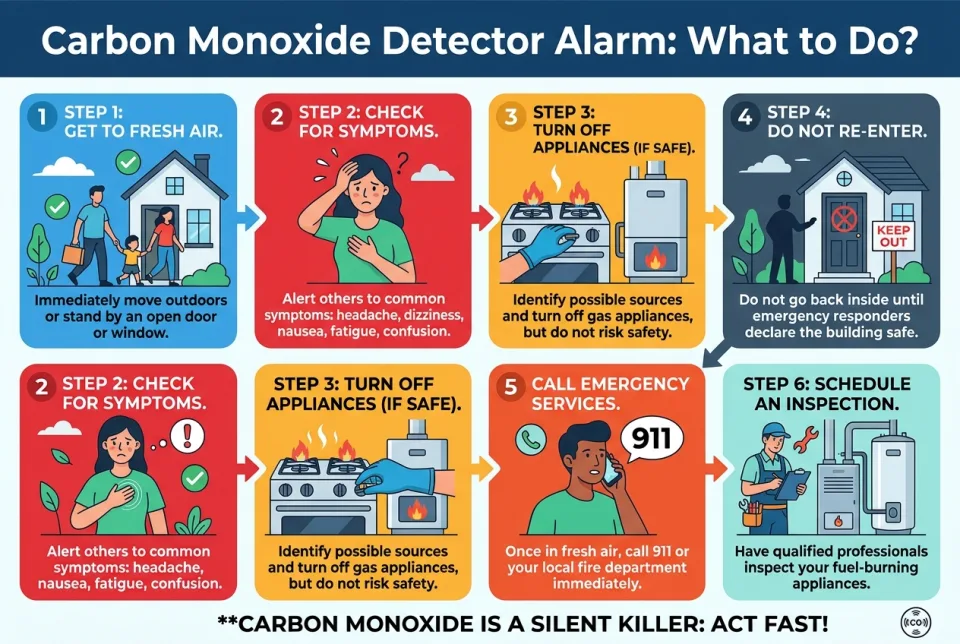
Quick answer
4 steps — read this before anything else
-
1
Get everyone out of the building immediately and into fresh air.
-
2
Call your local emergency services from outside.
-
3
Do not re-enter until emergency responders say it is safe.
-
4
Seek medical help if anyone has symptoms like headache, dizziness, or nausea.
Warning
Carbon monoxide is invisible and odorless and can be fatal. If your alarm sounds, evacuate immediately and call emergency services. Do not re-enter until cleared by professionals.
Important — please read
This content is general educational and informational only, and is not a substitute for professional medical advice, diagnosis or treatment. Always seek the advice of a qualified health provider with any questions you may have about a medical condition. Never disregard or delay seeking professional medical care because of something you read here. In an emergency or life-threatening situation, call your local emergency services (police, fire or ambulance) immediately.
A carbon monoxide (CO) detector alarm is a serious warning. CO is an invisible, odorless gas that can cause sudden illness or death. If your alarm sounds, act immediately: do not ignore it or assume it is a false alarm.
What is happening
Carbon monoxide is produced by fuel-burning appliances such as furnaces, water heaters, stoves, and generators. A detector alarm means CO levels have reached an unsafe threshold. Even if no one feels sick yet, the danger is real.
Emergency warning
If the alarm sounds or anyone has symptoms (headache, dizziness, nausea, confusion, shortness of breath), call your local emergency services immediately from a safe location. Do not wait to see if the alarm stops.
What to do first
- Evacuate everyone (including pets) to fresh air outside. Do not stop to gather belongings.
- Call emergency services from outside. If you cannot call, ask a neighbor.
- Do not re-enter the building until emergency responders or a qualified technician say it is safe.
- Check on everyone for symptoms. If anyone has symptoms, seek medical attention immediately, even if they seem mild.
- Air out the building only after everyone is out and responders have arrived. Open doors and windows if it is safe to do so, but only after evacuation.
What NOT to do
- Do not ignore the alarm or press the silence button and go back to sleep.
- Do not try to find the source of the CO before evacuating.
- Do not use any fuel-burning appliance (generator, grill, stove) indoors or in a garage, even with doors open.
- Do not assume it is a false alarm. Only a professional can confirm that.
- Do not re-enter until cleared by authorities.
When to seek professional care
Seek medical attention for anyone with symptoms of CO poisoning: headache, dizziness, weakness, nausea, vomiting, chest pain, confusion, or loss of consciousness. Symptoms can appear gradually and may be mistaken for the flu. If someone is unconscious or not breathing, call emergency services and start CPR if trained.
What to monitor
After evacuation, watch for symptoms in yourself and others. CO poisoning can cause delayed effects. Follow advice from medical professionals and do not return to the building until it has been inspected and cleared.
How to prevent it
- Install CO detectors on every level of your home and near sleeping areas. Test them monthly and replace batteries as recommended.
- Have fuel-burning appliances inspected annually by a qualified technician.
- Never use generators, grills, or camp stoves indoors, in garages, or near windows.
- Ensure chimneys and vents are clear and not blocked.
Your safety is the priority. Evacuate first, call for help, and stay out until professionals confirm it is safe. This is general information and not a substitute for professional medical advice. In an emergency, call your local emergency services.
Sources & references
Spotted an error? Report it — we correct factual mistakes promptly.
Read next
Smoke detector beeping low battery: what to do?
A chirping smoke detector usually means a low battery. Learn how to safely silence it, replace the battery, and keep your home protected.
Gasoline smell in the garage: what to do?
A strong gasoline smell in your garage is a fire and health hazard. Act quickly to eliminate ignition sources, ventilate, and find the source.
Elderly parent living alone: safety setup
A practical, room-by-room safety setup for an older adult living alone, covering falls, emergencies, medication, and daily check-ins.
Expired fire extinguisher: what to do?
An expired fire extinguisher may not work when you need it most. Learn how to check its condition, what to do with it, and how to replace it safely.
Related handy tools
Checklists, decision guides, scenarios and quizzes for the same situation.