Swimming pool water level dropping daily: what to do?
A pool that loses water every day is usually leaking or evaporating too fast. Learn how to tell the difference, find the cause, and fix it safely.
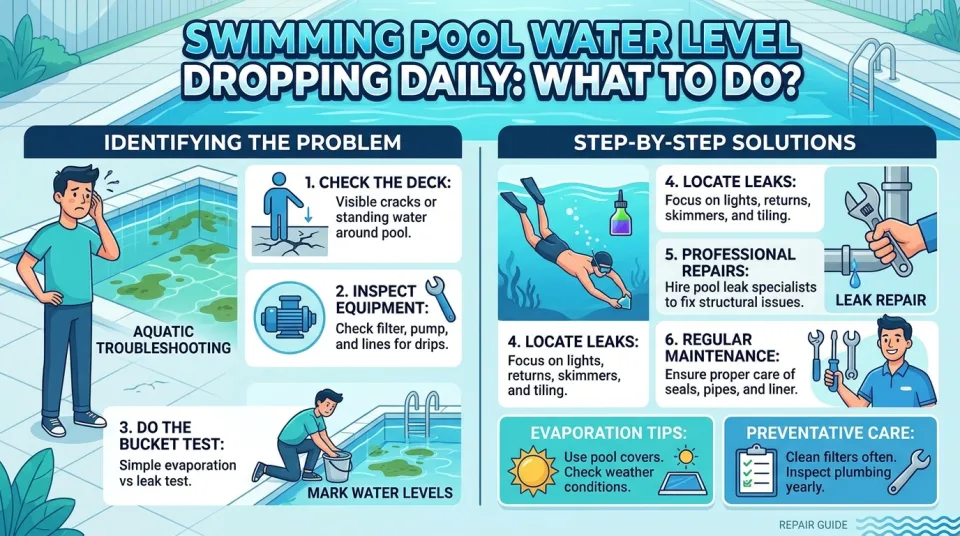
Quick answer
4 steps — read this before anything else
-
1
Do a bucket test to separate evaporation from a leak.
-
2
Check for visible leaks around the pump, filter, skimmer, and returns.
-
3
Inspect the pool shell and fittings for cracks or gaps.
-
4
If the loss is more than 1/4 inch per day, call a pool professional.
Warning
If you suspect a leak near electrical equipment, stay out of the water and keep others away until a professional has inspected it. Water and electricity are a dangerous combination.
A swimming pool that loses water every day is a common problem, but it is not always a leak. Evaporation, splashing, and backwashing can all lower the level. The key is to find out whether the loss is normal or a sign of a leak that needs repair.
What is happening
Water leaves a pool in three main ways: evaporation, physical loss (splashing, backwashing, draining), and leaks. Evaporation is usually steady and slow, often 1/8 to 1/4 inch per day depending on weather. A leak is faster and may be constant or only when the pump runs. Finding the pattern helps you act.
What to do first
- Do a bucket test. Fill a bucket with pool water and set it on a step so the water level matches the pool. Mark both levels. Wait 24 hours with the pump off. If the pool drops more than the bucket, you likely have a leak. If they drop equally, it is evaporation.
- Check for obvious leaks. Look around the pump, filter, heater, and all visible pipes for wet spots, drips, or corrosion. Check the skimmer throat and the return fittings for cracks.
- Inspect the pool shell. Walk the perimeter and look for cracks in the plaster, tile, or liner. In vinyl liners, look for tears or separations at fittings.
- Note when the loss happens. If the level drops only when the pump is running, the leak is likely on the pressure side (filter, heater, return lines). If it drops when the pump is off, it may be on the suction side or in the shell.
What NOT to do
- Do not keep adding water without finding the cause; you may be masking a leak that can damage the pool structure.
- Do not use leak-sealing chemicals without professional advice; they can clog equipment and are not a permanent fix.
- Do not run the pump if the water level is below the skimmer; it can draw air and damage the pump.
- Do not ignore a leak near electrical components; water and electricity are dangerous.
When to call a professional
Call a qualified pool professional if the bucket test shows a leak, if you cannot find the source, if the loss is more than 1/4 inch per day, or if you suspect a leak in underground plumbing. They have tools like pressure testing and dye testing to locate hidden leaks. Also call a professional if you see structural cracks or sinking ground around the pool.
What to monitor
Keep a daily log of the water level, pump run time, and weather. This helps confirm the leak and gives the professional useful information. Also monitor for signs of air in the system (bubbles in the pump basket or returns), which can indicate a suction-side leak.
How to prevent it
- Maintain proper water chemistry to avoid corrosion and scale that can damage surfaces.
- Inspect fittings, gaskets, and seals regularly and replace worn parts.
- Use a pool cover when not in use to reduce evaporation.
- Keep the water level at the recommended midpoint of the skimmer.
Next step: do the bucket test today. If it points to a leak, stop adding water and call a pool professional to locate and repair it before the problem worsens.
Spotted an error? Report it — we correct factual mistakes promptly.
Read next
Dishwasher flooded the kitchen floor: what to do?
A flooded kitchen from a dishwasher can cause damage and safety hazards. Act quickly to stop the water, cut power, and prevent further issues.
Mold growing behind furniture on outer walls: what to do?
Mold behind furniture on outer walls is usually caused by trapped moisture and poor air circulation. Learn safe steps to remove it, fix the cause, and prevent it from returning.
Damp patches on basement walls after snow melts: what to do?
Spring thaw can push water through foundation walls and cause damp patches in your basement. Learn how to find the source, dry the area safely, and prevent future problems.
Refrigerator water line leaks: what to do?
A leaking refrigerator water line can cause serious water damage. Learn how to stop the leak, clean up safely, and prevent future problems.
Related handy tools
Checklists, decision guides, scenarios and quizzes for the same situation.