Glass broken at home: what to do?
Broken glass can cause serious cuts and hidden slivers. Learn how to clean up safely and when to get medical help.
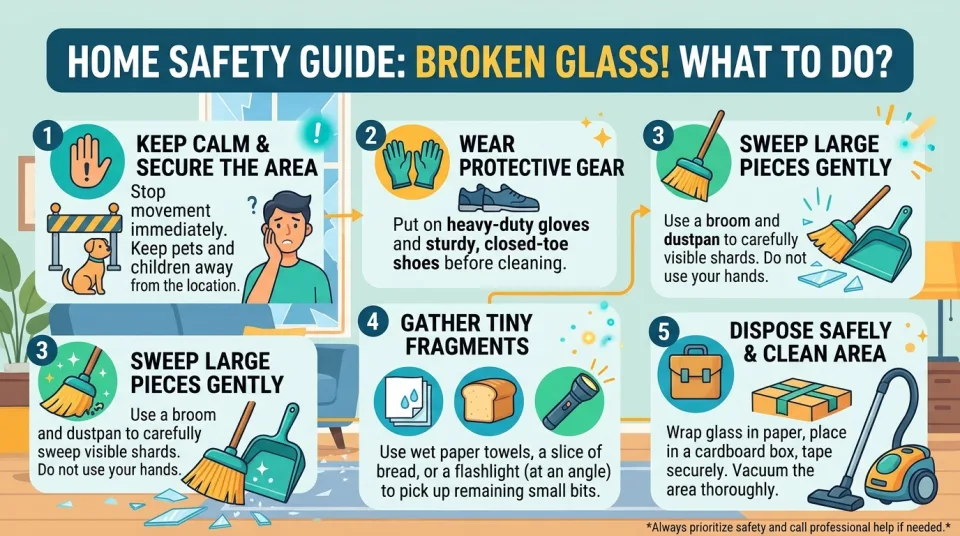
Quick answer
5 steps — read this before anything else
-
1
Keep people and pets away from the area.
-
2
Put on thick gloves and closed-toe shoes.
-
3
Pick up large pieces carefully; do not use bare hands.
-
4
Vacuum or sweep up small fragments, then wipe with a damp paper towel.
-
5
Dispose of glass safely in a sturdy container.
Warning
Broken glass can cause deep cuts and embedded shards. Never pick up glass with bare hands, and keep children and pets away until cleanup is complete.
Broken glass is a common household hazard that can cause serious cuts if not handled carefully. Whether it is a shattered drinking glass, a broken window, or a dropped mirror, the cleanup requires caution to avoid injury. This guide explains how to clean up broken glass safely and when to seek medical help.
What to do first
- Keep everyone away. Clear the area of people and pets. Do not walk barefoot or in socks near the broken glass.
- Protect yourself. Put on thick gloves (leather or heavy-duty) and closed-toe shoes. If glass is on a carpet, wear shoes with hard soles.
- Pick up large pieces. Carefully pick up large shards one at a time. Do not use bare hands. Place them in a sturdy container, such as a cardboard box or a double-bagged paper bag.
- Remove small fragments. Use a broom and dustpan to sweep up small pieces. Then vacuum the area thoroughly. Finally, wipe the area with a damp paper towel to catch any remaining slivers. Dispose of the paper towel in the trash.
- Check for hidden glass. Use a flashlight to inspect the area at a low angle; glass reflects light. Run your gloved hand over the surface to feel for any remaining pieces.
- Dispose of glass safely. Seal the container with tape or place it inside a larger box. Label it clearly as broken glass. Do not put loose glass in a plastic trash bag, as it can tear the bag and injure someone.
What NOT to do
- Do not use bare hands to pick up glass, even if you think the pieces are large.
- Do not use a vacuum with a bag or filter that may become damaged; glass dust can clog or ruin the vacuum. If you use a vacuum, empty it carefully afterward.
- Do not sweep glass with a broom that has soft bristles; it may scatter the pieces.
- Do not put glass in a recycling bin unless your local program accepts it; broken glass can injure sanitation workers.
- Do not ignore small cuts or embedded glass; they can become infected.
When to seek medical care
If someone is cut, apply pressure with a clean cloth to stop bleeding. For deep cuts, cuts that do not stop bleeding after 10 minutes of pressure, cuts on the face or hands, or cuts with glass embedded in the wound, seek medical attention immediately. Do not try to remove deeply embedded glass yourself. Call emergency services if bleeding is severe or if the person loses consciousness.
How to prevent glass breakage
- Handle glassware carefully and store it securely.
- Keep glass items away from the edges of counters and tables.
- Use safety film or tempered glass in windows and doors, especially in homes with children or pets.
- Clean up spills immediately to prevent slips that can lead to falls and broken glass.
After cleanup, double-check the area with a flashlight and a damp paper towel to ensure no tiny shards remain. If you suspect any glass is stuck in a foot or hand, seek medical care. For general information only; not a substitute for professional medical advice.
Spotted an error? Report it — we correct factual mistakes promptly.
Read next
How to test and replace a smoke alarm battery
Regular testing and timely battery replacement keep your smoke alarm working. Learn how to test your alarm and replace the battery safely.
Neighbor plays loud music at night: what to do?
A step-by-step guide to handling a noisy neighbor playing loud music at night, from polite conversation to formal complaints, while staying safe and calm.
Wardrobe emergency on event day: what to do?
A stain, tear, or broken zipper right before an event can feel like a disaster. Use this calm, practical guide to fix common wardrobe malfunctions quickly and get to your event on time.
Spilled drink on a laptop: what to do?
Liquid and electricity do not mix. Acting in the first 30 seconds, then drying and waiting before you power on, gives your laptop the best chance of surviving a spill.
Related handy tools
Checklists, decision guides, scenarios and quizzes for the same situation.