Circuit breaker keeps tripping: what to do?
A breaker that trips repeatedly is a warning sign. Learn how to reset it safely, find the cause, and know when to call an electrician.
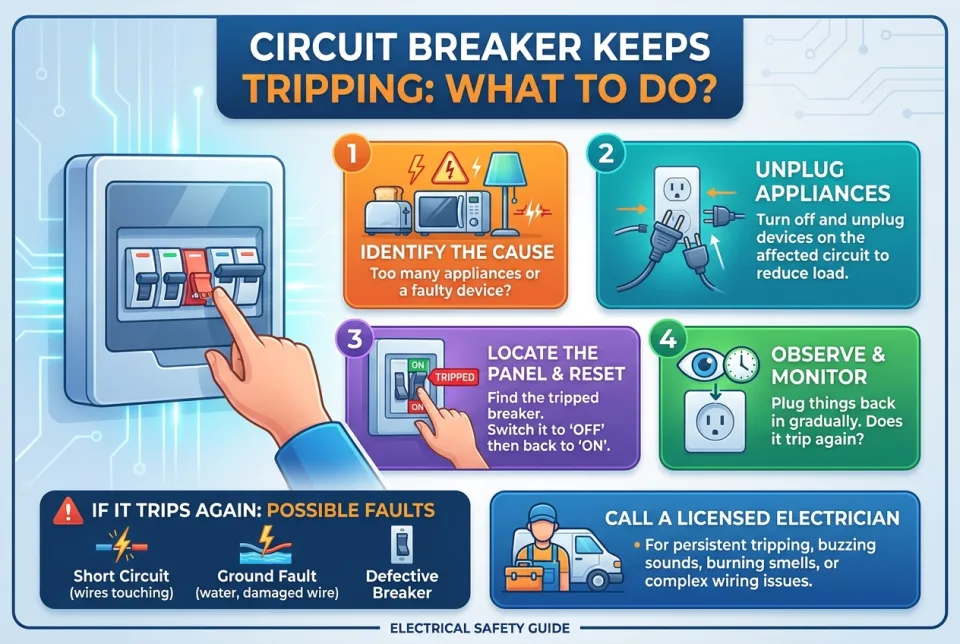
Quick answer
5 steps — read this before anything else
-
1
Turn off and unplug appliances on the affected circuit.
-
2
Reset the breaker once by switching it fully to OFF, then back to ON.
-
3
If it trips again immediately, leave it off and call a licensed electrician.
-
4
Never replace a breaker with a larger size or bypass it.
-
5
If you smell burning or see sparks, turn off the main power and call emergency services if there is fire.
Warning
Electrical faults can cause fire or shock. If you see sparks, smell burning, or the panel is hot, do not touch it. Evacuate and call emergency services.
A circuit breaker that keeps tripping is doing its job: it is protecting your wiring and appliances from overload, short circuits, or ground faults. Repeated tripping is not a nuisance to ignore; it is a signal that something is wrong. This guide explains what to do safely and when to get professional help.
What is happening
Breakers trip for three main reasons: an overload (too many appliances drawing more current than the circuit allows), a short circuit (a live wire touching a neutral or ground wire), or a ground fault (current leaking to earth, often through water or damaged insulation). Less commonly, the breaker itself may be faulty. Resetting the breaker without finding the cause can lead to overheating, fire, or electric shock.
Emergency warning
If you see sparks, smell burning, or notice scorched outlets or a hot breaker panel, do not touch the panel. Turn off the main power at the service panel only if it is safe to do so, evacuate, and call your local emergency services. Electrical fires can spread quickly.
What to do first
- Identify the circuit. Check which outlets, lights, or appliances lost power. This tells you which breaker to inspect.
- Unplug appliances on that circuit. Switch off and unplug everything connected to it, including chargers and small devices.
- Reset the breaker once. Open the panel cover (if it is safe and you can do so without touching live parts). Push the breaker firmly to the OFF position, then back to ON. Some breakers require a full reset to the middle position first.
- Observe. If the breaker stays on, plug appliances back in one at a time. If it trips when a particular appliance is connected, that appliance is likely faulty. Stop using it and have it repaired or replaced.
- If it trips again immediately with nothing plugged in, leave the breaker OFF. The wiring or the breaker itself needs professional attention.
What NOT to do
- Do not reset the breaker repeatedly. Each reset sends current through a fault and can worsen damage or start a fire.
- Do not replace the breaker with a larger amperage rating. The breaker is sized to protect the wire; a larger breaker allows the wire to overheat.
- Do not tape the breaker in the ON position or bypass it. This defeats the safety device entirely.
- Do not open the panel if you are unsure or if the panel is hot, wet, or damaged. Call an electrician.
- Do not ignore a breaker that trips only occasionally. Intermittent faults can be early warnings of a serious problem.
When to call a professional
Call a licensed electrician if any of the following apply: the breaker trips immediately after reset with nothing plugged in; the breaker feels hot; you see burn marks, discoloration, or a burning smell near the panel or outlets; the breaker trips when you use a specific appliance (have the appliance checked); you have repeated tripping in a bathroom, kitchen, or outdoor circuit (these often have ground-fault protection and may indicate moisture intrusion); or you are not comfortable working around the panel. For any sign of fire or smoke, call emergency services first.
How to prevent it
- Distribute high-draw appliances (heaters, kettles, hair dryers, power tools) across different circuits.
- Use one high-wattage appliance per outlet at a time.
- Keep outdoor outlets and connections dry and covered.
- Have your wiring inspected if your home is older or you have had repeated tripping.
If the breaker trips again after a single reset, stop and call a licensed electrician. Do not keep resetting it. This is general information and not a substitute for professional electrical advice.
Sources & references
Spotted an error? Report it — we correct factual mistakes promptly.
Read next
Short circuit at home: what to do?
A short circuit can cause sparks, smoke, or fire. Learn the safe steps to take immediately and how to prevent future hazards.
Christmas lights trip the fuse: what to do?
When your holiday lights keep tripping the fuse, it is a sign of overload or a fault. Learn how to reset safely, find the cause, and prevent a fire hazard.
Lights flickering in the house: what to do?
Flickering lights can signal anything from a loose bulb to a dangerous wiring fault. Learn how to assess the risk safely and when to call a professional.
Garage door stuck open: what to do?
A garage door stuck open is a security and safety risk. Learn how to safely secure it, diagnose common causes, and know when to call a professional.
Related handy tools
Checklists, decision guides, scenarios and quizzes for the same situation.