Garage door stuck open: what to do?
A garage door stuck open is a security and safety risk. Learn how to safely secure it, diagnose common causes, and know when to call a professional.
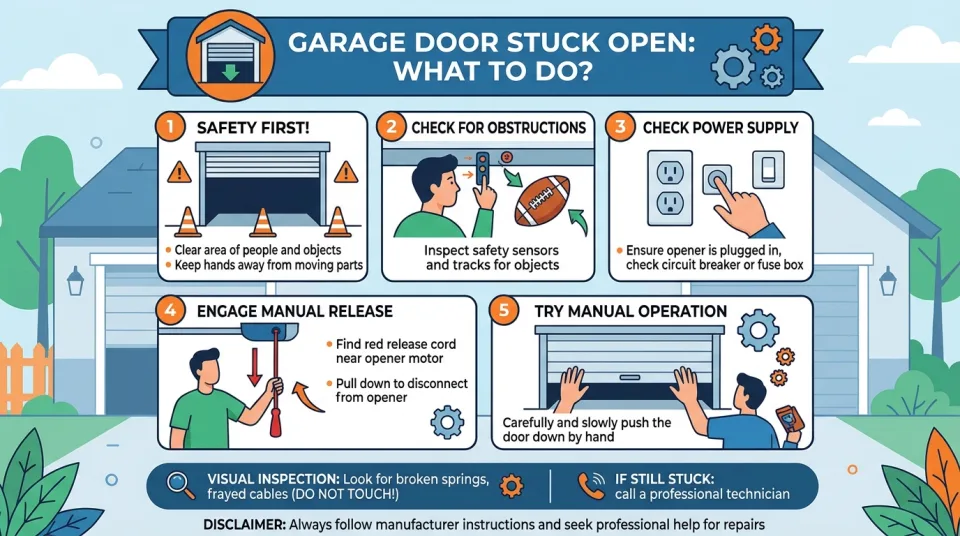
Quick answer
5 steps — read this before anything else
-
1
Keep people and pets away from the door and do not stand under it.
-
2
If the door is partially open, do not force it; secure the area and call a qualified garage door technician.
-
3
Check the remote, wall switch, and circuit breaker for simple power or signal issues.
-
4
Manually release the door only if you can safely control it, and never attempt to repair springs or cables yourself.
-
5
If the door cannot be secured, contact a professional immediately and consider temporary security measures.
Warning
Garage door springs and cables are under extreme tension and can cause severe injury. Never attempt to repair them yourself; call a qualified technician.
A garage door stuck open is more than an inconvenience: it leaves your home exposed and can be dangerous if the door is unstable. Stay calm, keep everyone clear, and follow these steps to secure the situation and decide whether you can fix it yourself or need a professional.
What is happening
Garage doors rely on a balance of springs, cables, and a motorized opener. A door that stops mid-way or stays open often points to a power failure, a tripped breaker, a misaligned safety sensor, a broken spring or cable, or a problem with the opener itself. Some issues are simple; others require expert repair.
Emergency warning
If the door is hanging unevenly, making loud cracking or snapping noises, or if you see a broken spring or frayed cable, stop immediately and call a qualified garage door technician. These components are under extreme tension and can cause serious injury. Do not attempt to repair them yourself.
What to do first
- Keep everyone away. Do not let anyone, especially children or pets, stand under or near the door. If the door is partially open, do not walk under it.
- Check for power. Confirm the opener is plugged in and the circuit breaker has not tripped. Try the wall switch and the remote to see if either works.
- Inspect the safety sensors. Look at the small sensors near the floor on each side of the door. If they are misaligned, dirty, or blocked, the door may not close. Gently clean the lenses and ensure they face each other.
- Look for obvious obstructions. Check the tracks for debris or objects that might be blocking the door. Do not put your hands near moving parts.
- Try the manual release (only if safe). If the door is fully open and stable, you may pull the red emergency release cord to disengage the opener. Only do this if you can safely control the door's descent; a heavy door can fall suddenly. If unsure, do not attempt it.
What NOT to do
- Do not force the door up or down, as this can damage the mechanism or cause injury.
- Never attempt to repair springs, cables, or other high-tension parts yourself. These require specialized tools and training.
- Do not leave the door open unattended if it cannot be secured; this invites theft or animal entry.
- Do not stand under a partially open door or allow anyone else to do so.
When to call a professional
Call a qualified garage door technician if:
- The door is stuck open and you cannot safely close it.
- You notice broken springs, frayed cables, or bent tracks.
- The opener runs but the door does not move, or the door moves erratically.
- You have tried basic troubleshooting without success.
Attempting complex repairs yourself can lead to serious injury or further damage.
How to prevent it
- Schedule annual maintenance by a professional to check springs, cables, and the opener.
- Keep tracks clean and lubricated according to the manufacturer's instructions.
- Test the safety reverse feature monthly: place a small object in the door's path and confirm it reverses.
- Never ignore unusual noises or slow operation; address small issues before they become major.
In summary: secure the area, try only safe and simple checks, and do not hesitate to call a professional for anything involving springs, cables, or a door that will not close. Your safety and home security come first.
Spotted an error? Report it — we correct factual mistakes promptly.
Read next
What to Do If You Can't Pay Your Rent in Canada
If you cannot pay rent in Canada, take immediate action by contacting your landlord, understanding your provincial tenancy rights, and seeking local financial support.
Solar panels damaged after a hailstorm: what to do?
Hail can crack solar panel glass and void warranties, but the system may still be live. Learn how to stay safe, document damage, and get repairs without risking shock or further loss.
Boiler pressure too low or too high: what to do?
Boiler pressure problems can stop your heating or damage the system. Learn safe steps to diagnose and correct low or high pressure, and when to call a professional.
Damp smell and stains in the attic: what to do?
A musty smell or water stains in the attic usually point to a leak, condensation, or poor ventilation. Here is how to find the cause and fix it safely.
Related handy tools
Checklists, decision guides, scenarios and quizzes for the same situation.