Christmas lights trip the fuse: what to do?
When your holiday lights keep tripping the fuse, it is a sign of overload or a fault. Learn how to reset safely, find the cause, and prevent a fire hazard.
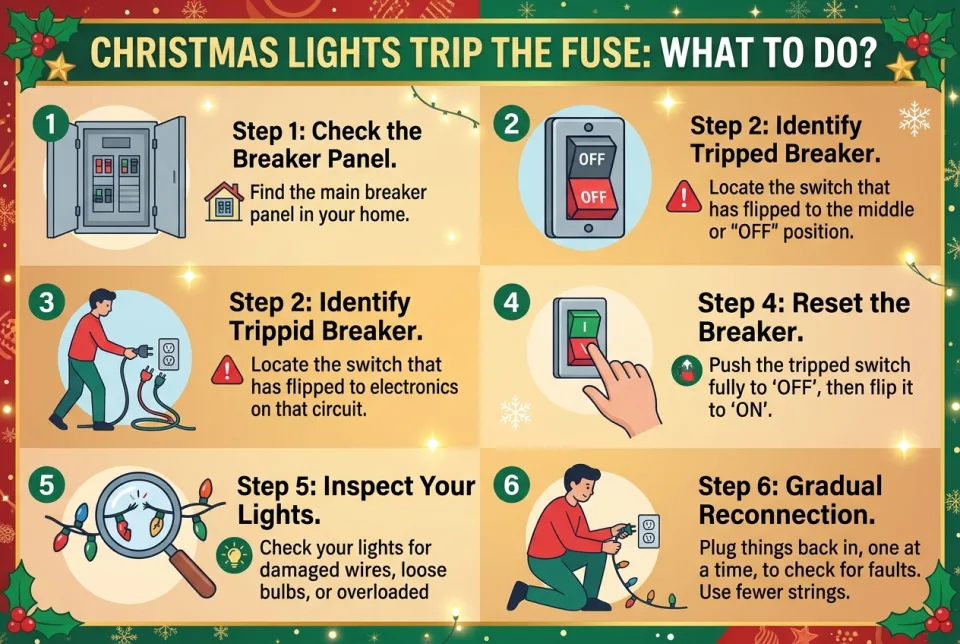
Quick answer
5 steps — read this before anything else
-
1
Turn off and unplug all lights on the affected circuit.
-
2
Reset the tripped breaker or replace the blown fuse once.
-
3
Plug in lights one set at a time to find the faulty string.
-
4
Replace damaged lights or cords; do not overload sockets.
-
5
If it trips again immediately, stop and call a qualified electrician.
Warning
If you see sparks, smoke, or flames, call emergency services immediately. Never bypass a fuse or keep resetting a breaker that trips repeatedly.
It is a common holiday headache: you plug in the tree lights and the room goes dark. A tripped fuse or breaker is a safety device doing its job, but it can also signal a real hazard. Here is how to respond safely and get your lights glowing again.
What is happening
Christmas lights draw electricity. When the total load on a circuit exceeds its rating, or when a wire is damaged, the breaker trips or the fuse blows to prevent overheating and fire. This is especially likely if you have added many light strings to one outlet, used extension cords, or plugged in a space heater on the same circuit.
Emergency warning
If you see sparks, smoke, flames, or smell burning, treat it as an emergency. Call your local emergency services immediately. Do not touch the wiring or try to reset anything until the power is off at the main switch and the area is safe.
What to do first
- Unplug the lights from the wall outlet. Do not pull the cord by the wire.
- Locate your fuse box or breaker panel. Identify the tripped breaker (usually in the middle position) or the blown fuse (clear window or scorched).
- Reset the breaker once by switching it fully off, then on. For a fuse, replace it with the same rating. Never use a higher-rated fuse or a coin.
- If it trips again immediately, stop. Do not keep resetting. This indicates a short circuit or overload that needs professional attention.
Find the cause
If the breaker holds after resetting, plug in your lights one string at a time. After each addition, check that the lights work and the breaker stays on. When it trips, you have found the problem string or the point of overload. Also inspect cords for cuts, crushed spots, or loose connections, and check that no bulb is broken or missing (a missing bulb can create a shock hazard).
What NOT to do
- Do not replace a fuse with a higher rating or bypass it with wire or foil.
- Do not keep resetting a breaker that trips repeatedly.
- Do not run extension cords under rugs or through doorways where they can be damaged.
- Do not connect more light strings than the manufacturer recommends (check the packaging).
- Do not use indoor-rated lights outdoors.
- Do not touch damaged wiring with wet hands or while standing on a wet floor.
When to call a professional
Call a qualified electrician if the breaker trips with nothing plugged in, if you see scorch marks or smell burning, if outlets feel hot, or if you are unsure about the condition of your wiring. For outdoor displays or large installations, a professional can ensure safety and code compliance.
How to prevent it
- Use LED lights, which draw far less power than incandescent bulbs.
- Distribute lights across multiple circuits; avoid daisy-chaining too many strings.
- Inspect lights each year and discard any with damaged cords or cracked plugs.
- Use outdoor lights and cords rated for outdoor use, and keep connections dry.
- Do not plug space heaters or other high-power appliances into the same circuit as your lights.
Most tripped fuses are easily fixed by reducing the load or replacing a faulty string. But repeated tripping is a warning you should never ignore. Stay safe, and enjoy a bright, hazard-free holiday.
This is general information, not professional electrical advice. If in doubt, consult a qualified electrician.
Spotted an error? Report it — we correct factual mistakes promptly.
Read next
Gasoline smell in the garage: what to do?
A strong gasoline smell in your garage is a fire and health hazard. Act quickly to eliminate ignition sources, ventilate, and find the source.
Power surge during a storm: what to do?
A power surge can damage electronics and start fires. Learn how to stay safe during and after a surge, and how to protect your home.
Fuse box buzzing or humming: what to do?
A buzzing or humming fuse box can be a sign of a serious electrical hazard. Learn the safe steps to take and when to call a professional.
Heating oil smell in the house: what to do?
A heating oil smell indoors can signal a leak, spill, or faulty equipment. Act quickly to protect your health and property.
Related handy tools
Checklists, decision guides, scenarios and quizzes for the same situation.