Power of attorney needed: what to do?
A power of attorney lets someone you trust act on your behalf. Here is how to decide which type you need, who to choose, and how to put it in place correctly.
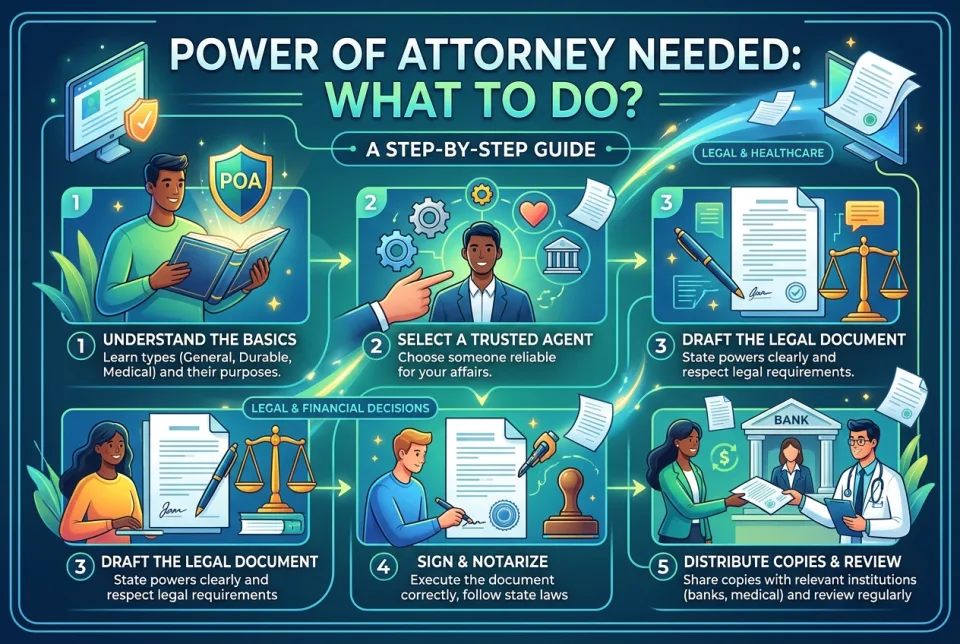
Quick answer
5 steps — read this before anything else
-
1
Decide what the document must cover: money and property, health care decisions, or both.
-
2
Choose a trusted agent and a backup agent, and talk to them before signing anything.
-
3
Check your state's requirements, since forms, witnesses and notarization vary.
-
4
Have a qualified attorney draft or review the document if your situation is complex.
-
5
Store signed originals safely and give copies to your agent and key institutions.
Important — please read
This content is general educational and informational only, and is not a substitute for professional medical advice, diagnosis or treatment. Always seek the advice of a qualified health provider with any questions you may have about a medical condition. Never disregard or delay seeking professional medical care because of something you read here. In an emergency or life-threatening situation, call your local emergency services (police, fire or ambulance) immediately.
A power of attorney is a legal document that lets you name someone to act for you, either for a single transaction or for a broad range of decisions. People need one for many reasons: a planned absence, a medical situation, a property sale, or simply to prepare for a time when they may not be able to manage their own affairs. The right steps depend on why you need it.
First, work out what the document must cover
Ask yourself what decisions the agent will actually make. This determines which document you need:
- Money and property: paying bills, managing bank accounts, selling a home, handling investments. This is a general or limited financial power of attorney.
- Health care: making medical decisions if you cannot speak for yourself. This is often called a health care power of attorney or health care proxy.
- A single task: for example, signing papers for one property closing while you are away. This is a limited power of attorney.
- Future incapacity: a durable power of attorney stays valid if you later lose capacity. A springing power of attorney only takes effect when a stated event occurs, such as a doctor confirming you cannot make decisions.
Choose your agent carefully
The person you name, often called the agent or attorney-in-fact, will have real authority. Pick someone trustworthy, organized and willing to take on the role. Name a backup agent in case your first choice cannot serve. Talk to both people before you sign, and explain what you want and do not want them to do.
Check the rules where you live
Power of attorney law is set by each state, and requirements differ. Witnesses, notarization, specific wording and signing formalities all vary. Some states require a notary; others require witnesses, or both. Some institutions will reject a document that does not meet their state's format. Confirm the current requirements for your state before you sign, and never use an outdated form from another state without checking it.
Get the document drafted correctly
For anything beyond a simple, short-term task, have a qualified attorney draft or review the document. This is especially important if you own property in more than one state, own a business, have a blended family, or want to limit the agent's powers. A poorly worded document can be refused by banks and hospitals or challenged later. If cost is a concern, legal aid organizations and some senior services offer low-cost help.
Sign it properly and store it safely
- Sign in front of the required witnesses or notary, following your state's rules exactly.
- Keep the signed original in a safe, known place and tell your agent where it is.
- Give copies to your agent, your doctor if it is a health care document, and any bank or institution that will rely on it.
- Keep a list of which institutions have copies.
Review it as life changes
Revisit the document after a marriage, divorce, death, move to another state, or a major change in your finances or health. You can revoke a power of attorney while you still have capacity, but you must notify your agent and any institutions holding copies in writing. Destroy old originals so they cannot be misused.
What not to do
- Do not sign a blank form or leave powers open-ended if you only need a narrow task done.
- Do not name someone without discussing the role with them first.
- Do not assume a health care document and a financial document are the same thing.
- Do not rely on a generic online form without checking your state's signing rules.
Start by writing down the decisions you need covered and the person you trust to make them, then confirm your state's requirements and get the document prepared properly. This is general information, not legal advice; consult a licensed attorney in your state for your specific situation.
Sources & references
Spotted an error? Report it — we correct factual mistakes promptly.
Read next
Rental deposit dispute: what to do?
If your landlord won't return your deposit, you have options. Learn how to document the issue, request an itemized statement, and escalate your dispute effectively.
Received a court summons: what to do?
A court summons is a serious legal document that requires your immediate attention. Learn the steps to respond correctly and protect your rights.
Disputing a utility bill that looks wrong: what to do?
A surprisingly high utility bill can be alarming. Learn how to check for errors, contact your provider, and resolve the dispute effectively.
Lost marriage or birth certificate: what to do?
Losing a vital record like a birth or marriage certificate can be stressful, but replacing it is usually straightforward. Learn the steps to get a certified copy from the right authority.
Related handy tools
Checklists, decision guides, scenarios and quizzes for the same situation.