Online purchase scam: getting money back
If you paid a scammer for an online purchase, act fast: contact your payment provider, report the scam, and secure your accounts. Here is a step-by-step guide to recovering your money and protecting yourself.
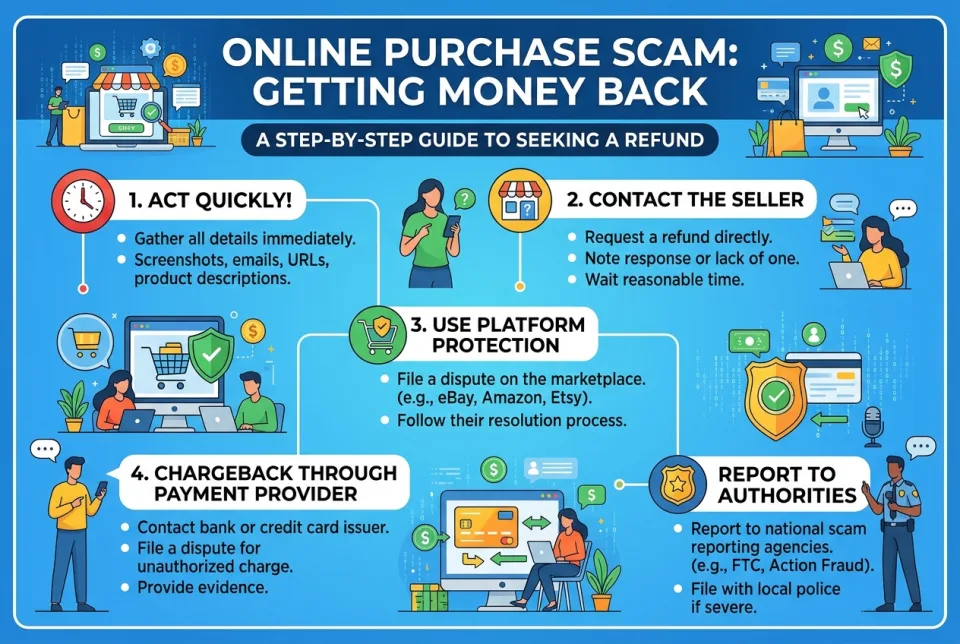
Quick answer
5 steps — read this before anything else
-
1
Contact your bank or payment provider immediately to report the fraudulent transaction and ask about chargeback or dispute options.
-
2
Change passwords for any accounts involved and enable two-factor authentication.
-
3
Report the scam to the platform where it occurred and to your local consumer protection agency.
-
4
Keep all evidence: screenshots, emails, receipts, and communication with the seller.
-
5
Monitor your accounts for unauthorized activity and consider a credit freeze if personal information was shared.
Important — please read
This content is general educational and informational only, and is not a substitute for professional medical advice, diagnosis or treatment. Always seek the advice of a qualified health provider with any questions you may have about a medical condition. Never disregard or delay seeking professional medical care because of something you read here. In an emergency or life-threatening situation, call your local emergency services (police, fire or ambulance) immediately.
Falling victim to an online purchase scam is stressful, but acting quickly can improve your chances of recovering your money. This guide outlines the steps to take if you paid for goods or services that never arrived or were not as described.
What is happening
An online purchase scam typically involves a seller who takes your payment but never delivers the product, delivers a fake or inferior item, or disappears after the transaction. Scammers often use fake websites, social media ads, or marketplace listings to lure buyers. Once you realize you have been scammed, time is critical: the faster you act, the better your chances of stopping the payment or getting a refund.
Step by step: what to do first
- Contact your payment provider immediately. If you paid by credit or debit card, call your bank or card issuer. Report the transaction as fraudulent and ask about a chargeback. For debit cards, act fast because protections may be limited. If you used a payment service like PayPal, open a dispute through their resolution center. For wire transfers or cryptocurrency, recovery is very difficult, but contact the provider anyway.
- Report to the platform. If the scam occurred on a marketplace (e.g., eBay, Amazon, Facebook Marketplace), report the seller and the listing. Platforms often have buyer protection programs that may reimburse you.
- Gather evidence. Save all communication with the seller, receipts, order confirmations, screenshots of the listing, and any tracking information. This will support your dispute.
- Change your passwords. If you created an account on the scam website or shared login details, change passwords for those accounts and any others that use the same credentials. Enable two-factor authentication where possible.
- Report the scam. File a report with your local consumer protection agency or national fraud reporting center (e.g., in the US, the FTC at ReportFraud.ftc.gov; in the UK, Action Fraud). In Australia, use Scamwatch. These reports help authorities track and shut down scammers.
- Monitor your accounts. Watch for unauthorized charges or signs of identity theft. If you shared sensitive personal information (e.g., Social Security number, bank details), consider placing a fraud alert or credit freeze with the major credit bureaus.
What NOT to do
- Do not send more money. Scammers often claim you need to pay fees or taxes to release your purchase. This is a second scam.
- Do not delay. Chargeback windows are limited (often 60-120 days), and debit card protections are weaker than credit card ones.
- Do not confront the scammer. Avoid further contact; it can complicate your case and expose you to more risk.
- Do not share additional personal information. Legitimate companies will not ask for passwords or sensitive data via email.
When to seek professional help
If you lost a significant amount of money, shared sensitive personal information, or suspect identity theft, consider consulting a consumer protection lawyer or a financial advisor. In the US, you can also contact your state attorney general's office. For identity theft, the FTC's IdentityTheft.gov provides a recovery plan.
How to prevent future scams
- Research sellers and websites before purchasing. Look for reviews and check for secure payment options.
- Use credit cards for online purchases; they offer stronger fraud protection than debit cards or wire transfers.
- Be wary of deals that seem too good to be true, especially on social media or unfamiliar sites.
- Verify the website's URL and look for HTTPS, but remember that HTTPS alone does not guarantee legitimacy.
Acting quickly is your best defense. Start by contacting your payment provider and filing a report. Stay vigilant and keep records of all actions taken.
Sources & references
Spotted an error? Report it — we correct factual mistakes promptly.
Read next
Rental deposit dispute: what to do?
If your landlord won't return your deposit, you have options. Learn how to document the issue, request an itemized statement, and escalate your dispute effectively.
Burglary: what to do?
If you discover a burglary, your safety comes first. Learn the steps to take, what not to touch, and how to secure your home and report the crime.
Harassment by phone or online: what to do?
Harassment by phone or online can be distressing and sometimes dangerous. Learn practical steps to protect yourself, document incidents, and seek help.
Power of attorney needed: what to do?
A power of attorney lets someone you trust act on your behalf. Here is how to decide which type you need, who to choose, and how to put it in place correctly.
Related handy tools
Checklists, decision guides, scenarios and quizzes for the same situation.