Lost marriage or birth certificate: what to do?
Losing a vital record like a birth or marriage certificate can be stressful, but replacing it is usually straightforward. Learn the steps to get a certified copy from the right authority.
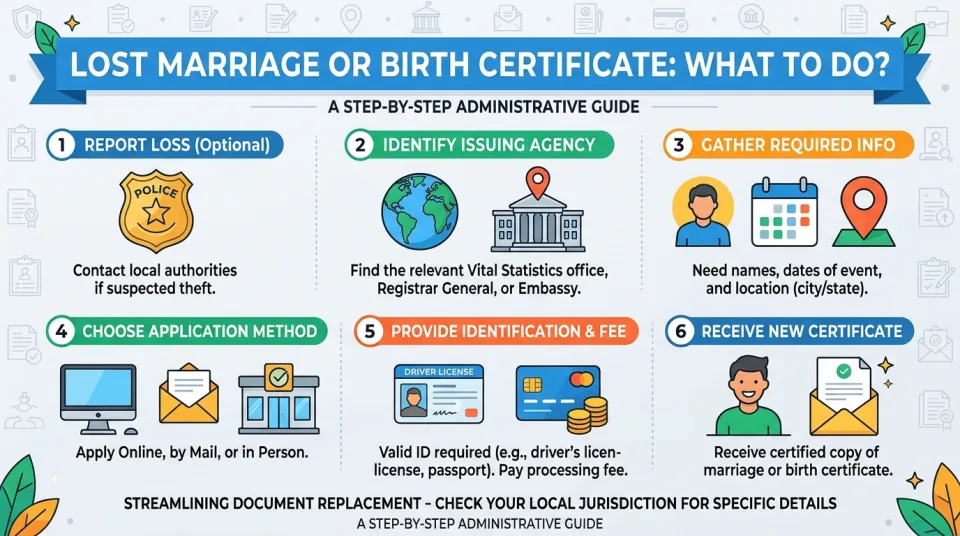
Quick answer
5 steps — read this before anything else
-
1
Identify the issuing authority (state or county vital records office).
-
2
Gather required information: full names, dates, places, and parents' details.
-
3
Apply for a certified copy online, by mail, or in person.
-
4
Pay the required fee and wait for processing.
-
5
Keep the new certificate in a safe place and consider a backup copy.
Important — please read
This content is general educational and informational only, and is not a substitute for professional medical advice, diagnosis or treatment. Always seek the advice of a qualified health provider with any questions you may have about a medical condition. Never disregard or delay seeking professional medical care because of something you read here. In an emergency or life-threatening situation, call your local emergency services (police, fire or ambulance) immediately.
Losing a birth or marriage certificate can feel like a major setback, but replacing it is a routine process. These documents are issued by government agencies, and certified copies are available for a fee. The key is to contact the correct office and provide the necessary details.
What is happening
Birth and marriage certificates are vital records. In the United States, they are typically held by the state or county vital records office where the event occurred. If you lose your copy, you can request a new certified copy from that same office. The process varies by location, but the general steps are similar.
Step by step
- Determine the issuing authority. For a birth certificate, contact the vital records office in the state or county where you were born. For a marriage certificate, contact the office in the state or county where the marriage license was issued. You can find this information on the official website of the state or county government.
- Gather required information. You will need to provide details such as full names (including maiden names), dates of birth or marriage, places of birth or marriage, and parents' names (for birth certificates). Having this information ready will speed up the application.
- Choose how to apply. Most offices allow you to apply online, by mail, or in person. Online applications are often the fastest. Check the official website for the specific office to find the accepted methods and any additional requirements, such as proof of identity.
- Pay the fee. There is usually a fee for a certified copy. Fees vary by location, so check the current amount on the official website. Payment methods may include credit card, check, or money order.
- Wait for processing. Processing times vary from a few days to several weeks. You may be able to request expedited service for an extra fee. Keep a record of your application and any confirmation number.
What NOT to do
- Do not use unofficial websites. Only use government websites ending in .gov or official county sites. Third-party sites may charge excessive fees or not deliver.
- Do not send original documents unless required. Often, copies are sufficient for identification. Check the instructions carefully.
- Do not delay if you need the certificate for a deadline. Apply as soon as possible, especially if you need it for a passport, visa, or legal matter.
When to seek professional help
If you encounter difficulties, such as being denied a copy because you are not the person named on the certificate or you lack required identification, contact the vital records office directly for guidance. In rare cases, you may need to consult a legal professional, but most replacements are straightforward.
How to prevent future loss
- Store your certificates in a fireproof safe or a safe deposit box.
- Keep a digital scan in a secure, encrypted folder.
- Order an extra certified copy to keep in a separate location.
Replacing a lost certificate is a manageable task. Start by identifying the correct office and gathering your information. With a little patience, you will have your document in hand soon.
Sources & references
Spotted an error? Report it — we correct factual mistakes promptly.
Read next
What Should You Do If a Contractor Takes Your Deposit and Never Starts the Work?
A contractor took your deposit but never started the job. Learn the practical steps to document the problem, demand your money back, and pursue legal options if needed.
What Should You Do If You Receive a Surprise Medical Bill?
A surprise medical bill can be confusing and stressful. Learn how to verify the charges, understand your rights under the No Surprises Act, and take action to dispute or reduce the bill.
What to Do in Case of a Layoff
Experiencing a job layoff can be overwhelming, but taking immediate, organized steps will help protect your finances, health coverage, and future career.
Filing in small claims court: what to do?
Small claims court can resolve disputes over modest amounts without a lawyer. Learn the key steps to file, prepare, and present your case effectively.
Related handy tools
Checklists, decision guides, scenarios and quizzes for the same situation.