Flash flood in a Moroccan oued: what to do?
Dry riverbeds (oueds) in Morocco can turn into violent torrents within minutes after rain falls far away. Knowing how to read the warning signs and where to move can save your life.
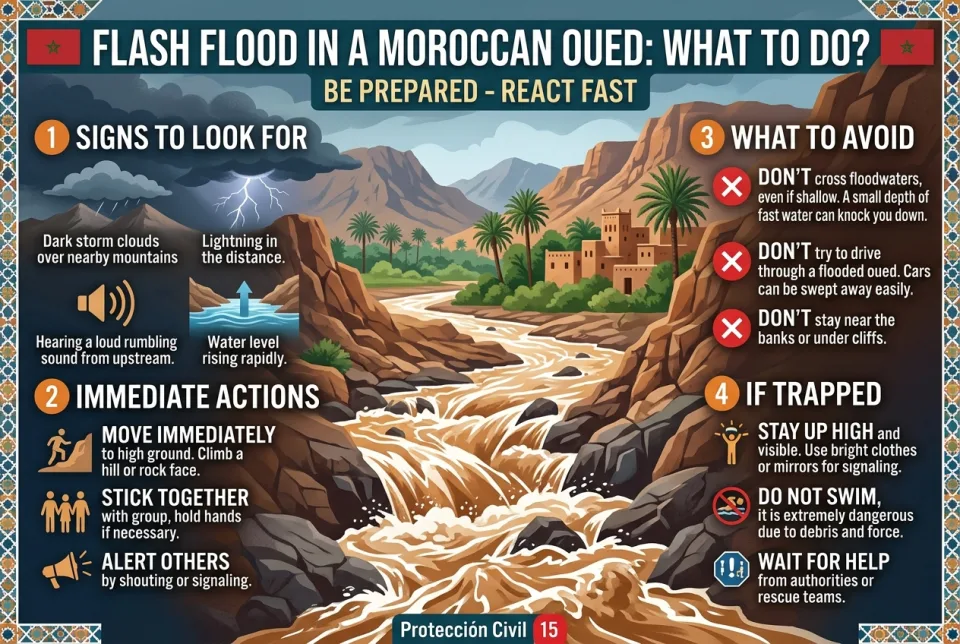
Quick answer
5 steps — read this before anything else
-
1
Move immediately to high ground on foot, away from the bed and sides of the oued.
-
2
Never try to cross or drive through flowing water, even if it looks shallow.
-
3
Leave tents, camps and parked vehicles in the riverbed and climb the nearest slope.
-
4
Call local emergency services if anyone is missing or trapped, and stay on high ground until water drops.
-
5
If you are in a group, keep everyone together on the same high point and count heads.
Warning
Flash floods in oueds arrive with little warning and can sweep away people, cars and tents. Never enter or cross flowing water. Move to high ground immediately and call local emergency services if anyone is missing or trapped.
Important — please read
This content is general educational and informational only, and is not a substitute for professional medical advice, diagnosis or treatment. Always seek the advice of a qualified health provider with any questions you may have about a medical condition. Never disregard or delay seeking professional medical care because of something you read here. In an emergency or life-threatening situation, call your local emergency services (police, fire or ambulance) immediately.
A Moroccan oued is a dry riverbed that stays empty for most of the year. When rain falls in the mountains or far upstream, water can arrive suddenly and with enormous force, even under a clear sky at your location. Flash floods in oueds are one of the leading causes of drowning deaths among hikers, campers and drivers in North Africa. The single most important rule is simple: get out of the riverbed and go up.
Emergency warning
If water is already rising, or you hear a roaring sound, treat it as an emergency. Move to high ground immediately and call local emergency services (in Morocco, dial 15 for ambulance and fire, or 19 for police) once you are safe. Do not wait to collect belongings.
What is happening
Oued floods are caused by rainfall that may be many kilometres away. The ground in dry catchments absorbs little water, so runoff concentrates fast into the channel. A trickle can become a wall of brown water carrying rocks, mud and debris within minutes. The flood usually passes in a few hours, but the peak is violent and unpredictable.
Warning signs to watch for
- Dark clouds, thunder or rain visible over nearby mountains, even if you are dry.
- A sudden change in water colour or a muddy trickle starting in the bed.
- A low rumbling or roaring sound, like a train or heavy truck.
- Birds and animals moving quickly out of the riverbed.
- Local people leaving the area or warning you in Arabic or Amazigh. Take this seriously.
What to do first
- Leave the riverbed on foot. Climb the nearest stable slope, not a sandy bank that may collapse.
- Go well above the high-water line. Look for debris and mud marks on rocks and trees and stay above them.
- Abandon vehicles, tents and gear. A car can be swept away in shallow fast water. People inside often drown.
- Do not cross to reach the other side. If you are already on the far bank, stay there and go up.
- Keep children and animals close and hold hands in a group so nobody is left behind.
- Call for help once you are on safe high ground, and give your location, the number of people and any injuries.
What NOT to do
- Never walk, swim or drive through moving floodwater. Even 15 cm of fast water can knock an adult off their feet, and 30 cm can move a small car.
- Do not shelter under bridges, in culverts or in narrow gorges where water funnels.
- Do not stand on the edge of the bank to take photos or watch the water arrive.
- Do not try to rescue someone by entering the water. Throw a rope, a float or a long branch and call for trained help.
- Do not return to the oued until the water has clearly dropped and local people say it is safe. A second surge can follow.
When to call for help
Call emergency services if anyone is missing, trapped, injured or in the water. Give the exact location, for example the nearest village, road or landmark, because oueds often have no address. If you have no signal, send someone to the nearest settlement for help while the rest of the group stays on high ground.
How to prevent it
Before camping or hiking in an oued, check the weather forecast for the whole catchment, not just your spot. Ask local guides about recent rain and safe routes. Never camp in the bed itself, pitch tents on high ground, and park vehicles facing out on high ground. Keep a charged phone and a whistle, and agree a meeting point on high ground before you set out.
This is general safety information, not a substitute for professional advice. In a real emergency, call local emergency services immediately.
Sources & references
Spotted an error? Report it — we correct factual mistakes promptly.
Read next
Tornado warning: what to do?
A tornado warning means a tornado has been sighted or indicated by radar. Act immediately: get to a safe shelter, protect your head, and stay tuned to official alerts.
Flash flood alert: what to do?
Flash floods can strike within minutes. Learn the immediate steps to protect yourself and your family, and what never to do when water rises.
Lightning storm catches you hiking: what to do?
When thunder roars, go indoors. If you are caught on a trail, descend and seek shelter in a building or a vehicle. If none is available, spread out and crouch low.
Hailstorm damage: what to do?
Hailstorms can damage roofs, windows, vehicles, and siding. Learn how to stay safe, document damage, and start the recovery process.
Related handy tools
Checklists, decision guides, scenarios and quizzes for the same situation.