Tornado warning: what to do?
A tornado warning means a tornado has been sighted or indicated by radar. Act immediately: get to a safe shelter, protect your head, and stay tuned to official alerts.
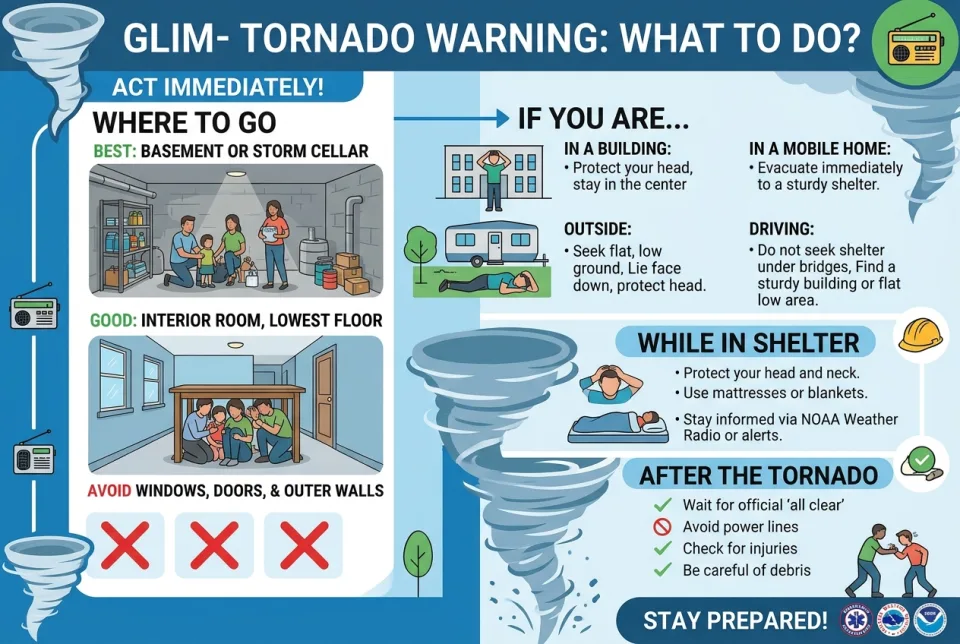
Quick answer
5 steps — read this before anything else
-
1
Seek shelter immediately in a basement, storm cellar, or interior room on the lowest floor.
-
2
If outside or in a vehicle, get to a sturdy building; as a last resort, lie flat in a low spot and protect your head.
-
3
Avoid windows, rooms with large spans, and mobile homes.
-
4
Protect your head and neck with your arms and a helmet or cushion.
-
5
Stay sheltered until official sources say the warning has ended.
Warning
A tornado warning is life-threatening. Seek sturdy shelter immediately and protect your head. Do not shelter in a mobile home, vehicle, or under an overpass.
Important — please read
This content is general educational and informational only, and is not a substitute for professional medical advice, diagnosis or treatment. Always seek the advice of a qualified health provider with any questions you may have about a medical condition. Never disregard or delay seeking professional medical care because of something you read here. In an emergency or life-threatening situation, call your local emergency services (police, fire or ambulance) immediately.
A tornado warning is issued when a tornado has been sighted by observers or indicated by radar. It is a life-threatening situation that demands immediate action. Unlike a watch, which means conditions are favorable, a warning means a tornado is occurring or imminent in your area. Do not wait to see the tornado; take shelter now.
What to do first
- Move to the safest shelter you can reach quickly. The best options are a basement, storm cellar, or a small interior room on the lowest floor of a sturdy building, such as a bathroom, closet, or hallway without windows.
- If you are in a mobile home or vehicle, leave immediately for a nearby sturdy building. Mobile homes and vehicles offer little protection. If no sturdy building is available, lie flat in a low-lying area such as a ditch, and cover your head with your hands.
- Protect your head and neck. Use your arms, a helmet, cushions, or blankets to shield against flying debris. Most tornado injuries are caused by debris, not the wind itself.
- Stay away from windows. Do not open windows; this does not equalize pressure and wastes time.
- Keep listening to official alerts. Use a battery-powered NOAA weather radio, a trusted weather app, or local emergency alerts. Do not rely on outdoor sirens alone, as they may not be heard indoors or may be sounded for other hazards.
What NOT to do
- Do not wait to see the tornado or finish what you are doing. Seconds matter.
- Do not shelter in a mobile home, vehicle, or under a bridge or overpass. These are dangerous and can increase risk.
- Do not open windows to reduce pressure; this is a myth and can be harmful.
- Do not leave a safe shelter to check on pets, belongings, or the storm.
- Do not assume the warning is a false alarm. Take every warning seriously.
When to call for help
Call local emergency services only if someone is injured, trapped, or in immediate danger after the storm has passed and it is safe to do so. Do not call emergency numbers for information about the storm; use official weather sources instead.
After the warning
Continue listening to official sources for updates and all-clear information. Be cautious of downed power lines, gas leaks, and unstable structures. Check on neighbors if it is safe, and report hazards to local authorities. If you smell gas or see sparks, leave the area and call emergency services from a safe distance.
How to prepare ahead
- Identify your safe room in advance and practice getting there with your household.
- Keep a emergency kit with water, a flashlight, a battery-powered weather radio, and a helmet or sturdy shoes.
- Sign up for local emergency alerts and know the difference between a watch and a warning.
This is general safety information and not a substitute for professional emergency guidance. In a life-threatening situation, call your local emergency services immediately.
Sources & references
Spotted an error? Report it — we correct factual mistakes promptly.
Read next
What Should You Do If a Tornado Warning Is Issued While You Are at Home?
A tornado warning means a tornado has been detected or is occurring. Know the safest room in your home and act immediately, without waiting to see the storm.
Tsunami warning after a coastal earthquake: what to do?
If you feel strong or long shaking near the coast, a tsunami may follow within minutes. Move inland or to high ground immediately and stay there until officials say it is safe.
Lightning storm catches you hiking: what to do?
When thunder roars, go indoors. If you are caught on a trail, descend and seek shelter in a building or a vehicle. If none is available, spread out and crouch low.
Hailstorm damage: what to do?
Hailstorms can damage roofs, windows, vehicles, and siding. Learn how to stay safe, document damage, and start the recovery process.
Related handy tools
Checklists, decision guides, scenarios and quizzes for the same situation.