Lightning storm catches you hiking: what to do?
When thunder roars, go indoors. If you are caught on a trail, descend and seek shelter in a building or a vehicle. If none is available, spread out and crouch low.
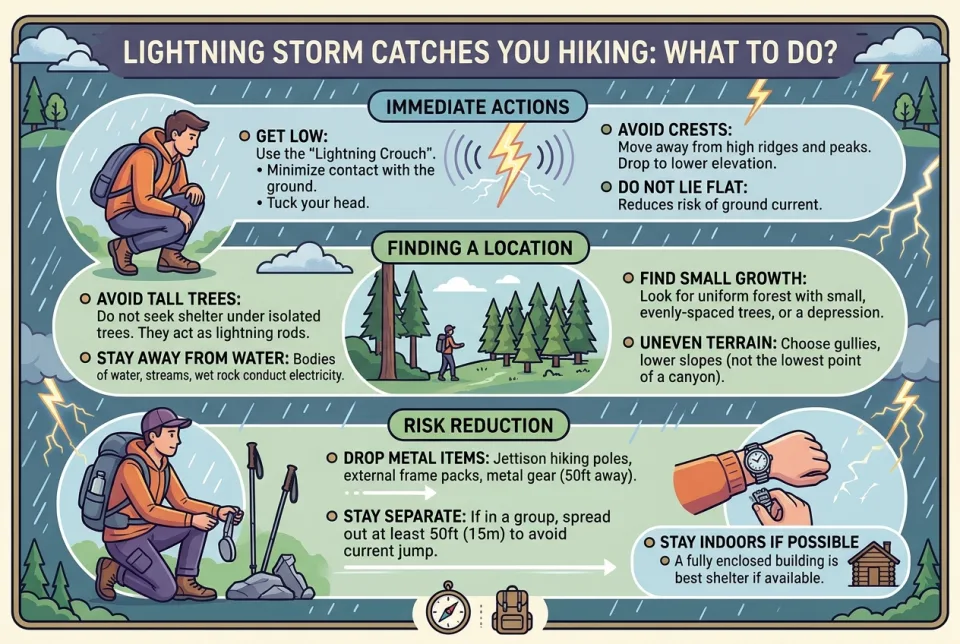
Quick answer
5 steps — read this before anything else
-
1
Check the forecast before you hike and turn back if you hear thunder.
-
2
Descend immediately and head for a substantial building or a hard-topped vehicle.
-
3
If no shelter is near, spread out at least 100 feet from others and crouch low on the balls of your feet.
-
4
Avoid ridges, summits, open fields, tall trees, water, and metal objects.
-
5
Wait at least 30 minutes after the last thunder before resuming your hike.
Warning
Lightning can kill. If you hear thunder, you are in danger. Seek shelter in a building or vehicle immediately. If none is available, crouch low and spread out.
Important — please read
This content is general educational and informational only, and is not a substitute for professional medical advice, diagnosis or treatment. Always seek the advice of a qualified health provider with any questions you may have about a medical condition. Never disregard or delay seeking professional medical care because of something you read here. In an emergency or life-threatening situation, call your local emergency services (police, fire or ambulance) immediately.
Lightning can strike well ahead of the rain and without warning. If you are hiking and hear thunder, you are already within striking distance. The safest action is to get off exposed terrain and into a safe shelter immediately.
Emergency warning
If someone is struck by lightning, call local emergency services immediately. A lightning strike can cause cardiac arrest, burns, and neurological damage. Start CPR if the person is unresponsive and not breathing, but only if it is safe to do so. Do not delay calling for help.
What to do first
- Assess your surroundings. Look for a substantial building (with plumbing and wiring) or a hard-topped vehicle. These are the only truly safe shelters. Tents, picnic shelters, and open structures offer no protection.
- Descend and move to shelter. If you are on a ridge, summit, or open area, move down and toward trees of uniform height (a forest) or a valley. Do not run unless you are close to shelter.
- If no shelter is available, spread out. Put at least 100 feet (30 meters) between you and others. Crouch down on the balls of your feet, tuck your head, and cover your ears. Do not lie flat. Make yourself a small target.
- Stay low and avoid contact with conductors. Drop hiking poles, remove metal-frame backpacks, and move away from fences, wires, and water.
What NOT to do
- Do not shelter under isolated trees, rock overhangs, or small caves. They can conduct electricity.
- Do not lie down on the ground. This increases your contact area and risk of ground current.
- Do not huddle in a group. Spreading out prevents multiple casualties.
- Do not continue hiking or set up camp during a storm. Wait it out.
- Do not use a phone with a cord or touch metal objects.
When to call for help
Call emergency services if someone is injured, unconscious, or has been struck by lightning. Even if they appear fine, lightning strike victims should be evaluated by a medical professional because internal injuries may not be immediately obvious.
What to monitor
Keep track of the time between lightning and thunder. If you see lightning and hear thunder within 30 seconds, the storm is within about 6 miles (10 km) and dangerous. Continue to monitor the weather and do not resume hiking until at least 30 minutes have passed since the last thunder.
How to prevent it
Check the weather forecast before you hike and be willing to change plans. Start early to avoid afternoon storms, especially in mountains. Know the signs of an approaching storm: darkening clouds, increasing wind, and distant thunder. If a storm is forecast, choose a lower-elevation trail or postpone your hike.
Lightning safety is about preparation and quick action. When thunder roars, go indoors. If you cannot, crouch low and spread out. Your best defense is to avoid being caught in the open during a storm.
This is general information and not a substitute for professional medical advice. In an emergency, call your local emergency services immediately.
Sources & references
Spotted an error? Report it — we correct factual mistakes promptly.
Read next
What to Do If You Get Lost While Hiking in Canada
If you lose your trail while hiking in Canada, stop moving immediately and stay calm. Following the STOP protocol increases your chances of a quick rescue.
Earthquake strikes while you are indoors: what to do?
During an earthquake indoors, drop, cover, and hold on to protect yourself from falling debris. Stay put until the shaking stops, then evacuate carefully.
Tsunami warning after a coastal earthquake: what to do?
If you feel strong or long shaking near the coast, a tsunami may follow within minutes. Move inland or to high ground immediately and stay there until officials say it is safe.
Hailstorm damage: what to do?
Hailstorms can damage roofs, windows, vehicles, and siding. Learn how to stay safe, document damage, and start the recovery process.
Related handy tools
Checklists, decision guides, scenarios and quizzes for the same situation.