Tsunami warning after a coastal earthquake: what to do?
If you feel strong or long shaking near the coast, a tsunami may follow within minutes. Move inland or to high ground immediately and stay there until officials say it is safe.
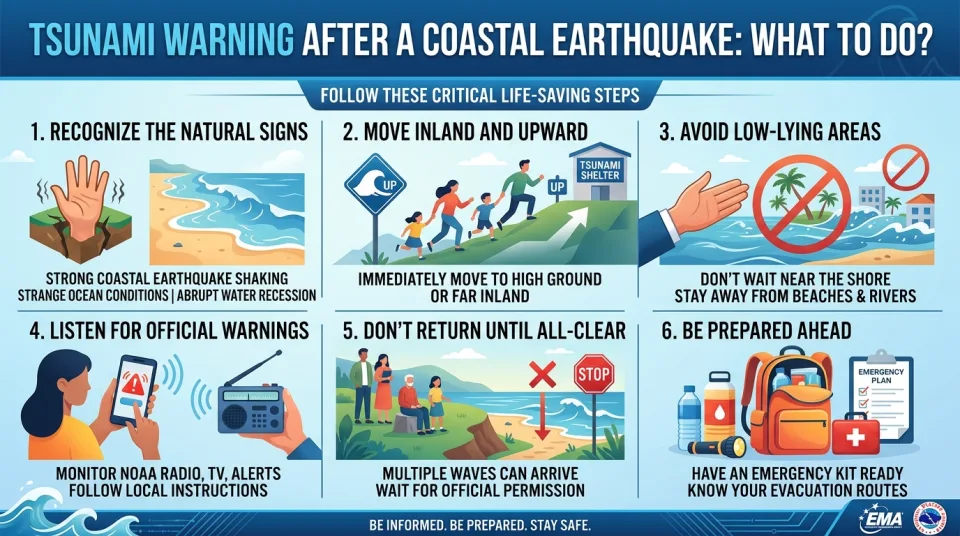
Quick answer
5 steps — read this before anything else
-
1
If you feel strong or long shaking near the coast, do not wait for an official warning: move inland or to high ground immediately.
-
2
Go on foot if possible; roads may jam and bridges may be damaged.
-
3
Get at least 30 m (100 ft) above sea level or well inland, away from beaches, rivers and harbors.
-
4
Stay away until officials give the all-clear; the first wave is often not the largest.
-
5
Never go to the shore to watch the water recede or the waves arrive.
Warning
A tsunami can arrive within minutes of coastal shaking. Do not wait for an official warning, and never go to the shore to watch the water.
Important — please read
This content is general educational and informational only, and is not a substitute for professional medical advice, diagnosis or treatment. Always seek the advice of a qualified health provider with any questions you may have about a medical condition. Never disregard or delay seeking professional medical care because of something you read here. In an emergency or life-threatening situation, call your local emergency services (police, fire or ambulance) immediately.
A tsunami is a series of fast-moving waves, usually triggered by an undersea earthquake, landslide or volcanic eruption. Near the source, the first wave can arrive within minutes of the shaking, sometimes before any official warning is issued. If you are on the coast and feel strong or prolonged shaking, treat it as a natural tsunami warning and act at once.
Emergency warning
If you are in immediate danger, call your local emergency services now. Do not call to ask whether a tsunami is coming; use official alerts, sirens, radio or emergency apps for that information, and keep phone lines free for people in danger.
What is happening
Earthquakes that last longer than about 20 seconds, or that are strong enough to make standing difficult, can generate a tsunami. The water may first pull back from the shore, exposing the seabed, but this is not always the case. Waves can travel faster than a person can run and can arrive as a wall of water, a rapid rise, or a series of surges over many hours.
What to do first
- Move immediately. Head inland or to high ground without waiting for a siren or phone alert. Do not stop to collect belongings.
- Go on foot if you can. Roads may be blocked, jammed or damaged, and driving can trap you in low-lying areas.
- Aim for height or distance. Get at least 30 m (100 ft) above sea level, or well inland beyond the expected inundation zone. Follow local evacuation route signs if they exist.
- Avoid rivers, harbors and estuaries. Tsunami waves can travel far upriver and surge into ports.
- Help others if it is safe. Warn nearby people, especially children and anyone who may not hear alerts, but do not delay your own evacuation.
- Stay put until officials say it is safe. Tsunami waves can continue for many hours, and later waves are often larger than the first.
What NOT to do
- Do not go to the beach, pier or harbor to watch the water recede or the waves arrive.
- Do not assume the danger has passed after one wave.
- Do not return to the coast until authorities issue an all-clear.
- Do not rely on a single source; if you feel shaking, act even if no alert has arrived.
- Do not shelter in a basement or underground car park near the coast.
When to call for help
Call emergency services only if someone is injured, trapped, missing or in immediate danger. Report your location clearly and follow instructions from responders. If you are safe, avoid non-urgent calls so lines stay open.
What to monitor
Keep listening to official emergency broadcasts, sirens and local authority messages. Watch for aftershocks, which can cause further damage, and for changes in the sea such as unusual withdrawal or a loud roar. Follow instructions about when and where it is safe to return.
How to prevent harm
Know your local evacuation routes and the nearest high ground before an emergency. Keep a battery-powered radio and a charged phone, and agree a family meeting point inland. If you live or work in a tsunami zone, practice the route so you can leave without thinking.
In short: strong or long shaking at the coast means move inland or uphill immediately, stay there, and wait for the official all-clear.
This is general information and not a substitute for professional emergency advice. In an emergency, call your local emergency services immediately.
Sources & references
Spotted an error? Report it — we correct factual mistakes promptly.
Read next
What Should You Do If a Tornado Warning Is Issued While You Are at Home?
A tornado warning means a tornado has been detected or is occurring. Know the safest room in your home and act immediately, without waiting to see the storm.
What to Do If You Receive an Emergency Evacuation Order
Receiving an emergency evacuation order means you must leave immediately. Learn the critical steps to evacuate safely, protect your family, and avoid hazards.
What to Do If You Lose Electricity During Winter
Essential safety steps to retain heat, prevent carbon monoxide poisoning, and protect your home during a cold-weather power outage.
What to Do If You're Stuck During a Snowstorm
If you are stranded in a vehicle or outdoors during a blizzard, remaining calm and following key cold-weather safety steps can save your life.
Related handy tools
Checklists, decision guides, scenarios and quizzes for the same situation.