Sandstorm in the desert: what to do?
A desert sandstorm can reduce visibility to zero and cause serious breathing problems. Learn how to protect yourself, your vehicle, and your group when the dust rolls in.
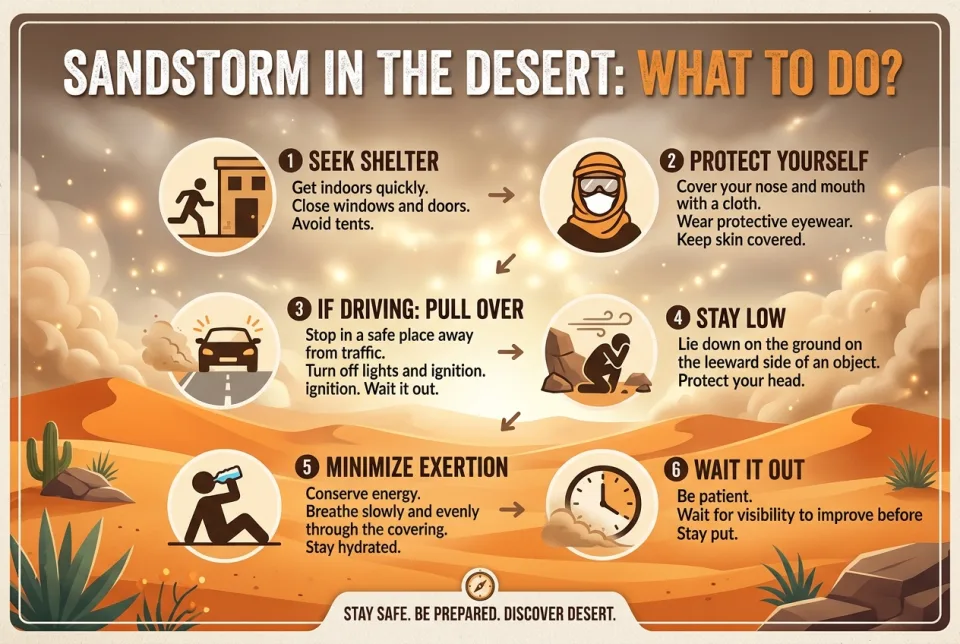
Quick answer
5 steps — read this before anything else
-
1
Get inside a building or vehicle immediately and close all windows and doors.
-
2
If caught outside, turn your back to the wind, cover your nose and mouth with a cloth, and crouch low behind solid cover.
-
3
If driving, pull well off the road, turn off lights, and stay buckled inside with hazards on.
-
4
Do not try to outrun or walk through a sandstorm; visibility can drop to near zero in seconds.
-
5
Call local emergency services if anyone has trouble breathing, is lost, or is injured.
Warning
Sandstorms can cause zero visibility and severe breathing problems. Get indoors or into a vehicle immediately and never try to walk or drive through the densest dust.
Important — please read
This content is general educational and informational only, and is not a substitute for professional medical advice, diagnosis or treatment. Always seek the advice of a qualified health provider with any questions you may have about a medical condition. Never disregard or delay seeking professional medical care because of something you read here. In an emergency or life-threatening situation, call your local emergency services (police, fire or ambulance) immediately.
A desert sandstorm, also called a dust storm or haboob, is a wall of wind-driven sand and dust that can appear with little warning. Visibility can fall to a few metres in seconds, the air becomes hard to breathe, and loose objects become dangerous projectiles. The safest response is to get out of the open and wait it out.
Emergency warning
Call your local emergency services immediately if someone cannot breathe, has chest pain, is missing, or if a vehicle is stranded or overturned. Sandstorms can be life-threatening, especially for people with asthma, older adults, and young children.
What is happening
Strong winds lift loose sand and fine dust from dry ground. The densest part is often a moving wall that passes in minutes to hours, but fine dust can linger in the air long after the visible wall has gone. The main hazards are loss of visibility, eye and lung irritation, and disorientation if you leave shelter.
What to do first
- Get indoors or into a vehicle. A building with closed windows and doors is best. A car with windows up and air conditioning on recirculate is a good second choice.
- Close all windows, doors, and vents. Seal gaps under doors with a towel or tape if dust is blowing in.
- Protect your airways. Breathe through a damp cloth, a scarf, or a well-fitting mask if you must be outside briefly.
- If caught outside with no shelter, turn your back to the wind, crouch low behind a rock, wall, or vehicle, cover your nose and mouth, and wait. Do not try to walk to safety through zero visibility.
- If driving, pull as far off the road as you safely can, turn off your lights (so following drivers do not mistake them for the road), set hazard lights, and stay buckled inside. Do not stop in the travel lane.
What NOT to do
- Do not try to outrun a sandstorm on foot or by driving into it.
- Do not leave your vehicle to look for help unless it is an absolute emergency.
- Do not rub your eyes; rinse with clean water if sand gets in.
- Do not use contact lenses during a dust event if you can avoid it.
- Do not assume the storm is over when the wind drops; dust can return.
When to seek professional care
Seek medical help if anyone has persistent coughing, wheezing, chest tightness, trouble breathing, or eye pain that does not improve after rinsing. People with asthma or other lung conditions should follow their personal action plan and call emergency services if symptoms are severe.
What to monitor
Watch local weather alerts and visibility reports. Keep listening for updates on wind speed and duration. Check on children, older adults, and anyone with breathing problems. After the storm, check for damage to vehicles and shelters before going back outside.
How to prevent it
Before travelling in desert regions, check the forecast and carry water, a face covering, goggles, a torch, and a charged phone. Know the nearest solid shelter. If you live in a dust-prone area, keep windows sealed and have a plan for pets and livestock.
Stay put, protect your breathing, and wait for the storm to pass. Call emergency services if anyone is in danger.
This is general information and not a substitute for professional medical advice. In an emergency, call your local emergency services.
Sources & references
Spotted an error? Report it — we correct factual mistakes promptly.
Read next
Tornado warning: what to do?
A tornado warning means a tornado has been sighted or indicated by radar. Act immediately: get to a safe shelter, protect your head, and stay tuned to official alerts.
Earthquake strikes while you are indoors: what to do?
During an earthquake indoors, drop, cover, and hold on to protect yourself from falling debris. Stay put until the shaking stops, then evacuate carefully.
Flash flood alert: what to do?
Flash floods can strike within minutes. Learn the immediate steps to protect yourself and your family, and what never to do when water rises.
Hailstorm damage: what to do?
Hailstorms can damage roofs, windows, vehicles, and siding. Learn how to stay safe, document damage, and start the recovery process.
Related handy tools
Checklists, decision guides, scenarios and quizzes for the same situation.