Charged again after cancelling a subscription: what to do?
If a company charges you after you cancelled, act quickly: gather proof, contact the company, and if needed dispute the charge with your bank or card issuer.
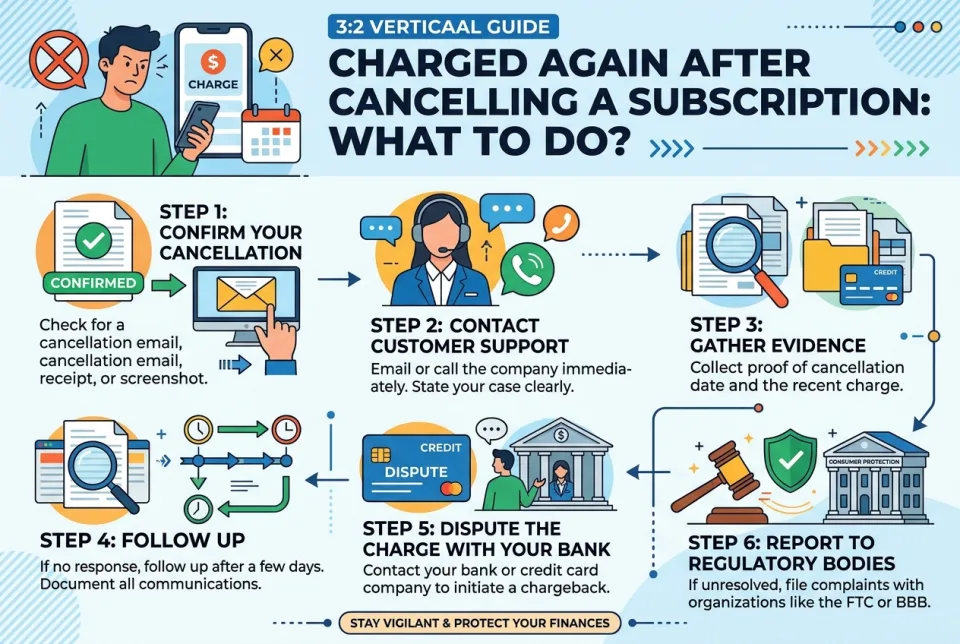
Quick answer
5 steps — read this before anything else
-
1
Check your cancellation confirmation and gather evidence (email, screenshot, reference number).
-
2
Contact the company in writing and request a refund; keep a copy of your message.
-
3
If they refuse or ignore you, dispute the charge with your card issuer or bank.
-
4
Cancel the payment method (e.g., card or direct debit) if the charges continue.
-
5
Report the company to a consumer protection agency if the problem persists.
Important — please read
This content is general educational and informational only, and is not a substitute for professional medical advice, diagnosis or treatment. Always seek the advice of a qualified health provider with any questions you may have about a medical condition. Never disregard or delay seeking professional medical care because of something you read here. In an emergency or life-threatening situation, call your local emergency services (police, fire or ambulance) immediately.
You cancelled a subscription, but the charges keep coming. This is frustrating but common. The good news is that you have clear steps to take to stop the charges and get your money back.
What is happening
Many subscriptions renew automatically. Even after you cancel, a company may charge you again due to a system error, a delayed cancellation, or in some cases, unfair practices. Your goal is to stop the charges and recover any money taken after your cancellation.
What to do first
- Find your cancellation proof. Look for a confirmation email, a screenshot of the cancellation screen, or a reference number. If you cancelled by phone, note the date, time, and the name of the person you spoke to.
- Check your bank statement. Identify the exact charge date and amount. This will help when you contact the company or your bank.
- Contact the company in writing. Use email or their support portal so you have a record. State clearly that you cancelled on [date] and that the charge is unauthorized. Ask for a full refund and written confirmation that your subscription is cancelled. Keep a copy of your message.
If the company does not help
If you do not get a satisfactory response within a reasonable time (e.g., 7-10 business days), escalate:
- Dispute the charge with your card issuer or bank. Call the number on the back of your card and say you want to dispute a charge for a cancelled subscription. Provide your cancellation proof. Many banks allow you to start a dispute online. Keep records of all communication.
- Cancel the payment method. If the company keeps charging, ask your bank to block future payments from that merchant. For direct debits, you can cancel the mandate with your bank. Note that this does not cancel the subscription itself, so also inform the company in writing that you have cancelled.
- Report the company. File a complaint with your local consumer protection agency or a trade association. In the US, you can report to the Federal Trade Commission (FTC) and your state attorney general. In the UK, contact Citizens Advice. In the EU, use the European Consumer Centre. This helps regulators track patterns of abuse.
What NOT to do
- Do not ignore the charge. It may continue and damage your credit if unpaid (for services like phone contracts).
- Do not cancel your card without first disputing the charge, as this can complicate the dispute process.
- Do not rely on verbal promises. Always get confirmation in writing.
- Do not delay. Many banks have time limits for disputes (often 60-120 days from the charge date).
How to prevent it
- When cancelling, always ask for a confirmation email and save it.
- Use a virtual card or a separate payment method for subscriptions to limit exposure.
- Keep a list of subscriptions and their renewal dates. Review it regularly.
- Consider using a subscription management service or your bank's tools to track recurring payments.
Act promptly: gather your proof, contact the company, and if needed, dispute the charge with your bank. You have rights as a consumer, and persistence usually pays off.
Sources & references
Spotted an error? Report it — we correct factual mistakes promptly.
Read next
Bluetooth device refuses to pair: what to do?
When a Bluetooth device won't pair, the fix is usually simple. Follow these steps to get it connected.
Printer shows offline: what to do?
A printer showing offline is usually a simple connection or power issue. Follow these steps to get it back online quickly.
Laptop stolen: what to do?
If your laptop is stolen, act quickly to protect your data and accounts. Here is a step-by-step guide to secure your information and report the theft.
Suspicious charge on credit card: what to do?
A suspicious charge on your credit card can be alarming, but acting quickly can limit the damage. Here is a step-by-step guide to dispute it and protect your account.
Related handy tools
Checklists, decision guides, scenarios and quizzes for the same situation.