Overdraft fees surprise: what to do?
An unexpected overdraft fee can be frustrating. Learn the steps to take, how to request a refund, and ways to avoid future fees.
Quick answer
5 steps — read this before anything else
-
1
Check your account balance and recent transactions to confirm the fee.
-
2
Contact your bank or credit union immediately and politely ask for a refund.
-
3
Adjust your budget to cover the negative balance and avoid further fees.
-
4
Set up low-balance alerts and consider opting out of overdraft coverage.
-
5
If unresolved, escalate to a supervisor or file a complaint with the CFPB.
Important — please read
This content is general educational and informational only, and is not a substitute for professional medical advice, diagnosis or treatment. Always seek the advice of a qualified health provider with any questions you may have about a medical condition. Never disregard or delay seeking professional medical care because of something you read here. In an emergency or life-threatening situation, call your local emergency services (police, fire or ambulance) immediately.
Discovering an unexpected overdraft fee on your bank statement can be a shock, especially when you thought you had enough money. Overdraft fees occur when you spend more than your available balance, and banks may charge a fee for each transaction that overdraws your account. The good news is that you can often resolve the situation quickly and take steps to prevent it from happening again.
What is happening
When your account balance goes below zero, your bank may either decline the transaction or cover it and charge an overdraft fee. Some banks also charge a daily fee if the account remains negative. These fees can add up fast, but many banks are willing to reverse them, especially if it is your first time or a small mistake.
Step by step: what to do first
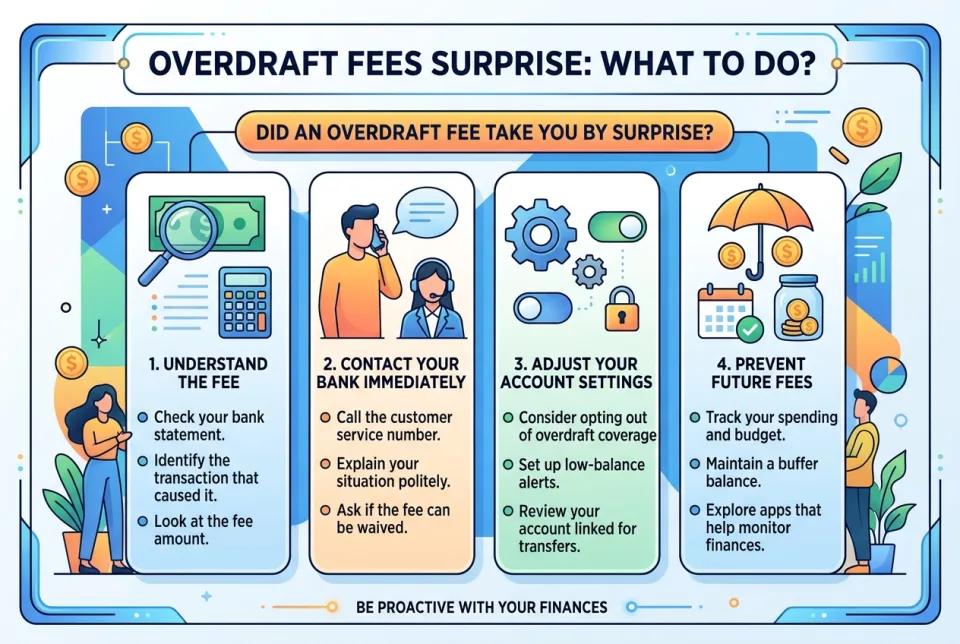
- Review your account. Log in to your bank's app or website and check the recent transactions. Identify which transaction caused the overdraft and confirm the fee amount.
- Contact your bank immediately. Call the customer service number on the back of your debit card or visit a branch. Explain the situation calmly and ask for a refund of the overdraft fee. Many banks have a policy to waive the first fee or offer a one-time courtesy refund.
- Bring your account up to date. If your balance is still negative, deposit enough money to cover the negative amount plus any pending fees. This stops additional fees from accumulating.
- Ask about overdraft protection options. Inquire about linking a savings account for overdraft protection or opting out of overdraft coverage entirely. Opting out means transactions that would overdraw your account will be declined, which can help you avoid fees.
- Set up alerts. Enable low-balance notifications through your bank's app or online banking so you are warned before your balance gets too low.
- Escalate if needed. If the representative refuses to refund the fee, politely ask to speak with a supervisor. If you still do not get a satisfactory response, you can file a complaint with the Consumer Financial Protection Bureau (CFPB) or your bank's regulator.
What NOT to do
- Do not ignore the fee. It will not go away and may lead to more fees or account closure.
- Do not get angry with customer service. Being polite and persistent is more effective.
- Do not assume you cannot get a refund. Many banks are flexible, especially for first-time mistakes.
- Do not continue spending if your account is negative. Stop using your debit card until the balance is positive.
When to seek professional help
If you are repeatedly hit with overdraft fees and struggling to manage your finances, consider speaking with a nonprofit credit counselor. They can help you create a budget and negotiate with creditors. Also, if you believe the bank has engaged in unfair or deceptive practices, contact the CFPB or your state's attorney general.
How to prevent future overdraft fees
- Keep a buffer in your checking account. Aim for at least a small cushion to cover unexpected expenses.
- Track your spending regularly using a budgeting app or your bank's tools.
- Link a savings account for overdraft protection (if available) to avoid fees when you overdraw.
- Opt out of overdraft coverage for debit card transactions. This means transactions that would overdraw your account will be declined, but you will not be charged a fee.
- Review your bank's fee schedule and compare with other banks. Some banks offer accounts with no overdraft fees.
Overdraft fees can be a hassle, but with quick action and a few preventive measures, you can minimize their impact and keep your finances on track.
Sources & references
Spotted an error? Report it — we correct factual mistakes promptly.
Read next
Credit score dropped suddenly: what to do?
A sudden credit score drop can be alarming, but it is often fixable. Learn the common causes and the steps to take to identify and address the issue.
Duplicate subscription charges on my statement: what to do?
If you see the same subscription charge twice, act quickly to stop further charges and request a refund. Here is a step-by-step guide to resolve duplicate subscription charges.
Cheque I deposited bounced: what to do?
A bounced cheque means the money is not yours yet. Learn the right steps to protect your account and recover what you are owed.
Tax refund delayed for weeks: what to do?
If your tax refund is weeks late, don't panic. Learn the common reasons for delays and the steps you can take to check your status and get help.
Related handy tools
Checklists, decision guides, scenarios and quizzes for the same situation.