Cheque I deposited bounced: what to do?
A bounced cheque means the money is not yours yet. Learn the right steps to protect your account and recover what you are owed.
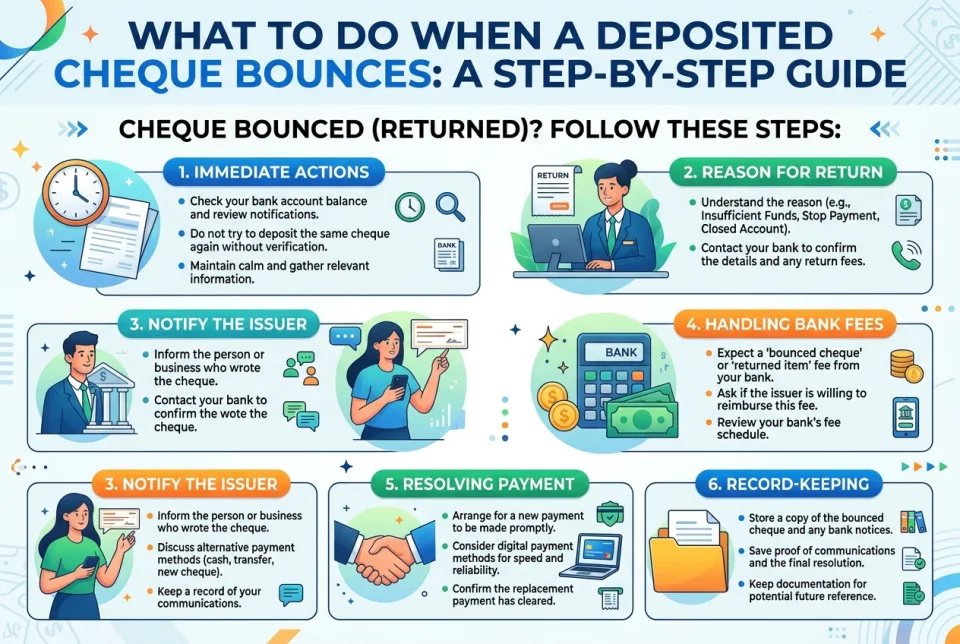
Quick answer
5 steps — read this before anything else
-
1
Check your bank statement and confirm the returned cheque fee.
-
2
Contact the person or business who wrote the cheque and ask for a replacement or another payment method.
-
3
Do not spend the money or send goods or services until the replacement payment has fully cleared.
-
4
Keep the bounced cheque, bank notice, and any communication as evidence.
-
5
If the payer does not cooperate, consider small claims court or a collection agency.
Important — please read
This content is general educational and informational only, and is not a substitute for professional medical advice, diagnosis or treatment. Always seek the advice of a qualified health provider with any questions you may have about a medical condition. Never disregard or delay seeking professional medical care because of something you read here. In an emergency or life-threatening situation, call your local emergency services (police, fire or ambulance) immediately.
A cheque you deposited has been returned unpaid by the payer's bank. This is often called a bounced cheque or a returned cheque. The money may have appeared in your account temporarily, but it has now been reversed. You may also have been charged a returned cheque fee by your bank.
What is happening
When you deposit a cheque, your bank credits your account provisionally. It then presents the cheque to the payer's bank for payment. If the payer's account has insufficient funds, the cheque is stale-dated, the account is closed, or the signature does not match, the cheque is returned unpaid. Your bank reverses the credit and may charge you a fee. The cheque itself is not automatically a guarantee of payment.
What to do first
- Check your bank account and any notices. Confirm the cheque was returned and note any fee. Ask your bank for the reason for the return if it is not clear.
- Do not use the funds. If the money was already spent or withdrawn, you may have a negative balance. Do not send goods, complete work, or transfer money based on the bounced cheque.
- Contact the payer promptly. Tell them the cheque bounced and ask for a replacement cheque or another form of payment such as a bank transfer. Keep the conversation polite and in writing where possible.
- Keep records. Save the bounced cheque, the bank's return notice, and all messages with the payer. These may be needed if you have to take further action.
What NOT to do
- Do not redeposit the same cheque without checking with your bank. It will likely bounce again and may incur another fee.
- Do not accept a replacement cheque from a payer you do not trust without verifying funds. Consider asking for a bank draft or electronic transfer instead.
- Do not threaten or harass the payer. Keep communication professional.
- Do not ignore the issue. A bounced cheque can lead to overdraft fees and damage to your credit if your account goes negative.
When to seek professional help
If the payer refuses to pay or cannot be reached, you may need to take legal action. For small amounts, small claims court is often the simplest route. For larger amounts, consult a lawyer. If the cheque was intentionally fraudulent, report it to your local police and your bank. Keep in mind that laws about bounced cheques vary by country and state.
How to prevent it
- Ask for payment by bank transfer or another guaranteed method when possible.
- For large or unfamiliar payments, wait until the cheque has fully cleared before releasing goods or services.
- Consider using a cheque verification service if you regularly accept cheques.
Act quickly and keep good records. Most bounced cheque problems are resolved when the payer issues a replacement payment. If not, you have clear steps to recover what you are owed.
Spotted an error? Report it — we correct factual mistakes promptly.
Read next
What to Do If You Lose Your Job and Have No Savings
Losing your job without a financial safety net is challenging, but taking swift, structured actions can help stabilize your situation. Learn how to secure emergency aid, manage urgent bills, and protect your essentials.
What to Do If You Run Out of Money Before Payday
Running out of cash before your next paycheck requires immediate triage to protect essential living needs. Learn how to prioritize expenses, negotiate with creditors, and access temporary relief safely.
What to Do If You Spend Too Much Money
Discover immediate, actionable steps to regain control of your finances after overspending, from halting impulse purchases to creating a recovery budget.
What to Do If You Have Too Much Debt
Managing overwhelming debt requires a clear plan, budgeting, direct creditor communication, and knowing where to seek non-profit assistance. Follow this step-by-step guide to take control of your finances.
Related handy tools
Checklists, decision guides, scenarios and quizzes for the same situation.