Filing in small claims court: what to do?
Small claims court can resolve disputes over modest amounts without a lawyer. Learn the key steps to file, prepare, and present your case effectively.
Quick answer
5 steps — read this before anything else
-
1
Check if your dispute qualifies for small claims court (amount and type).
-
2
Gather evidence: contracts, receipts, photos, and communication records.
-
3
Send a demand letter to the other party before filing.
-
4
File the claim at the correct courthouse and pay the filing fee.
-
5
Prepare for the hearing: organize evidence, practice your statement, and arrive early.
Important — please read
This content is general educational and informational only, and is not a substitute for professional medical advice, diagnosis or treatment. Always seek the advice of a qualified health provider with any questions you may have about a medical condition. Never disregard or delay seeking professional medical care because of something you read here. In an emergency or life-threatening situation, call your local emergency services (police, fire or ambulance) immediately.
Small claims court is designed to resolve disputes quickly and inexpensively, typically without lawyers. Whether you are owed money for a service, a faulty product, or a minor accident, the process follows a similar path. This guide outlines the general steps, but court rules vary by location, so always check your local court's website or clerk's office for specifics.
What is small claims court?
Small claims courts handle civil disputes involving relatively small amounts of money, often up to a few thousand dollars. The exact limit and the types of cases allowed (for example, some exclude eviction or defamation) depend on your jurisdiction. The process is less formal than regular court, and you usually represent yourself.
What to do first
- Confirm eligibility. Check your local court's monetary limit and whether your type of claim is permitted. Also note the statute of limitations (the deadline to file), which varies by claim type.
- Try to resolve it directly. Send a written demand letter to the other party. State the amount owed, why, and a deadline (e.g., 14 days). Keep a copy. This step is often required before filing and may lead to settlement.
- Gather evidence. Collect contracts, receipts, invoices, bank statements, photos, emails, text messages, and any other proof. Organize them chronologically and make copies.
- Identify the correct defendant. Get the exact legal name and address of the person or business you are suing. For a business, check your state's business registry.
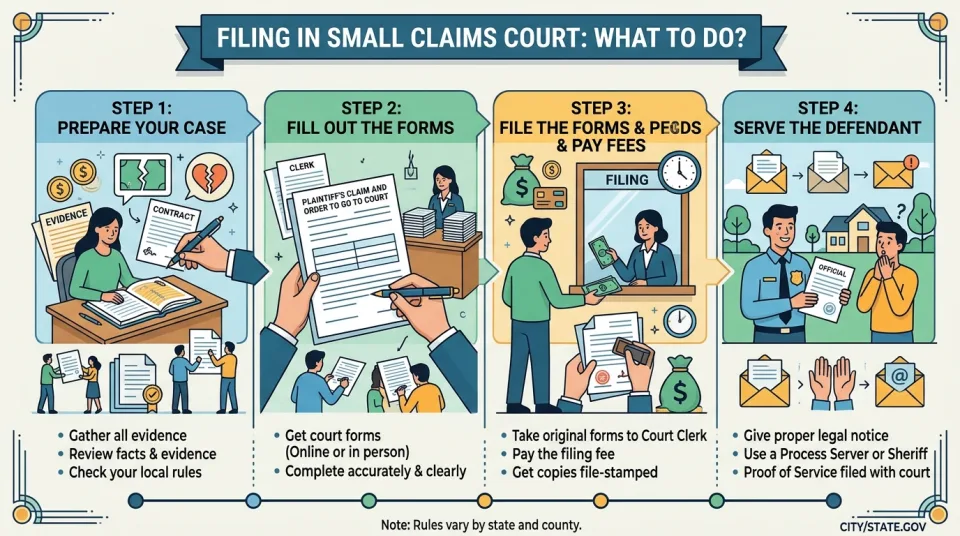
- File the claim. Obtain the forms from the court clerk or website. Fill them out accurately, describing the claim clearly. File at the courthouse that has jurisdiction (usually where the defendant lives or where the incident occurred). Pay the filing fee, which may be waived if you qualify for a fee waiver.
- Serve the defendant. The court will either serve the defendant for you or instruct you on how to do it. Proper service is critical; if it is not done correctly, your case may be delayed or dismissed.
Preparing for the hearing
- Organize your evidence. Bring original documents and at least two copies (one for the judge, one for the other side). Use a folder with labeled sections.
- Practice your presentation. You will have limited time. Prepare a concise summary of the facts and your damages. Stick to what you can prove.
- Consider witnesses. If someone has firsthand knowledge, ask them to attend. Notify the court in advance if required.
- Arrive early. Dress neatly, be polite, and turn off your phone. Address the judge as "Your Honor."
What NOT to do
- Do not ignore the statute of limitations; you could lose your right to sue.
- Do not sue the wrong party or use an incorrect address; service will fail.
- Do not exaggerate or present evidence you cannot authenticate.
- Do not miss the hearing; if you do, you may lose by default.
- Do not discuss the case on social media; it could be used against you.
When to seek professional advice
While small claims is designed for self-representation, consider consulting a lawyer if your case is complex, involves a large amount, or if the other party has a lawyer. Some courts offer free or low-cost legal clinics.
After the hearing, the judge may rule immediately or mail a decision later. If you win, you may need to take steps to collect the judgment. If you lose, you may have the right to appeal, but deadlines are short. Always check your local rules.
This is general legal information, not legal advice. For advice on your specific situation, consult a qualified attorney in your area.
Spotted an error? Report it — we correct factual mistakes promptly.
Read next
What Should You Do If a Contractor Takes Your Deposit and Never Starts the Work?
A contractor took your deposit but never started the job. Learn the practical steps to document the problem, demand your money back, and pursue legal options if needed.
What Should You Do If You Receive a Surprise Medical Bill?
A surprise medical bill can be confusing and stressful. Learn how to verify the charges, understand your rights under the No Surprises Act, and take action to dispute or reduce the bill.
What to Do in Case of a Layoff
Experiencing a job layoff can be overwhelming, but taking immediate, organized steps will help protect your finances, health coverage, and future career.
Burglary: what to do?
If you discover a burglary, your safety comes first. Learn the steps to take, what not to touch, and how to secure your home and report the crime.
Related handy tools
Checklists, decision guides, scenarios and quizzes for the same situation.