Leftover rice: the real danger explained
Leftover rice can cause food poisoning if not handled properly. Learn the safe way to store, reheat, and when to throw it out.
Quick answer
5 steps — read this before anything else
-
1
Cool cooked rice quickly and refrigerate within 1 hour.
-
2
Store in the fridge for no more than 1 day.
-
3
Reheat thoroughly until steaming hot all the way through.
-
4
Never reheat rice more than once.
-
5
Throw away rice that has been left at room temperature for over 2 hours.
Warning
Leftover rice left at room temperature can grow bacteria that produce toxins not destroyed by reheating. If rice has been out for over 2 hours, throw it away.
Important — please read
This content is general educational and informational only, and is not a substitute for professional medical advice, diagnosis or treatment. Always seek the advice of a qualified health provider with any questions you may have about a medical condition. Never disregard or delay seeking professional medical care because of something you read here. In an emergency or life-threatening situation, call your local emergency services (police, fire or ambulance) immediately.
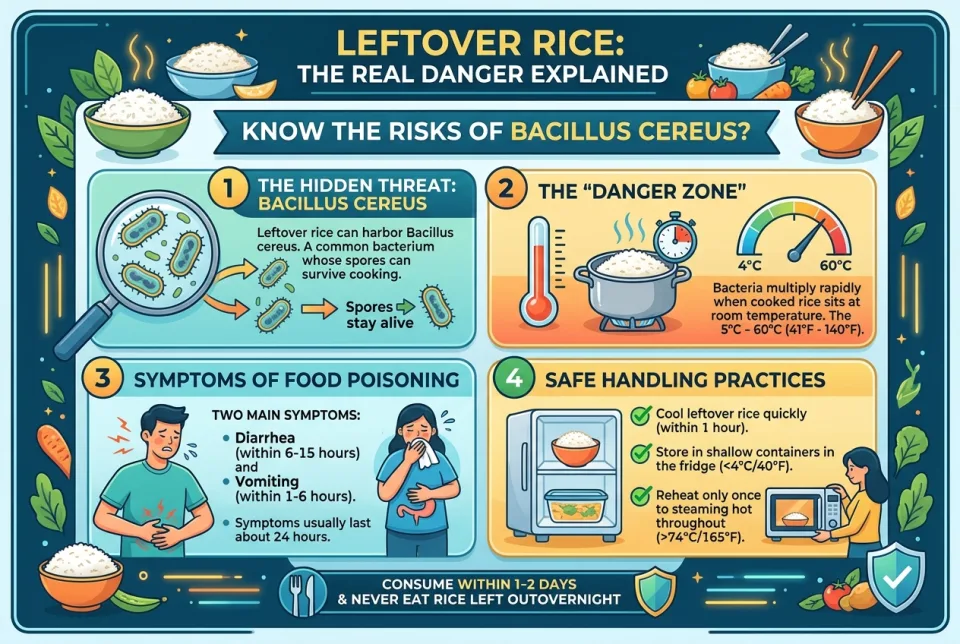
Leftover rice is a common food, but it can be a source of food poisoning if not handled correctly. The danger comes from a bacterium called Bacillus cereus, which is often present in raw rice. When rice is cooked, the heat kills the bacteria but not the spores they form. If cooked rice is left at room temperature, these spores can germinate into bacteria that multiply and produce toxins. These toxins are not destroyed by reheating, so reheating does not make unsafe rice safe.
What is happening
Cooked rice is a moist, starchy food that supports bacterial growth. The key risk is Bacillus cereus, which can cause two types of illness: a diarrheal type and a vomiting type. The vomiting type is caused by a toxin that forms in the food and is heat-stable. Symptoms can include nausea, vomiting, and abdominal cramps, usually within 1 to 6 hours after eating. The diarrheal type causes watery diarrhea and cramps, typically 6 to 15 hours after eating. Most people recover within 24 hours, but some can become severely ill.
Emergency warning
If you or someone else develops severe symptoms such as persistent vomiting, bloody diarrhea, high fever, severe abdominal pain, or signs of dehydration (dry mouth, little urine, dizziness), seek medical attention immediately. Call your local emergency services if symptoms are severe or worsening.
What to do first
- Cool rice quickly: After cooking, spread rice in a shallow container and refrigerate within 1 hour. Do not leave it out to cool for long periods.
- Store safely: Keep cooked rice in the refrigerator at or below 40°F (4°C) and use within 1 day.
- Reheat thoroughly: Reheat rice until it is steaming hot all the way through (at least 165°F or 74°C). Stir to ensure even heating.
- Discard if in doubt: If rice has been left at room temperature for more than 2 hours, throw it away. Do not taste it to check.
What NOT to do
- Do not leave cooked rice at room temperature for more than 2 hours.
- Do not reheat rice more than once.
- Do not rely on reheating to kill toxins; it does not.
- Do not keep leftover rice for more than 1 day in the fridge.
- Do not cool rice slowly in large containers; spread it out.
When to seek professional care
Seek medical advice if symptoms are severe, last more than a few days, or if you are at higher risk (pregnant, elderly, young children, or immunocompromised). Call emergency services if you have signs of severe dehydration, confusion, or bloody diarrhea.
What to monitor
Watch for nausea, vomiting, diarrhea, abdominal cramps, and fever. Monitor for signs of dehydration, especially in children and older adults.
How to prevent it
- Cook rice just before serving when possible.
- If you plan to store leftovers, cool quickly and refrigerate promptly.
- Keep hot foods hot (above 140°F/60°C) and cold foods cold (below 40°F/4°C).
- Wash hands and utensils before handling food.
By following these simple steps, you can enjoy leftover rice safely. When in doubt, throw it out.
This is general information and not a substitute for professional medical advice. In an emergency, call your local emergency services.
Sources & references
Spotted an error? Report it — we correct factual mistakes promptly.
Read next
Reusing cooking oil: when to stop
Reusing cooking oil can save money, but degraded oil can affect food quality and may form harmful compounds. Learn the signs that mean it is time to discard it.
Deep fryer oil catches fire: what to do?
A deep fryer oil fire can escalate in seconds. Knowing the right immediate actions and what never to do can prevent injury and damage.
Cutting board materials: hygiene truths
Wood, plastic, bamboo, or glass? Learn how cutting board materials compare for hygiene and how to clean them to reduce cross-contamination.
Freezer-burned food: still safe to eat?
Freezer burn affects quality, not safety. Learn how to tell if freezer-burned food is still safe to eat and how to prevent it.
Related handy tools
Checklists, decision guides, scenarios and quizzes for the same situation.