Cutting board materials: hygiene truths
Wood, plastic, bamboo, or glass? Learn how cutting board materials compare for hygiene and how to clean them to reduce cross-contamination.
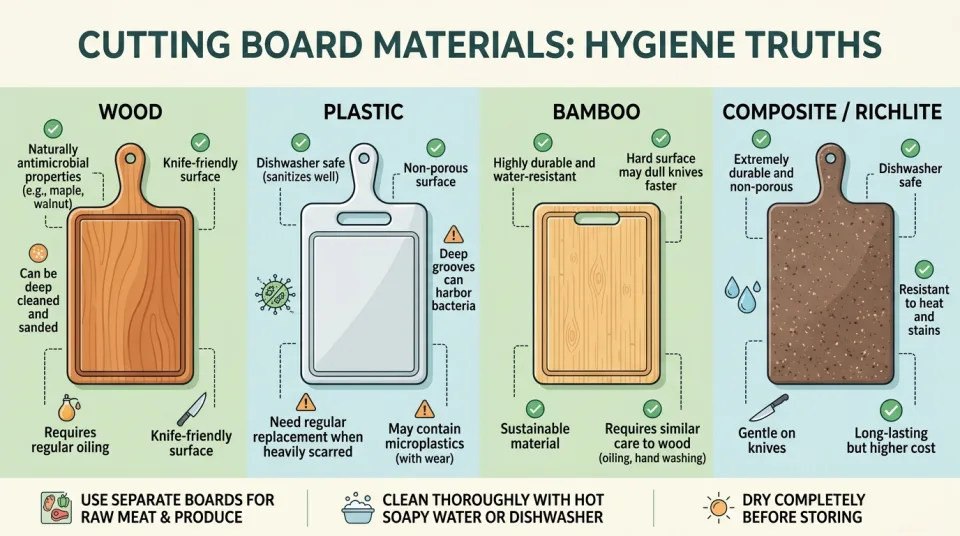
Quick answer
5 steps — read this before anything else
-
1
Use separate boards for raw meat and ready-to-eat foods.
-
2
Clean and sanitize your board after every use, especially after raw meat.
-
3
Replace boards that are deeply scored, cracked, or warped.
-
4
Never put a wooden board in the dishwasher.
-
5
Wash your hands before and after handling cutting boards.
Warning
Raw meat juices on cutting boards can spread dangerous bacteria. Always clean and sanitize boards after contact with raw meat, poultry, or seafood, and keep separate boards for raw and ready-to-eat foods.
Cutting boards are a common source of cross-contamination in the kitchen. The material you choose affects how easy it is to clean and how well it resists bacteria. Here is what you need to know about wood, plastic, bamboo, and glass boards, and how to keep any board hygienic.
How materials compare
Wood (maple, oak) is naturally porous, but studies have shown that bacteria on wood can die off over time. However, wood requires careful maintenance: it should not be soaked or put in the dishwasher, and it needs regular oiling to prevent cracking. Deep cuts can harbor bacteria if not cleaned thoroughly.
Plastic is non-porous and easy to clean, and many plastic boards are dishwasher-safe. The downside is that plastic scratches easily, and bacteria can become trapped in deep grooves. Replace plastic boards when they become heavily scored.
Bamboo is harder and denser than most woods, but it is still porous and can crack if not cared for. Like wood, it should be hand-washed and oiled occasionally.
Glass and tempered glass are non-porous and very easy to sanitize, but they dull knives quickly and can shatter if dropped. They are best for light tasks like slicing fruit or cheese.
What to do first: cleaning and sanitizing
- Scrape off food debris into the trash, not the sink.
- Wash with hot, soapy water using a sponge or brush. For wood and bamboo, wash quickly and do not soak.
- Rinse thoroughly with clean water.
- Sanitize after raw meat, poultry, or seafood. Use a solution of 1 tablespoon of unscented chlorine bleach per gallon of water (or follow the label on a commercial sanitizer). Flood the surface, let it stand for a few minutes, then rinse and air-dry. For wood, use a food-safe sanitizer or a vinegar solution, but note that vinegar is not a disinfectant.
- Dry completely before storing. Stand boards on edge to air-dry.
What NOT to do
- Do not use the same board for raw meat and ready-to-eat foods without cleaning and sanitizing in between.
- Do not put wooden or bamboo boards in the dishwasher; the heat and water will cause cracking and warping.
- Do not ignore deep cuts or cracks; bacteria can hide there and are hard to remove.
- Do not use a board that has been used for raw meat and then only wiped with a cloth; that spreads bacteria.
- Do not soak wooden boards; it can cause them to split.
When to replace a board
Replace any board that has deep grooves, cracks, or is warped. Plastic boards with many deep scratches should be retired. Wooden boards can sometimes be sanded and re-oiled, but if cracks are deep, replace them.
How to prevent cross-contamination
- Use at least two boards: one for raw meat and one for ready-to-eat foods.
- Consider color-coded boards for different food types.
- Wash your hands before and after handling boards.
- Clean and sanitize the countertop and utensils that touched the board.
No material is inherently sterile; proper cleaning and separation matter most. Choose a board that suits your cooking style, and maintain it well. If you suspect foodborne illness (fever, vomiting, diarrhea), seek medical advice.
This is general information and not a substitute for professional medical advice. In an emergency, call your local emergency services.
Sources & references
Spotted an error? Report it — we correct factual mistakes promptly.
Read next
What Do You Do If Your Homemade Food Tastes Bland? 9 Ways to Improve Flavor
Bland food is usually missing one of a few key elements: salt, acid, fat, or umami. Here are nine practical ways to fix the flavor of a dish without starting over.
What to Do If Your Chicken Always Turns Out Dry?
Dry chicken is usually a temperature and timing problem, not a recipe problem. These eight practical tricks help you keep chicken juicy every time, from brining to resting.
Why Are My Pancakes Flat? 9 Tips for Fluffier Results
Flat pancakes usually come down to old leavening, overmixing, or a pan that is too cool. Here are nine practical fixes, plus what to do with the batch you already made.
What to Do If You Keep Ordering Takeout: 8 Ways to Make Home Cooking Easier
If takeout has become your default dinner, small changes to planning, shopping and kitchen setup can make home cooking the easier choice. Here are 8 practical ways to cook at home more often without relying on willpower alone.
Related handy tools
Checklists, decision guides, scenarios and quizzes for the same situation.