Reusing cooking oil: when to stop
Reusing cooking oil can save money, but degraded oil can affect food quality and may form harmful compounds. Learn the signs that mean it is time to discard it.
Quick answer
5 steps — read this before anything else
-
1
Strain used oil through a fine mesh or cheesecloth after it cools.
-
2
Store in a sealed container in a cool, dark place.
-
3
Reuse oil only 2-3 times for light frying, fewer for heavy frying.
-
4
Discard oil if it smells rancid, looks dark or thick, or smokes at low heat.
-
5
Never pour oil down the drain; dispose of it in the trash or at a recycling center.
Warning
Reusing oil that is heavily degraded can produce harmful compounds and unpleasant flavors. Discard oil showing signs of breakdown.
Reusing cooking oil is common in home kitchens, but oil does not last forever. As oil is heated, it undergoes chemical changes that can affect flavor, nutrition, and safety. Knowing when to stop reusing oil helps you avoid off-flavors and potentially harmful compounds.
What happens when oil is reused
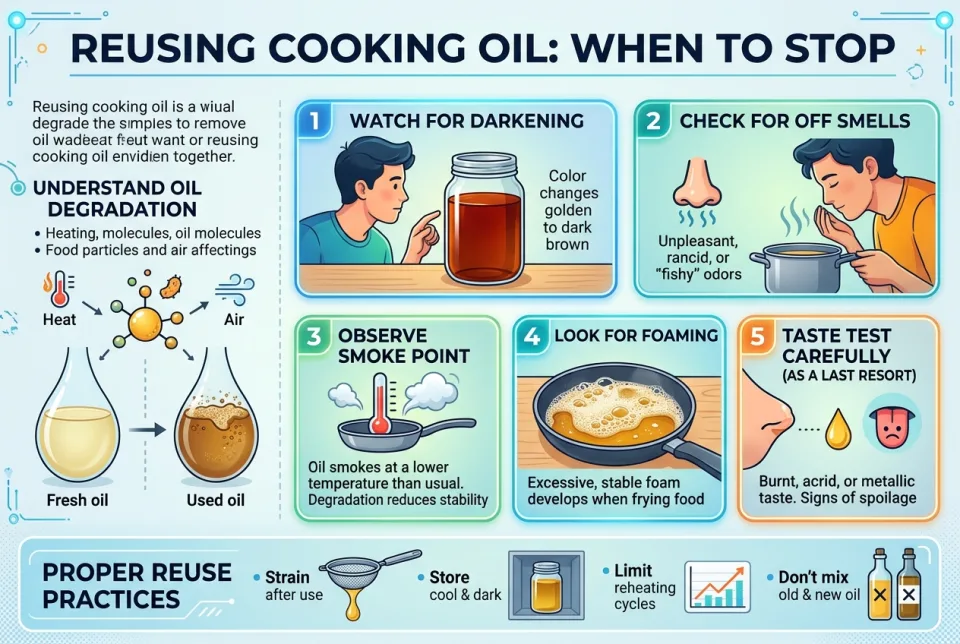
Each time oil is heated, especially at high temperatures, it breaks down through oxidation and polymerization. This produces free fatty acids, aldehydes, and other compounds that can give food an unpleasant taste and may be harmful when consumed in large amounts. The smoke point also drops, meaning the oil begins to smoke at lower temperatures, which can create acrid fumes and off-flavors.
Signs that oil should be discarded
- Smell: A rancid, sour, or paint-like odor indicates breakdown.
- Appearance: Dark color, excessive foam, or a thick, sticky consistency.
- Smoke: Oil that smokes at a lower temperature than usual (e.g., before it reaches frying temperature).
- Texture: Oil that feels gummy or leaves a sticky residue on utensils.
- Food quality: Food cooked in the oil tastes greasy, has an off-flavor, or browns too quickly.
If any of these signs are present, discard the oil. Do not try to filter or dilute it to extend use.
How many times can oil be reused?
There is no universal rule, but as a general guide, oil used for light frying (e.g., vegetables, tempura) can be reused 2-3 times. Oil used for heavy frying (e.g., breaded foods, meats) or at high temperatures should be reused fewer times, perhaps once or twice. Always strain the oil after each use to remove food particles, which accelerate breakdown. Store it in a sealed container in a cool, dark place, and never mix old oil with fresh oil.
What not to do
- Do not reuse oil that has been heated to the point of smoking.
- Do not reuse oil that has come into contact with large amounts of water or food debris.
- Do not pour used oil down the sink; it can clog pipes and harm the environment.
- Do not store used oil at room temperature for long periods; refrigerate if keeping for more than a few days.
Safe disposal
Let the oil cool completely, then pour it into a sealed container and dispose of it in the trash. Many communities have recycling programs for used cooking oil; check local guidelines. Never pour oil down the drain.
When to seek professional advice
If you accidentally consume oil that has turned rancid and experience nausea, vomiting, or diarrhea, contact your healthcare provider or a poison control center for guidance. In case of severe symptoms, call local emergency services.
This information is general and not a substitute for professional medical advice. In an emergency, call your local emergency number.
Spotted an error? Report it — we correct factual mistakes promptly.
Read next
What Do You Do When You Don't Have Enough Ingredients for a Recipe?
Missing an ingredient doesn't have to ruin your meal. Learn 10 smart substitutions and a simple strategy to adapt any recipe on the fly.
What to Do If You Keep Ordering Takeout: 8 Ways to Make Home Cooking Easier
If takeout has become your default dinner, small changes to planning, shopping and kitchen setup can make home cooking the easier choice. Here are 8 practical ways to cook at home more often without relying on willpower alone.
What to Do If You Keep Ordering Takeout: 8 Ways to Make Home Cooking Easier
If takeout has become your default dinner, the problem is usually friction, not willpower. These eight practical changes make cooking at home faster, cheaper and easier than ordering.
Deep fryer oil catches fire: what to do?
A deep fryer oil fire can escalate in seconds. Knowing the right immediate actions and what never to do can prevent injury and damage.
Related handy tools
Checklists, decision guides, scenarios and quizzes for the same situation.