Deep fryer oil catches fire: what to do?
A deep fryer oil fire can escalate in seconds. Knowing the right immediate actions and what never to do can prevent injury and damage.
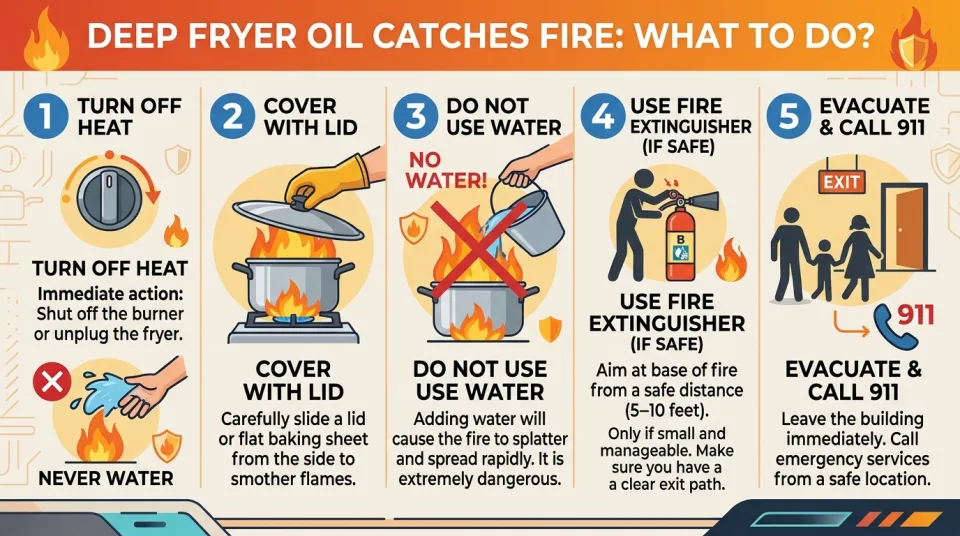
Quick answer
5 steps — read this before anything else
-
1
Call emergency services immediately if the fire is not instantly extinguished or if there is any doubt.
-
2
Turn off the heat source if safe to do so.
-
3
Smother the fire with a metal lid or fire blanket, or use a Class K extinguisher.
-
4
Never use water on an oil fire.
-
5
Evacuate and stay out if the fire does not go out immediately.
Warning
Never use water on a deep fryer oil fire. Water causes hot oil to explode and can cause severe burns and rapid fire spread.
Important — please read
This content is general educational and informational only, and is not a substitute for professional medical advice, diagnosis or treatment. Always seek the advice of a qualified health provider with any questions you may have about a medical condition. Never disregard or delay seeking professional medical care because of something you read here. In an emergency or life-threatening situation, call your local emergency services (police, fire or ambulance) immediately.
Deep fryer oil fires are dangerous because hot oil can ignite suddenly and spread quickly. The following guidance follows accepted fire safety advice from organizations such as the National Fire Protection Association (NFPA) and FEMA. Always prioritize your safety and call emergency services if the situation is not immediately controlled.
Emergency warning
If the fire is not put out within a few seconds, or if it is growing, call your local emergency services immediately. Do not attempt to fight a large or spreading fire. Evacuate everyone from the building and stay out.
What to do first
- Turn off the heat source. If you can safely reach the controls, switch off the fryer and any heat source. Do not reach over the fire.
- Smother the fire. Cover the fryer with a metal lid or a fire blanket. This cuts off oxygen. If you have a Class K extinguisher (for cooking oil fires), use it according to the instructions. Never use a glass lid or ceramic plate, as they can shatter.
- Do not move the fryer. Moving a burning fryer can splash hot oil and spread the fire.
- Evacuate if the fire persists. If the fire does not go out immediately or if smoke fills the room, leave the building and call emergency services from a safe location.
What NOT to do
- Never use water. Water causes hot oil to explode violently, spreading fire and causing severe burns.
- Do not use a fire extinguisher not rated for oil fires. Water, foam, and standard ABC extinguishers can make an oil fire worse. Use only a Class K extinguisher or smother with a lid.
- Do not attempt to carry the fryer outside. The oil can splash and cause serious injury.
- Do not fan the flames or use a towel to swat the fire. This can spread burning oil.
- Do not turn on a vent hood or exhaust fan. This can draw flames into the ductwork.
When to call for help
Call emergency services immediately if:
- The fire does not go out within a few seconds after smothering.
- Flames are spreading beyond the fryer.
- There is heavy smoke or the fire is blocking your exit.
- Anyone has been burned or inhaled smoke.
What to monitor
After the fire is out, do not use the fryer again until it has been inspected and cleaned by a professional. Monitor for any signs of re-ignition, such as smoke or heat, and keep a fire watch until you are sure it is safe. If you have any burns, seek medical attention.
How to prevent it
- Never leave hot oil unattended.
- Keep the fryer at the recommended temperature and do not overfill it.
- Keep water and ice away from hot oil.
- Clean up oil spills immediately and keep the area free of clutter.
- Have a Class K extinguisher or a metal lid nearby.
This is general information and not a substitute for professional fire safety advice. In an emergency, always call your local emergency services.
Sources & references
Spotted an error? Report it — we correct factual mistakes promptly.
Read next
What Do You Do If Your Homemade Food Tastes Bland? 9 Ways to Improve Flavor
Bland food is usually missing one of a few key elements: salt, acid, fat, or umami. Here are nine practical ways to fix the flavor of a dish without starting over.
What to Do If Your Chicken Always Turns Out Dry?
Dry chicken is usually a temperature and timing problem, not a recipe problem. These eight practical tricks help you keep chicken juicy every time, from brining to resting.
What to Do If Your Cookies Spread Too Much? 8 Baking Fixes to Try
Flat, spreading cookies are usually caused by warm dough, too much butter, or a hot pan. Here are 8 practical fixes to save the batch and prevent it next time.
What to Do If You Keep Ordering Takeout: 8 Ways to Make Home Cooking Easier
If takeout has become your default dinner, small changes to planning, shopping and kitchen setup can make home cooking the easier choice. Here are 8 practical ways to cook at home more often without relying on willpower alone.
Related handy tools
Checklists, decision guides, scenarios and quizzes for the same situation.