Freezer-burned food: still safe to eat?
Freezer burn affects quality, not safety. Learn how to tell if freezer-burned food is still safe to eat and how to prevent it.
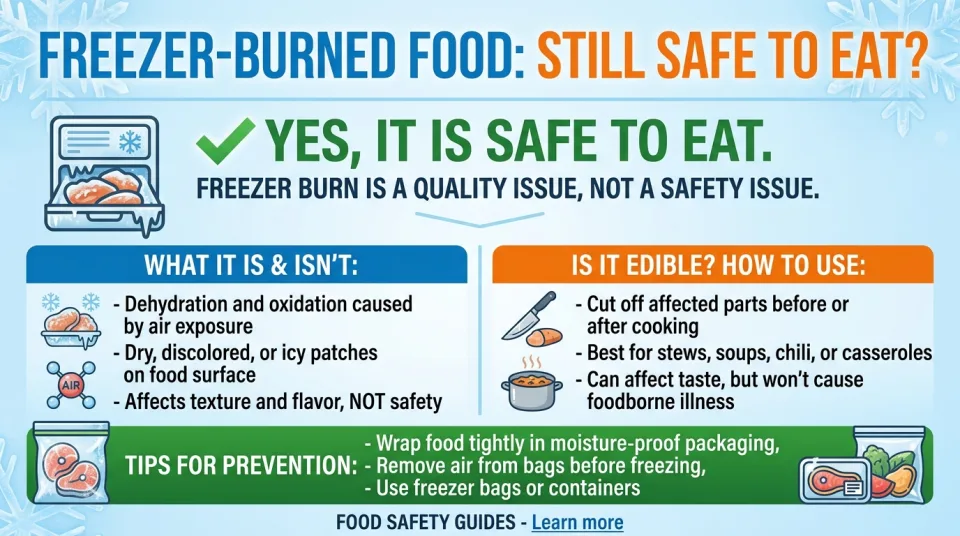
Quick answer
5 steps — read this before anything else
-
1
Check that the food has been kept frozen at 0°F (-18°C) or below the whole time.
-
2
Inspect for ice crystals, dry patches, or discoloration: these are signs of freezer burn, not spoilage.
-
3
If the food was thawed and refrozen, or shows mold, off-odors, or slime, discard it.
-
4
Trim away freezer-burned areas before cooking; the rest is safe to eat.
-
5
Prevent future freezer burn by wrapping food tightly and using it within recommended storage times.
Warning
If food has been above 40°F (4°C) for more than 2 hours, or shows mold, slime, or off-odors, discard it immediately. Do not taste to check safety.
Freezer burn is a common concern, but it is primarily a quality issue, not a safety one. Freezer burn happens when food loses moisture through sublimation, causing dry, grayish-brown patches and a tough texture. As long as the food has been kept at a safe temperature (0°F / -18°C or below) continuously, it remains safe to eat. However, safety can be compromised if the food was thawed and refrozen or shows signs of spoilage.
What is happening
Freezer burn occurs when air reaches the food surface and moisture escapes as vapor. This leads to dehydration and oxidation, which affect flavor, texture, and appearance but do not create harmful bacteria. The food is still safe if it has been stored properly.
What to do first
- Verify freezer temperature: Confirm the freezer has been at 0°F (-18°C) or below. If it has been above that for an extended period, the food may be unsafe.
- Inspect the food: Look for ice crystals, dry patches, or discoloration. These are typical of freezer burn. Check for signs of spoilage: mold, slime, or off-odors. If any are present, discard the food.
- Consider the history: If the food was thawed and refrozen, or if the freezer lost power for more than a few hours, it may not be safe. When in doubt, throw it out.
- Trim and use: For freezer-burned food that passes inspection, cut away the affected areas. The remaining food is safe to cook and eat, though it may be drier or less flavorful.
What NOT to do
- Do not assume freezer burn means spoilage; it is not a safety indicator by itself.
- Do not eat food that has been above 40°F (4°C) for more than two hours, or that shows mold, slime, or off-odors.
- Do not refreeze thawed food without cooking it first, unless it was thawed in the refrigerator.
- Do not rely on smell alone to determine safety; some harmful bacteria do not produce odors.
When to seek professional care
If you or someone else develops symptoms of foodborne illness (such as nausea, vomiting, diarrhea, or fever) after eating questionable food, seek medical attention. This is especially important for young children, older adults, pregnant women, and people with weakened immune systems.
What to monitor
After eating, monitor for signs of food poisoning within 1-3 days. Symptoms can include stomach cramps, nausea, vomiting, diarrhea, and fever. If symptoms are severe or persistent, contact a healthcare provider.
How to prevent freezer burn
- Wrap food tightly in moisture-proof material (freezer bags, foil, or plastic wrap), removing as much air as possible.
- Use airtight containers for liquids and small items.
- Label and date items, and use them within recommended storage times (e.g., 3-6 months for most meats, 6-12 months for fruits and vegetables).
- Maintain freezer temperature at 0°F (-18°C) or below and keep the freezer not more than two-thirds full to allow air circulation.
In summary, freezer-burned food is generally safe if it has been kept frozen properly. Trim affected areas and use the food in cooked dishes where texture is less noticeable. Always prioritize safety: when in doubt, throw it out.
This is general information and not a substitute for professional medical advice. In an emergency, call your local emergency services.
Sources & references
Spotted an error? Report it — we correct factual mistakes promptly.
Read next
What Do You Do If Your Homemade Food Tastes Bland? 9 Ways to Improve Flavor
Bland food is usually missing one of a few key elements: salt, acid, fat, or umami. Here are nine practical ways to fix the flavor of a dish without starting over.
What to Do If Your Chicken Always Turns Out Dry?
Dry chicken is usually a temperature and timing problem, not a recipe problem. These eight practical tricks help you keep chicken juicy every time, from brining to resting.
Why Are My Pancakes Flat? 9 Tips for Fluffier Results
Flat pancakes usually come down to old leavening, overmixing, or a pan that is too cool. Here are nine practical fixes, plus what to do with the batch you already made.
What to Do If You Keep Ordering Takeout: 8 Ways to Make Home Cooking Easier
If takeout has become your default dinner, small changes to planning, shopping and kitchen setup can make home cooking the easier choice. Here are 8 practical ways to cook at home more often without relying on willpower alone.
Related handy tools
Checklists, decision guides, scenarios and quizzes for the same situation.