Grease fire in the pan: what to do?
A pan of burning oil can turn into a house fire in seconds. Cut off the oxygen, never use water, and know when to get out and call for help.
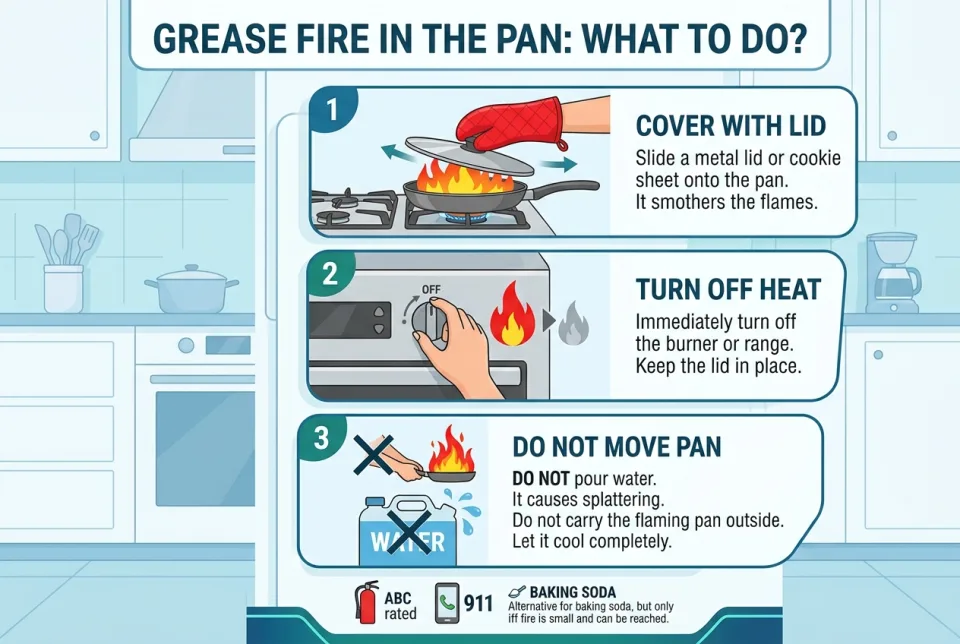
Quick answer
4 steps — read this before anything else
-
1
Turn off the heat source if you can reach it safely.
-
2
Smother the flames by sliding a metal lid or a large metal pan over the burning pan.
-
3
Leave the pan in place and do not move it.
-
4
If flames spread beyond the pan, get everyone out and call local emergency services.
Warning
Never pour water on a grease fire. Water causes burning oil to erupt and can cause severe burns and rapid fire spread. If the fire is not out within seconds or is spreading, evacuate and call emergency services.
Important — please read
This content is general educational and informational only, and is not a substitute for professional medical advice, diagnosis or treatment. Always seek the advice of a qualified health provider with any questions you may have about a medical condition. Never disregard or delay seeking professional medical care because of something you read here. In an emergency or life-threatening situation, call your local emergency services (police, fire or ambulance) immediately.
A grease fire happens when cooking oil or fat gets hot enough to ignite, usually while frying or heating oil in a pan. It is one of the fastest-spreading kitchen fires because burning oil splashes, and because the most common instinct, throwing water on it, makes it dramatically worse. Stay calm, act in the right order, and know the point at which you should stop fighting the fire and leave.
Emergency warning
If flames have spread beyond the pan, are reaching cabinets or the ceiling, or the room is filling with smoke, get everyone out immediately and call your local emergency services from outside. Do not go back inside for any reason.
What to do first
- Turn off the heat. If the burner controls are reachable without putting your hand or arm over the flames, switch the burner off. This removes the energy feeding the fire.
- Smother the flames. Slide a metal lid, a baking sheet, or a larger metal pan over the burning pan. Slide it on from the side rather than dropping it from above, so you do not push flames outward. Leave it in place for at least several minutes after the flames disappear; the oil stays dangerously hot.
- Turn off the exhaust fan if you can reach the switch safely. It can pull flames into the ductwork.
- Leave the pan where it is. Do not carry a burning pan through the kitchen or outside. Hot oil can slosh, spill, and burn you or spread fire.
- If you have a fire extinguisher rated for kitchen fires and you know how to use it, use it only if the fire is small and you have a clear exit behind you. Otherwise, evacuate.
What NOT to do
- Never pour water on a grease fire. Water flashes to steam instantly, throwing burning oil into the air and onto you and nearby surfaces.
- Do not use a glass lid. It can shatter from the heat.
- Do not use flour, sugar, or baking powder. Flour can explode into a fireball, and sugar fuels the flames.
- Do not swat the flames with a towel or move the pan. Both spread fire and cause severe burns.
- Do not open the oven or microwave if the fire started inside; keep the door closed and turn the appliance off.
When to call for help
Call your local emergency services if the fire does not go out within a few seconds of smothering, if it spreads to anything other than the pan, if smoke fills the room, or if anyone has been burned. For a burn, cool it under cool running water and seek medical care for large, deep, or facial burns, or any burn on a child. Call emergency services for burns that are severe or cover a large area.
What to monitor
After the fire is out, keep the lid on and watch the pan for several minutes. Do not touch the pan or the oil until it has cooled completely. Check that no embers landed on towels, curtains, or cabinets.
How to prevent it
Stay in the kitchen while frying, keep oil below the smoking point, and keep a metal lid within reach. Keep towels and packaging away from the stove, and never heat oil in a pan you are not watching.
This is general safety information, not a substitute for professional advice. In an emergency, call your local emergency services immediately.
Sources & references
Spotted an error? Report it — we correct factual mistakes promptly.
Read next
Freezer defrosted overnight: what to do?
A freezer that thaws overnight can compromise food safety. Learn how to assess the situation, decide what to keep, and prevent future thawing.
Gas stove won't light: what to do?
A gas stove that won't light can be a simple fix or a sign of a dangerous gas leak. Learn the safe steps to take before you try again.
Deep fryer oil catches fire: what to do?
A deep fryer oil fire can escalate in seconds. Knowing the right immediate actions and what never to do can prevent injury and damage.
Food poisoning suspected: what to do?
If you think you have food poisoning, the priority is to prevent dehydration and watch for signs that need emergency care. Learn the safe steps, what to avoid, and when to get help.
Related handy tools
Checklists, decision guides, scenarios and quizzes for the same situation.