Freezer defrosted overnight: what to do?
A freezer that thaws overnight can compromise food safety. Learn how to assess the situation, decide what to keep, and prevent future thawing.
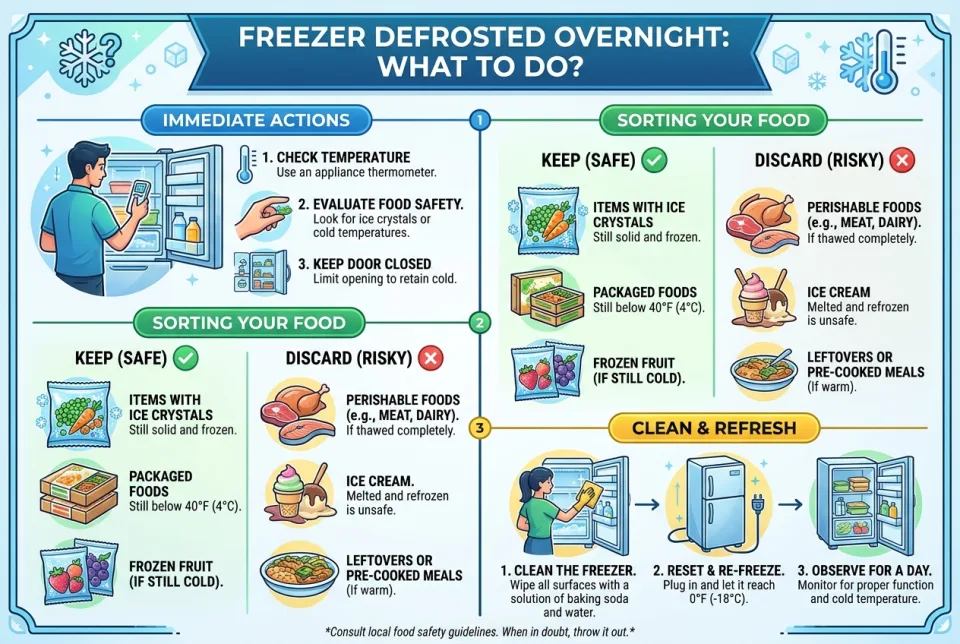
Quick answer
5 steps — read this before anything else
-
1
Keep the freezer closed until you are ready to assess the contents.
-
2
Check the internal temperature with a thermometer; if it is above 40°F (4°C), the food may be unsafe.
-
3
Discard perishable foods that have been above 40°F for more than 2 hours.
-
4
Refreeze or cook safe items immediately, or move them to a working refrigerator.
-
5
Find and fix the cause of the thawing to prevent it from happening again.
Warning
If the freezer temperature exceeded 40°F (4°C) for more than 2 hours, discard perishable foods to avoid foodborne illness. Do not taste food to check safety.
Discovering that your freezer has defrosted overnight can be unsettling. The safety of the food inside depends on how warm it got and for how long. This guide explains how to assess the situation, what to keep or discard, and how to prevent future thawing.
What is happening
A freezer that defrosts overnight means the internal temperature has risen above freezing (32°F / 0°C). If the temperature stayed at or below 40°F (4°C), most food may still be safe. If it rose above 40°F for more than 2 hours, perishable items like meat, poultry, fish, dairy, and cooked leftovers should be considered unsafe. The cause could be a power outage, a faulty door seal, a broken thermostat, or a freezer left open.
What to do first
- Keep the freezer closed. Do not open it repeatedly; this lets cold air escape and warm air in.
- Check the temperature. Use a food thermometer to measure the internal temperature of the freezer and of the food itself. If you do not have a thermometer, act as if the temperature exceeded 40°F.
- Inspect the food. Look for signs of thawing: soft textures, ice crystals, or pooling liquid. Even if food looks cold, it may have been above 40°F for too long.
- Decide what to keep. If the freezer stayed at or below 40°F, most food can be refrozen or cooked. If it was above 40°F for more than 2 hours, discard perishable foods. Do not taste food to check safety.
- Act quickly. For safe items, either refreeze them (if still partially frozen and safe) or cook them immediately. Alternatively, move them to a working refrigerator.
What NOT to do
- Do not refreeze thawed food that has been above 40°F for more than 2 hours. Refreezing does not kill bacteria; it only pauses their growth.
- Do not rely on smell or taste. Foodborne pathogens like Salmonella and E. coli do not always change the taste, smell, or appearance of food.
- Do not open the freezer repeatedly to check on things; this accelerates warming.
- Do not ignore the cause. A defrosted freezer often signals a mechanical issue or a power problem that needs attention.
When to call for help
If you suspect a mechanical failure (e.g., the freezer is not cooling, makes unusual noises, or has a faulty seal), contact a qualified appliance technician. If the thawing was due to a power outage, check with your utility company for restoration times. For food safety questions, contact your local health department or a food safety hotline.
What to monitor
After restarting the freezer, monitor its temperature for the next 24 hours to ensure it returns to 0°F (-18°C) or below. Check that the door seals properly and that the freezer is not overpacked, which can block airflow.
How to prevent it
- Use a freezer thermometer and check it regularly.
- Keep the freezer full but not overloaded to maintain cold temperatures.
- Inspect door seals for cracks or gaps and replace them if needed.
- During a power outage, keep the freezer closed. A full freezer can keep food safe for about 48 hours; a half-full one for about 24 hours.
- Consider a backup power source for critical frozen items.
By acting quickly and following these steps, you can minimize food waste and reduce the risk of foodborne illness. When in doubt, throw it out.
Sources & references
Spotted an error? Report it — we correct factual mistakes promptly.
Read next
What Do You Do If Your Homemade Food Tastes Bland? 9 Ways to Improve Flavor
Bland food is usually missing one of a few key elements: salt, acid, fat, or umami. Here are nine practical ways to fix the flavor of a dish without starting over.
What to Do If Your Chicken Always Turns Out Dry?
Dry chicken is usually a temperature and timing problem, not a recipe problem. These eight practical tricks help you keep chicken juicy every time, from brining to resting.
What to Do If You Keep Ordering Takeout: 8 Ways to Make Home Cooking Easier
If takeout has become your default dinner, small changes to planning, shopping and kitchen setup can make home cooking the easier choice. Here are 8 practical ways to cook at home more often without relying on willpower alone.
Deep fryer oil catches fire: what to do?
A deep fryer oil fire can escalate in seconds. Knowing the right immediate actions and what never to do can prevent injury and damage.
Related handy tools
Checklists, decision guides, scenarios and quizzes for the same situation.