Gas stove won't light: what to do?
A gas stove that won't light can be a simple fix or a sign of a dangerous gas leak. Learn the safe steps to take before you try again.
Quick answer
4 steps — read this before anything else
-
1
If you smell gas, do not operate any switches or flames: leave the building and call your gas emergency service from outside.
-
2
If there is no smell, check that the gas supply valve is open and the burner parts are clean and dry.
-
3
Turn off the burner knob and wait a few minutes before trying again.
-
4
If the stove still won't light, stop trying and call a qualified gas appliance technician.
Warning
If you smell gas, do not operate electrical switches or use flames. Leave the building and call your gas emergency service from outside.
Important — please read
This content is general educational and informational only, and is not a substitute for professional medical advice, diagnosis or treatment. Always seek the advice of a qualified health provider with any questions you may have about a medical condition. Never disregard or delay seeking professional medical care because of something you read here. In an emergency or life-threatening situation, call your local emergency services (police, fire or ambulance) immediately.
A gas stove that won't light can be frustrating, but it can also be a warning sign of a gas leak or a faulty appliance. Your first priority is to rule out danger before you try to fix anything.
What is happening
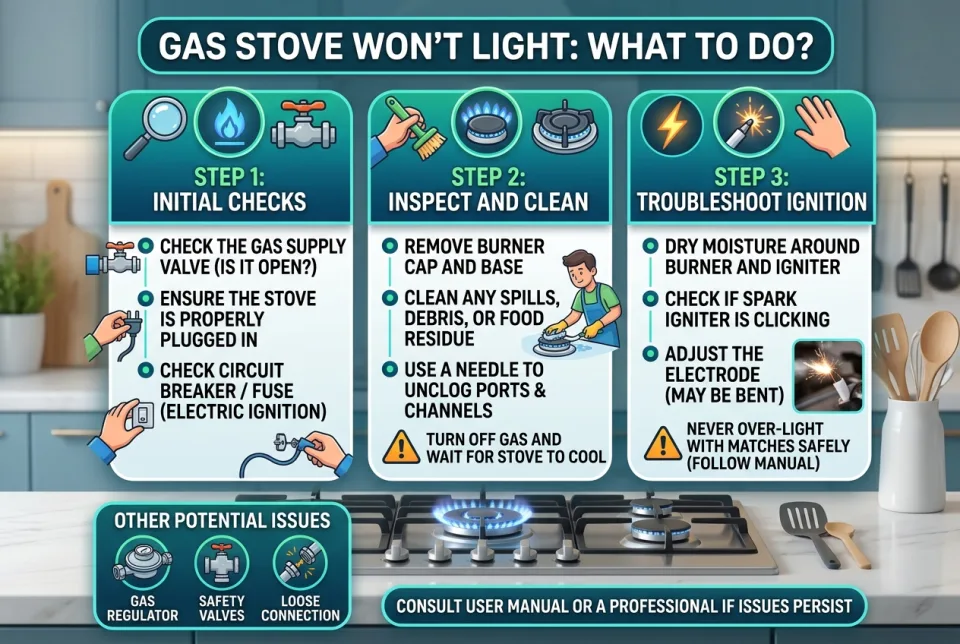
Gas stoves light either by a standing pilot light or an electronic igniter. If the burner does not light, the cause could be a closed gas valve, a dirty or wet burner, a blocked jet, a faulty igniter, or a problem with the gas supply. In some cases, unburned gas may be escaping into the room, which is a serious hazard.
Emergency warning
If you smell gas, hear a hissing sound, or feel dizzy or nauseous, treat it as an emergency. Do not turn any electrical switches on or off, do not use a phone inside the building, and do not light a flame. Leave the building immediately and call your local gas emergency service or emergency services from a safe distance. Do not re-enter until you are told it is safe.
What to do first (if you do not smell gas)
- Turn off the burner. Make sure the knob is in the off position.
- Check the gas supply. Confirm that the main gas valve to the stove is open. If you have a gas cylinder, check that it is not empty.
- Wait a few minutes. Let any unburned gas dissipate before trying again.
- Clean and dry the burner. Remove the burner cap and head. Check for food debris, moisture, or blockages in the gas ports. Dry thoroughly before reassembling.
- Try to light it again. If your stove has a pilot light, follow the manufacturer's instructions to relight it. For electronic ignition, turn the knob and listen for the clicking sound.
What NOT to do
- Do not keep trying to light the burner repeatedly. If it does not light after a couple of attempts, stop. Repeated attempts can release unburned gas into the room.
- Do not use a match or lighter to light a burner that is not designed for manual lighting. Follow the manufacturer's instructions only.
- Do not ignore a gas smell. Even a faint smell should be treated seriously.
- Do not attempt to repair the stove yourself beyond basic cleaning and checking the gas supply. Gas appliances should be serviced by a qualified technician.
When to call for help
Call a qualified gas appliance technician if:
- The stove still won't light after basic checks.
- You notice a gas smell at any time.
- The igniter does not click or spark.
- The flame is weak, yellow, or uneven.
- You suspect a blocked jet or a faulty gas valve.
If you smell gas, call your gas emergency service immediately, not a technician.
What to monitor
After a successful lighting, check that the flame is blue and steady. A yellow or orange flame may indicate incomplete combustion or a dirty burner. If the flame is uneven or noisy, turn off the burner and clean the ports. If the problem persists, call a technician.
How to prevent it
- Clean the burners regularly to prevent blockages.
- Keep the burner area dry.
- Have your gas stove serviced periodically by a qualified technician.
- Install a gas detector if you rely on gas appliances.
This is general information and not a substitute for professional advice. In an emergency, call your local emergency services.
Sources & references
Spotted an error? Report it — we correct factual mistakes promptly.
Read next
What Do You Do If Your Homemade Food Tastes Bland? 9 Ways to Improve Flavor
Bland food is usually missing one of a few key elements: salt, acid, fat, or umami. Here are nine practical ways to fix the flavor of a dish without starting over.
What to Do If You Keep Ordering Takeout: 8 Ways to Make Home Cooking Easier
If takeout has become your default dinner, small changes to planning, shopping and kitchen setup can make home cooking the easier choice. Here are 8 practical ways to cook at home more often without relying on willpower alone.
Raw chicken and cross-contamination: what to do?
Raw chicken can spread harmful bacteria like Salmonella and Campylobacter to hands, utensils, and surfaces. Learn how to clean up safely and prevent cross-contamination.
Freezer defrosted overnight: what to do?
A freezer that thaws overnight can compromise food safety. Learn how to assess the situation, decide what to keep, and prevent future thawing.
Related handy tools
Checklists, decision guides, scenarios and quizzes for the same situation.