Garbage disposal jammed: what to do?
A jammed garbage disposal can often be freed safely without calling a plumber. Learn the correct steps, the dangerous mistakes to avoid, and when to get professional help.
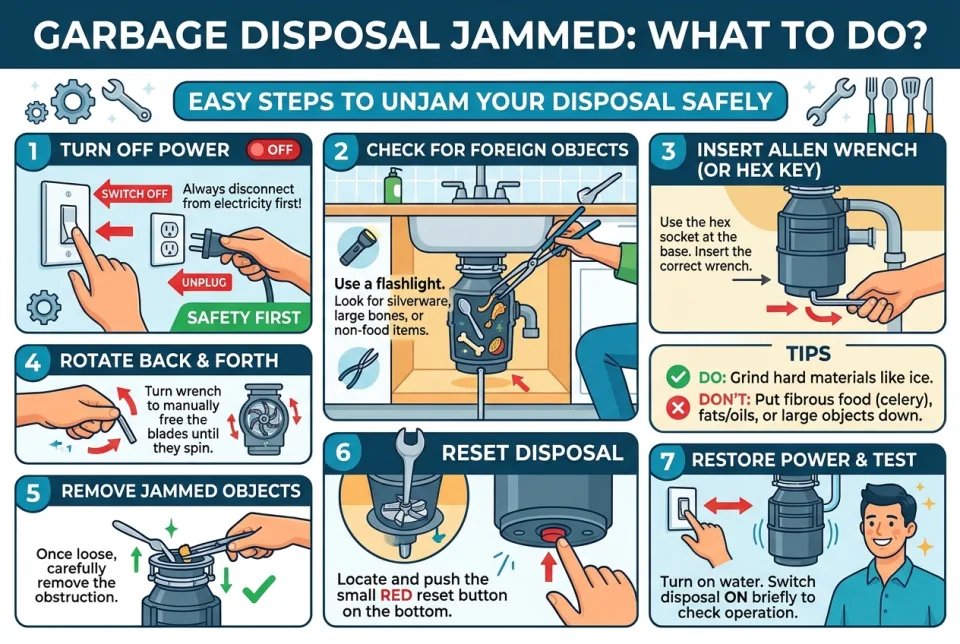
Quick answer
5 steps — read this before anything else
-
1
Turn off the disposal and unplug it or switch off its circuit breaker.
-
2
Never put your hand or fingers into the disposal.
-
3
Use the hex wrench that came with the unit to turn the flywheel from the bottom.
-
4
Remove visible debris with pliers or tongs, then press the red reset button.
-
5
If it still will not turn, call a qualified appliance repair professional.
Warning
Never put your hand or fingers into a garbage disposal, even when it is turned off. Always disconnect power at the plug or circuit breaker before attempting any repair.
A jammed garbage disposal is a common household problem that is usually easy to fix. The key is to work safely: the blades are sharp, and the unit can start unexpectedly if power is still connected. Follow these steps to clear the jam without risking injury.
What is happening
Most jams occur when food waste, a bone, or a foreign object gets wedged between the impellers (the spinning plates) and the grind ring. The motor may hum without turning, or the unit may be completely silent if the internal overload switch has tripped. Never assume the disposal is safe to reach into, even when it appears off.
Emergency warning
If you smell burning, see smoke, or notice sparking, stop immediately and call local emergency services if there is a fire. For electrical hazards, do not touch the disposal or any wet surfaces; turn off power at the main breaker only if it is safe to do so, and call a qualified electrician.
Step by step
- Cut the power. Turn off the disposal switch and unplug the unit from the wall outlet. If it is hardwired, switch off the dedicated circuit breaker at your electrical panel. Lock the panel if possible so no one turns it back on.
- Never put your hand inside. Use long-handled pliers, tongs, or a flashlight to look for and remove any visible object. Do not use your fingers, even with the power off.
- Free the flywheel. Most disposals come with a hex wrench (or an Allen key) that fits a socket on the bottom of the unit. Insert the wrench and turn it back and forth to rotate the flywheel and dislodge the jam. If you do not have the wrench, check the manual or use a suitable Allen key.
- Reset the disposal. Press the red reset button on the bottom or side of the unit. If it clicks, the overload protector has tripped and is now reset.
- Test with cold water. Remove the wrench, restore power, and run a strong stream of cold water into the sink. Turn the disposal on briefly. If it hums but does not spin, turn it off immediately and repeat the wrench step.
- Clear the drain line. If the disposal runs but drains slowly, the trap or drain pipe may be clogged. Place a bucket under the trap and carefully remove it to clear debris, or use a drain snake.
What NOT to do
- Never put your hand or fingers into the disposal, even when it is switched off.
- Do not use chemical drain cleaners in a disposal; they can damage the unit and are hazardous.
- Do not pour grease, oil, or fat down the drain; they solidify and cause clogs.
- Do not force the flywheel with excessive force; if it will not turn, stop and call a professional.
- Do not run the disposal without a steady flow of cold water.
When to call for help
Call a qualified appliance repair professional if the flywheel will not turn after several attempts, if the disposal trips the breaker repeatedly, if you see water leaking from the unit, or if the motor is completely dead. For electrical issues, always use a licensed electrician.
How to prevent jams
- Scrape plates into the trash before rinsing.
- Feed small amounts of food waste and run cold water for 15-20 seconds after grinding.
- Avoid fibrous foods (celery, corn husks), large bones, coffee grounds, and starchy foods like rice and pasta.
- Run the disposal regularly to keep parts moving freely.
If you have followed these steps and the disposal still will not work, do not keep resetting it. Turn off the power and contact a professional. This guide is general information and not a substitute for professional advice; in an emergency, call local emergency services.
Sources & references
Spotted an error? Report it — we correct factual mistakes promptly.
Read next
Burned socket smell in the wall: what to do?
A burning smell from a wall socket is a serious fire hazard. Act quickly to cut power and get professional help.
Solar panels damaged after a hailstorm: what to do?
Hail can crack solar panel glass and void warranties, but the system may still be live. Learn how to stay safe, document damage, and get repairs without risking shock or further loss.
Boiler pressure too low or too high: what to do?
Boiler pressure problems can stop your heating or damage the system. Learn safe steps to diagnose and correct low or high pressure, and when to call a professional.
Damp smell and stains in the attic: what to do?
A musty smell or water stains in the attic usually point to a leak, condensation, or poor ventilation. Here is how to find the cause and fix it safely.
Related handy tools
Checklists, decision guides, scenarios and quizzes for the same situation.