Driving through a flooded road: what to do?
Flooded roads are far more dangerous than they look. Learn why you should never drive into standing water, and what to do if you are already caught in a flood.
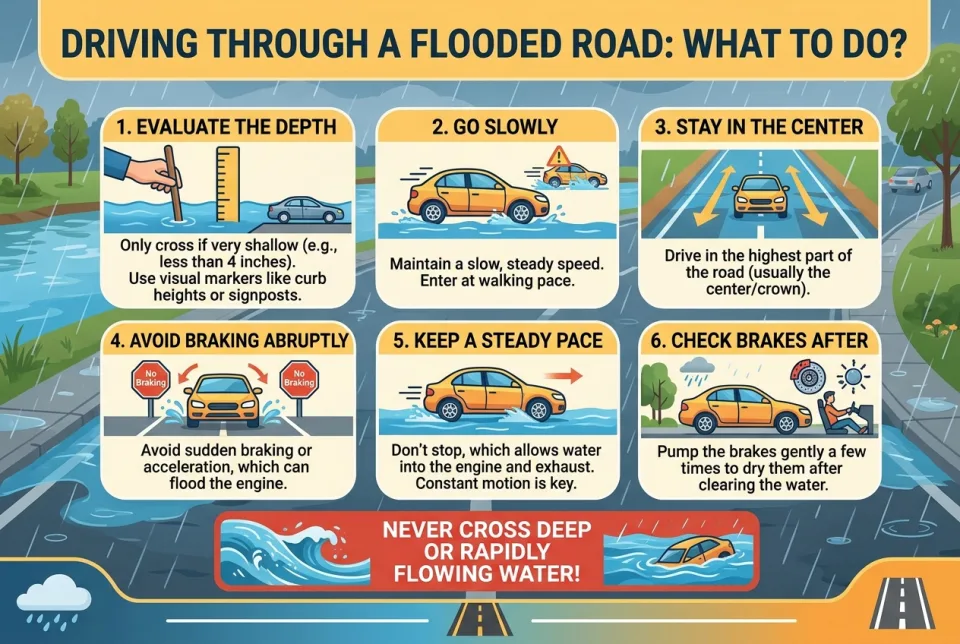
Quick answer
4 steps — read this before anything else
-
1
Never drive into floodwater: turn around and find another route.
-
2
If water starts rising around your car, unbuckle, get out, and move to higher ground immediately.
-
3
If your car is swept away, stay calm, unbuckle, and escape through a window if the door will not open.
-
4
Call local emergency services if anyone is trapped or in immediate danger.
Warning
Never drive into floodwater. Just 30 cm (12 inches) of moving water can float many cars, and 60 cm (24 inches) can sweep away most vehicles. Turn around, do not drown.
Important — please read
This content is general educational and informational only, and is not a substitute for professional medical advice, diagnosis or treatment. Always seek the advice of a qualified health provider with any questions you may have about a medical condition. Never disregard or delay seeking professional medical care because of something you read here. In an emergency or life-threatening situation, call your local emergency services (police, fire or ambulance) immediately.
Floodwater on a road can hide washed-out pavement, debris, and strong currents. Even shallow-looking water can be deeper and faster than it appears. The safest choice is always to avoid driving into it.
Why flooded roads are so dangerous
Moving water exerts powerful force on a vehicle. Just a foot of moving water can float many cars, and two feet can carry away most vehicles, including SUVs and trucks. The roadbed may also be eroded underneath, so the surface can collapse without warning. Murky water hides these hazards, and at night it is almost impossible to judge depth or current.
If you see a flooded road ahead
- Stop and turn around. Do not attempt to cross, even if other vehicles have passed. Find an alternate route.
- Do not ignore barricades or warning signs. They are there because the road is unsafe.
- Warn others if it is safe to do so. If you can pull over safely, alert approaching drivers with your hazard lights.
If you are already in rising water
- Stay calm and act quickly. Unbuckle your seatbelt and check that passengers, especially children, can get out.
- Get out of the vehicle. Open a door if the water pressure allows; otherwise open or break a side window. Do not wait for the car to fill.
- Move to higher ground. Do not try to retrieve belongings. Once out, move away from the vehicle and the water.
- Call local emergency services if anyone is trapped or missing.
If your vehicle is swept away
Unbuckle immediately. If the door will not open because of water pressure, use a window: side windows are easier to break than the windshield. Once out, try to stay upstream of the vehicle and get to the nearest bank or high ground. Do not re-enter the water to help unless you are trained and have proper equipment.
What NOT to do
- Do not drive through water of unknown depth or speed, even if it looks shallow.
- Do not drive around barricades or into water covering the road.
- Do not stay in the car hoping it will not float; act early.
- Do not walk or swim into moving floodwater to retrieve a vehicle or belongings.
- Do not touch downed power lines or electrical equipment near water.
When to call for help
Call local emergency services immediately if a vehicle is trapped, someone is in the water, or water is rising quickly around you. Do not wait until the situation becomes critical.
How to prepare
Check weather forecasts before travel and avoid routes near rivers, streams, and low-lying areas during heavy rain. Keep a window-breaking tool in your car if you drive in flood-prone regions. Remember that floodwater can be contaminated with sewage and debris, so wash thoroughly if you come into contact with it.
This is general safety information, not a substitute for professional advice. In an emergency, call your local emergency services immediately.
Sources & references
Spotted an error? Report it — we correct factual mistakes promptly.
Read next
Car smells of burning rubber: what to do?
A burning rubber smell in your car can signal a serious hazard like an overheating engine, a slipping belt, or an electrical fault. Learn how to respond safely and when to get professional help.
Headlights stopped working at night: what to do?
Driving with no headlights at night is extremely dangerous. Learn how to stop safely, make yourself visible, and get help without causing a crash.
Brake failure while driving: what to do?
Brake failure at speed is a true emergency. Stay calm, pump the pedal, downshift, and use the handbrake or road friction to slow down safely.
Driver fatigue on a long trip: what to do?
Fatigue behind the wheel is a serious hazard. Learn the safe, proven steps to manage tiredness on a long drive and when to stop for good.
Related handy tools
Checklists, decision guides, scenarios and quizzes for the same situation.