Brake failure while driving: what to do?
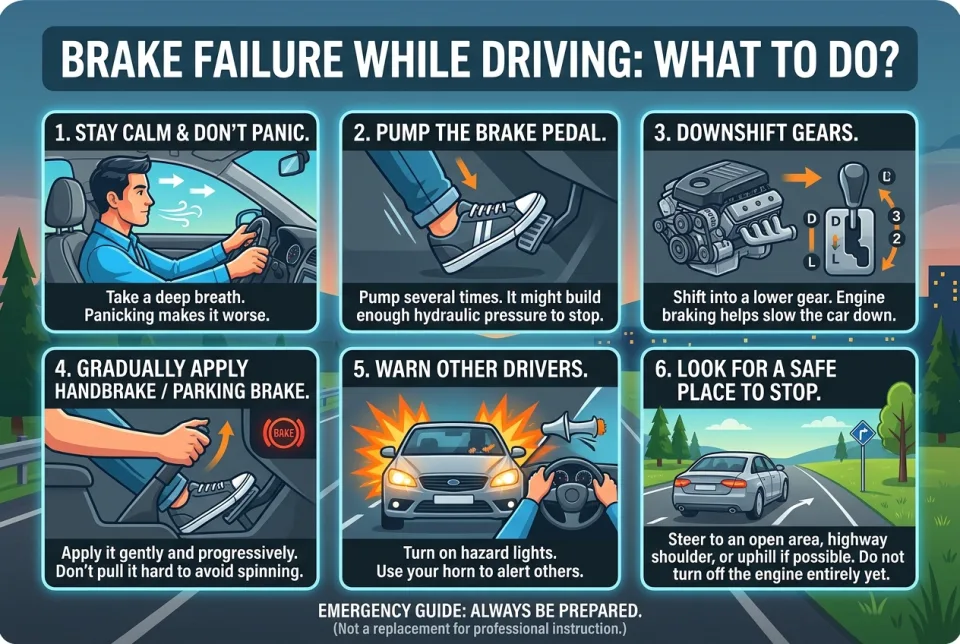
Brake failure at speed is a true emergency. Stay calm, pump the pedal, downshift, and use the handbrake or road friction to slow down safely.
Quick answer
5 steps — read this before anything else
-
1
Stay calm and keep both hands on the wheel.
-
2
Pump the brake pedal firmly several times to build pressure.
-
3
Downshift to a lower gear to use engine braking.
-
4
Apply the handbrake gradually, not suddenly.
-
5
If needed, use a safe runoff or scrape against a barrier to slow down.
Warning
Brake failure can lead to a crash. If you cannot stop and are in danger, call emergency services immediately. Do not turn off the engine while moving, as you will lose power steering and airbags.
Important — please read
This content is general educational and informational only, and is not a substitute for professional medical advice, diagnosis or treatment. Always seek the advice of a qualified health provider with any questions you may have about a medical condition. Never disregard or delay seeking professional medical care because of something you read here. In an emergency or life-threatening situation, call your local emergency services (police, fire or ambulance) immediately.
Brake failure while driving is rare but extremely dangerous. The right actions in the first few seconds can mean the difference between a controlled stop and a crash. This guide explains what to do, what not to do, and how to reduce the risk.
Emergency warning
If you cannot stop and are heading toward a collision, call your local emergency services immediately (for example, 911 in the US and Canada, 999 in the UK, 112 in the EU). Do not wait until after the crash to call for help.
What is happening
Brake failure can happen for several reasons: a loss of hydraulic pressure (leak or air in the lines), overheated brakes (brake fade), a broken brake line, or a faulty master cylinder. The pedal may feel soft, go all the way to the floor, or the car may pull to one side. Knowing the signs helps you react faster.
Step by step: what to do first
- Stay calm and keep control. Grip the wheel firmly with both hands. Panic makes everything worse.
- Pump the brake pedal. Press and release it rapidly several times. This can build pressure if the problem is a small leak or air in the lines. If the pedal feels firm after pumping, keep pressure on it.
- Downshift to a lower gear. If you have a manual transmission, shift down through the gears. In an automatic, move the selector to a lower range (L, 2, or 1, or use the manual mode). Engine braking will slow the car without using the brakes.
- Use the handbrake (parking brake) gradually. Pull it up slowly and steadily. Do not yank it, as that can lock the rear wheels and cause a skid. If the car starts to skid, release it slightly and steer into the skid.
- Look for a safe runoff area. Aim for an open shoulder, an uphill slope, or a grassy area. Avoid water, trees, and oncoming traffic. If no runoff exists, gently scrape the side of the car against a guardrail or curb to slow down, keeping your hands on the wheel.
- Turn on your hazard lights to warn other drivers.
- Once stopped, set the parking brake, turn off the engine, and call for help. Do not drive the car again until a professional inspects it.
What NOT to do
- Do not turn off the engine. You will lose power steering and possibly airbags, making the car much harder to control.
- Do not pump the brake pedal if it is already firm and the car is not slowing. In that case, the problem may be brake fade from overheating; pumping can make it worse. Instead, downshift and let the brakes cool.
- Do not yank the handbrake. Sudden application can cause a spin.
- Do not steer into oncoming traffic or off a high edge. Choose the least dangerous path.
- Do not ignore warning signs. A soft pedal, a brake warning light, or a burning smell means get the car checked immediately.
When to call for help
Call emergency services if you cannot stop, if you are heading toward a collision, or if you have crashed. If you manage to stop safely but the brakes failed, call a tow truck and a mechanic. Do not attempt to drive the car.
How to prevent brake failure
- Have your brakes inspected at the interval recommended by your manufacturer, and immediately if you notice any change in pedal feel or braking performance.
- Check brake fluid levels regularly and look for leaks under the car.
- When driving downhill, use a lower gear to avoid overheating the brakes.
- Do not ride the brakes; use them in short, firm applications.
After any brake failure, have the entire brake system inspected by a qualified mechanic before driving again. This is general information and not a substitute for professional automotive advice. In an emergency, call your local emergency services immediately.
Sources & references
Spotted an error? Report it — we correct factual mistakes promptly.
Read next
What should you do after a car accident?
A step-by-step guide to staying safe, getting help, and handling the aftermath of a car accident, from securing the scene to exchanging information.
Accident in a rental car abroad: what to do?
A step-by-step guide to handling a rental car accident in a foreign country, from securing the scene to notifying the rental company and your insurer.
Car smells of burning rubber: what to do?
A burning rubber smell in your car can signal a serious hazard like an overheating engine, a slipping belt, or an electrical fault. Learn how to respond safely and when to get professional help.
Headlights stopped working at night: what to do?
Driving with no headlights at night is extremely dangerous. Learn how to stop safely, make yourself visible, and get help without causing a crash.
Related handy tools
Checklists, decision guides, scenarios and quizzes for the same situation.