Headlights stopped working at night: what to do?
Driving with no headlights at night is extremely dangerous. Learn how to stop safely, make yourself visible, and get help without causing a crash.
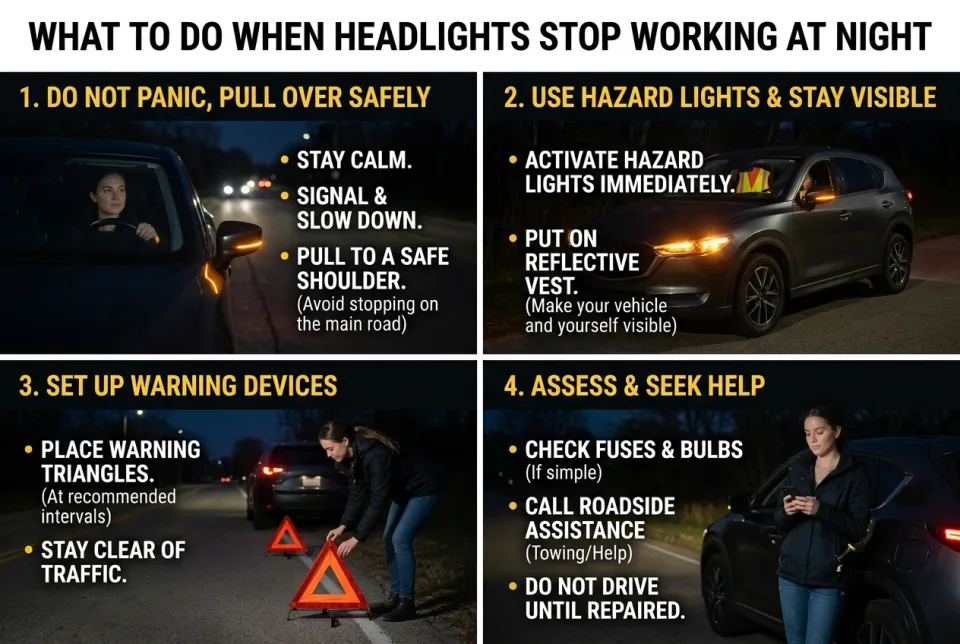
Quick answer
5 steps — read this before anything else
-
1
Slow down and move to the right lane or shoulder as soon as it is safe.
-
2
Turn on your hazard lights and any other lights that still work.
-
3
Stop in a safe, well-lit place away from traffic if possible.
-
4
Do not continue driving in the dark; call for help or a tow.
-
5
If you must stop on the road, stay in the car with your seatbelt on and call emergency services if you are in a dangerous spot.
Warning
Driving without headlights at night is extremely dangerous. Stop safely as soon as possible and do not continue driving in the dark.
Important — please read
This content is general educational and informational only, and is not a substitute for professional medical advice, diagnosis or treatment. Always seek the advice of a qualified health provider with any questions you may have about a medical condition. Never disregard or delay seeking professional medical care because of something you read here. In an emergency or life-threatening situation, call your local emergency services (police, fire or ambulance) immediately.
Losing your headlights at night is a sudden emergency. You may not be able to see the road, and other drivers may not see you. The priority is to stop safely and avoid a collision. Do not try to drive home or to a garage in the dark.
What is happening
Headlights can fail for several reasons: a blown fuse, a dead battery or alternator, a faulty switch, or damaged wiring. Sometimes only the low beams fail, or only one side. In some cars, a failure of the main lighting circuit also affects tail lights and dashboard lights. If all lights go out at once, suspect a fuse or a charging system problem.
Emergency warning
If you are on a dark road with no lights and cannot see, treat this as an emergency. Call your local emergency services immediately if you are in a dangerous position, such as stopped in a live traffic lane or on a blind curve.
What to do first
- Stay calm and slow down. Ease off the accelerator and brake gently. Do not slam on the brakes.
- Turn on your hazard lights and any other lights that still work (parking lights, fog lights, high beams if they function).
- Move to the right (or the correct side for your country) and look for a safe place to stop: a shoulder, a lay-by, a parking lot, or a well-lit side street.
- Stop as far from traffic as possible. If you cannot reach a safe spot, stop where you are but keep hazards on.
- Assess the situation. If you are in a live lane or on a dangerous curve, call emergency services and ask for help. Do not stand outside the car in traffic.
What NOT to do
- Do not keep driving in the dark hoping the lights will come back on. You risk a head-on collision.
- Do not use high beams as a substitute if they also do not work; they will not help if the circuit is dead.
- Do not get out and walk along a dark road unless it is clearly safe and you are away from traffic.
- Do not try to repair the car by the roadside at night in traffic. Wait for professional help.
- Do not rely on your phone flashlight as a headlight while driving.
When to call for help
Call emergency services if you are stopped in a live traffic lane, on a blind curve, or if you feel unsafe. Otherwise, call a roadside assistance service or a tow truck. If you have passengers, keep them in the car with seatbelts on and hazard lights flashing.
What to monitor
Watch for approaching traffic and keep your hazard lights on. If you are stopped on the shoulder, stay inside the car unless you are certain you can exit safely away from traffic. If you smell burning or see smoke, get everyone out and move well away from the vehicle, then call emergency services.
How to prevent it
Check your lights regularly, including tail lights and turn signals. Replace bulbs promptly. If a fuse blows repeatedly, have the electrical system checked by a mechanic. Keep a flashlight and reflective triangle in the car for emergencies.
Remember: this is general information and not a substitute for professional advice. In an emergency, call your local emergency services immediately.
Spotted an error? Report it — we correct factual mistakes promptly.
Read next
What should you do after a car accident?
A step-by-step guide to staying safe, getting help, and handling the aftermath of a car accident, from securing the scene to exchanging information.
Accident in a rental car abroad: what to do?
A step-by-step guide to handling a rental car accident in a foreign country, from securing the scene to notifying the rental company and your insurer.
Car breakdown on a Moroccan highway: what to do?
A breakdown on a Moroccan highway can be stressful, but following a few key steps will keep you safe and get you help quickly. Here is what to do.
Windshield wipers stopped working in the rain: what to do?
When wipers fail in the rain, your visibility can vanish in seconds. Learn how to react safely, get off the road, and prevent this from happening again.
Related handy tools
Checklists, decision guides, scenarios and quizzes for the same situation.