Wire transfer sent to wrong account: what to do?
Wiring money to the wrong account can be stressful, but quick action may improve your chances of recovery. Learn the steps to take and how to avoid mistakes.
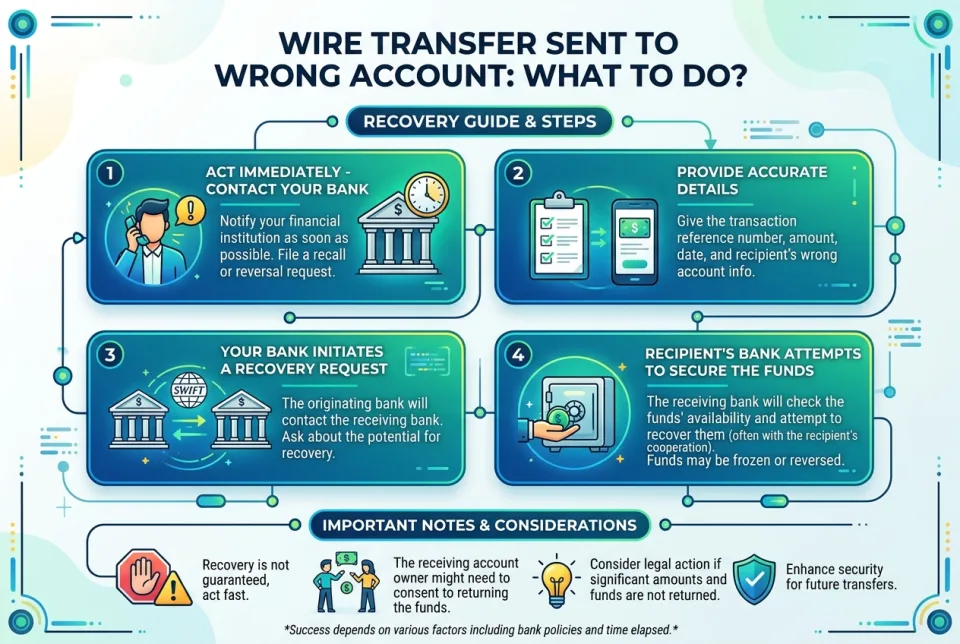
Quick answer
5 steps — read this before anything else
-
1
Call your bank immediately to report the error and request a recall.
-
2
Gather all transaction details: date, amount, recipient account, and reference number.
-
3
Ask your bank to contact the receiving bank to request a return of funds.
-
4
File a report with your local police if fraud is suspected.
-
5
Follow up in writing with your bank and keep records of all communications.
Warning
Wire transfers are often irreversible. Act immediately to maximize the chance of recovery.
Important — please read
This content is general educational and informational only, and is not a substitute for professional medical advice, diagnosis or treatment. Always seek the advice of a qualified health provider with any questions you may have about a medical condition. Never disregard or delay seeking professional medical care because of something you read here. In an emergency or life-threatening situation, call your local emergency services (police, fire or ambulance) immediately.
If you have sent a wire transfer to the wrong account, acting quickly is critical. Wire transfers are generally final and irreversible once processed, but banks can sometimes help recover funds if notified promptly. This guide outlines the steps to take and what to avoid.
What is happening
When you initiate a wire transfer, your bank sends instructions to the receiving bank to credit a specific account. Once the funds are deposited, reversing the transaction requires the recipient's consent or legal action. The likelihood of recovery depends on how quickly you act and whether the recipient can be identified.
Emergency warning
If you suspect fraud or that the transfer was sent to a fraudulent account, contact your bank immediately and report it to the police. Do not delay.
What to do first
- Call your bank right away. Use the phone number on your bank's official website or your account statement. Explain the error and ask them to initiate a recall. Speed is crucial because if the funds have not yet been picked up, they may be stopped.
- Provide all details. Have your transaction reference number, the amount, the date, the recipient's account details, and any supporting documents ready.
- Ask for a recall. Your bank can send a recall request to the receiving bank. The receiving bank will contact the account holder to request permission to return the funds. This process can take time and is not guaranteed.
- Document everything. Keep a record of all communications, including dates, times, names of bank representatives, and any reference numbers. Follow up in writing (email or letter) to create a paper trail.
- File a police report. If you believe the transfer was due to fraud or theft, report it to your local police. This can support your case with the bank and may be required for insurance claims.
What NOT to do
- Do not delay. Waiting reduces the chance of recovery.
- Do not contact the recipient directly. Attempting to resolve it yourself could complicate the bank's recovery efforts or alert a fraudulent recipient.
- Do not send more money. Scammers sometimes pose as someone who can recover your funds for a fee. This is a secondary scam.
- Do not assume the bank will fix it automatically. You must actively pursue the recall.
When to seek professional help
If the amount is significant or the bank is unresponsive, consider consulting a lawyer who specializes in financial disputes. For fraud cases, you may also report to a national fraud reporting center, such as the FTC in the US or Action Fraud in the UK.
What to monitor
Keep an eye on your account for any unauthorized transactions. If you shared personal information, monitor for identity theft. Follow up with your bank regularly until the issue is resolved.
How to prevent it
- Double-check recipient details. Verify the account number and sort code (or routing number) with the recipient through a trusted channel before sending.
- Use secure methods. For large sums, consider using a bank transfer with confirmation of payee services if available.
- Be wary of urgency. Scammers often create a sense of urgency. Take your time to verify.
In summary, act fast, contact your bank, and keep detailed records. While recovery is not guaranteed, prompt action gives you the best chance.
Spotted an error? Report it — we correct factual mistakes promptly.
Read next
Overdraft fees surprise: what to do?
An unexpected overdraft fee can be frustrating. Learn the steps to take, how to request a refund, and ways to avoid future fees.
Credit score dropped suddenly: what to do?
A sudden credit score drop can be alarming, but it is often fixable. Learn the common causes and the steps to take to identify and address the issue.
Duplicate subscription charges on my statement: what to do?
If you see the same subscription charge twice, act quickly to stop further charges and request a refund. Here is a step-by-step guide to resolve duplicate subscription charges.
Tax refund delayed for weeks: what to do?
If your tax refund is weeks late, don't panic. Learn the common reasons for delays and the steps you can take to check your status and get help.
Related handy tools
Checklists, decision guides, scenarios and quizzes for the same situation.