Teaching your child to call 911: what to do?
Teaching a child to call 911 can save a life. Learn age-appropriate steps, what to say, and how to practice safely without causing fear.
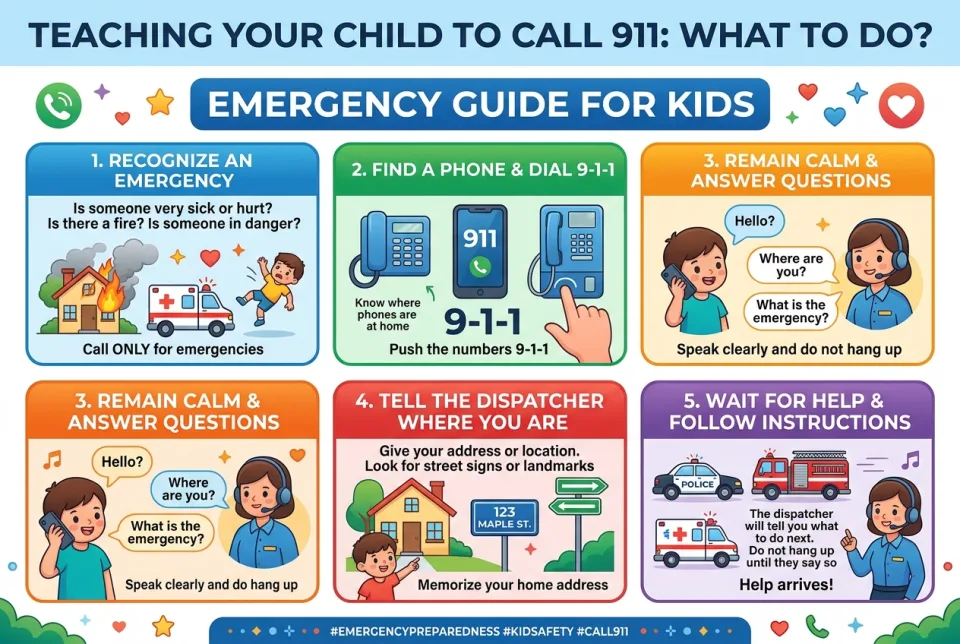
Quick answer
5 steps — read this before anything else
-
1
Start teaching around age 4-5 with simple lessons: 911 is for emergencies only.
-
2
Practice saying your address and phone number together.
-
3
Role-play calm conversations and what to say to the dispatcher.
-
4
Explain when to call: fire, someone not breathing, or a stranger danger.
-
5
Rehearse with a toy phone or unplugged phone, never a real 911 call.
Warning
Never make test calls to 911. Use a toy phone or unplugged phone for practice. Calling 911 as a prank is illegal and can delay help for someone in a real emergency.
Important — please read
This content is general educational and informational only, and is not a substitute for professional medical advice, diagnosis or treatment. Always seek the advice of a qualified health provider with any questions you may have about a medical condition. Never disregard or delay seeking professional medical care because of something you read here. In an emergency or life-threatening situation, call your local emergency services (police, fire or ambulance) immediately.
Teaching your child to call 911 is a practical safety skill that can make a real difference in an emergency. Children as young as 4 or 5 can learn the basics, but the approach should match their age and maturity. The goal is to help them feel confident, not frightened.
What to teach at each age
Preschool (ages 4-5): Keep it simple. Teach that 911 is for emergencies only, and that they should never call it as a joke. Help them memorize their address and a parent's phone number. Show them how to unlock a smartphone or press the emergency call button if they have one.
Early elementary (ages 6-8): Explain what counts as an emergency: fire, someone who won't wake up, a serious injury, or a stranger trying to get in. Practice what to say: their name, address, and what is happening. Teach them to stay on the line until the dispatcher says it's okay to hang up.
Older children (ages 9+): They can understand more details, such as when to call for a medical emergency versus a non-emergency. They should also know how to use a landline if cell service is down and how to text 911 if voice calls aren't possible (available in many areas).
Step-by-step: how to teach and practice
- Explain what 911 is. Say clearly: "911 is for emergencies only. If someone is hurt badly, if there's a fire, or if you feel very unsafe, call 911."
- Teach your address and phone number. Practice saying them together daily until your child can recite them without help. Write them down and post them near the phone.
- Role-play. Use a toy phone or an unplugged phone. Pretend to be the dispatcher and ask: "What is your emergency?" "What is your address?" "What is your name?" Have your child answer calmly and clearly.
- Practice staying on the line. Explain that the dispatcher may ask questions and that they should not hang up until told to.
- Show how to call. On a smartphone, show how to open the phone app and dial 911. On a locked phone, show the emergency call option. Make sure they know they can call even without a passcode.
- Discuss when NOT to call. Explain that calling 911 as a prank is dangerous and illegal. If they call by mistake, they should stay on the line and explain.
What NOT to do
- Don't use 911 as a threat ("If you're bad, I'll call the police"). This can make children afraid to call in a real emergency.
- Don't make test calls to 911. Use a toy phone or unplugged phone instead.
- Don't overwhelm young children with too much information at once. Keep lessons short and repeat them often.
- Don't assume your child knows what to do. Practice regularly, just like a fire drill.
When to call for help
Teach your child to call 911 immediately if:
- There is a fire or smoke.
- Someone is unconscious, not breathing, or seriously injured.
- A stranger tries to break in or follows them.
- They are home alone and feel unsafe.
If your child is ever unsure, it's better to call and let the dispatcher decide. Dispatchers are trained to help.
What to monitor
After teaching, check your child's understanding by asking simple questions: "When would you call 911?" "What would you say?" Praise their efforts. Revisit the lesson every few months and after any real emergency in your community.
This guide is general information and not a substitute for professional medical or emergency advice. In an emergency, call your local emergency services immediately.
Sources & references
Spotted an error? Report it — we correct factual mistakes promptly.
Read next
What Should You Do If Your Child Is Refused Entry to School Because of Missing Documents?
If your child is turned away from school because of missing paperwork, stay calm and act quickly. This guide explains how to resolve the issue and get your child enrolled.
Car seat safety check: what to do?
A proper car seat check takes minutes and prevents serious injury. Learn the key checks for installation, harness fit, and when to replace a seat.
Child gets a fever at night: what to do?
A step-by-step guide for parents on how to safely manage a child's fever at night, including when to call for help and what to avoid.
Child swallowed a small object: what to do?
Most small objects pass through without harm, but some can cause serious injury. Learn when to act fast and when to watch and wait.
Related handy tools
Checklists, decision guides, scenarios and quizzes for the same situation.