Child gets a fever at night: what to do?
A step-by-step guide for parents on how to safely manage a child's fever at night, including when to call for help and what to avoid.
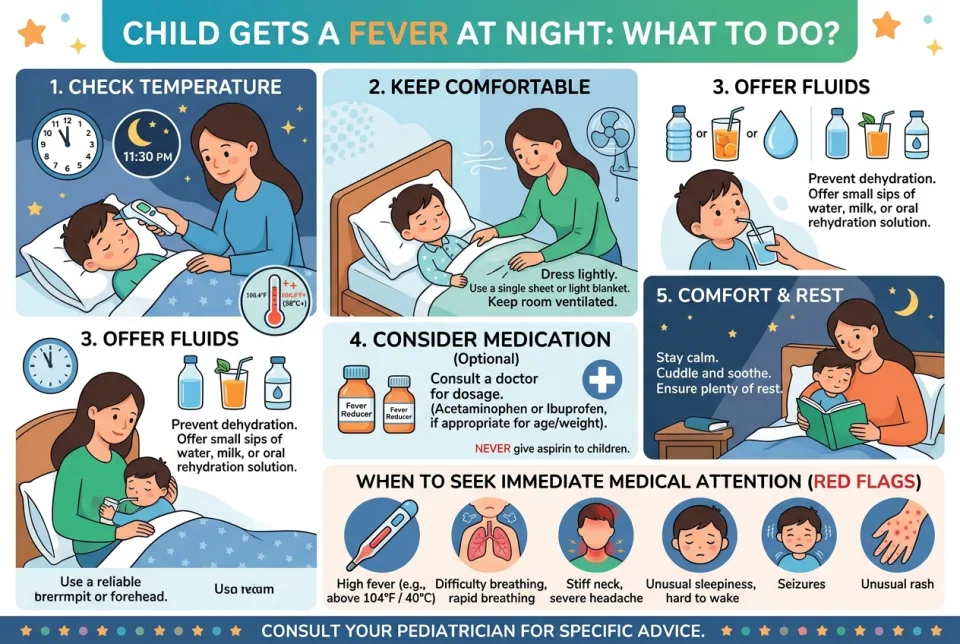
Quick answer
5 steps — read this before anything else
-
1
Check the child's temperature and observe for other symptoms.
-
2
If the child is under 3 months old with a fever, call emergency services or a doctor immediately.
-
3
Keep the child comfortable, offer fluids, and dress them lightly.
-
4
Do not give aspirin to a child. Use fever medication only as directed by a doctor.
-
5
Seek emergency care if the child has trouble breathing, is hard to wake, or has a seizure.
Warning
Call emergency services immediately if your child is under 3 months old with a fever, has trouble breathing, is hard to wake, or has a seizure.
Important — please read
This content is general educational and informational only, and is not a substitute for professional medical advice, diagnosis or treatment. Always seek the advice of a qualified health provider with any questions you may have about a medical condition. Never disregard or delay seeking professional medical care because of something you read here. In an emergency or life-threatening situation, call your local emergency services (police, fire or ambulance) immediately.
It can be frightening when your child develops a fever at night. A fever is a common sign that the body is fighting an infection. Most fevers are not dangerous, but they can make your child uncomfortable and may require medical attention in some cases. This guide will help you decide what to do and when to get help.
What is happening?
A fever is a body temperature of 100.4°F (38°C) or higher. It is usually caused by a viral or bacterial infection. Fever itself is not an illness; it is a symptom. The height of the fever does not always indicate how serious the illness is. How your child looks and acts is more important.
Emergency warning
Call your local emergency services immediately if your child:
- Is under 3 months old and has a rectal temperature of 100.4°F (38°C) or higher.
- Has trouble breathing or is breathing very fast.
- Is hard to wake up or is unusually drowsy.
- Has a seizure (convulsion).
- Has a stiff neck, severe headache, or a rash that does not fade when pressed.
- Is dehydrated (no tears, dry mouth, little urine).
- Has a fever above 104°F (40°C) that does not come down with medication.
What to do first
- Check the temperature. Use a digital thermometer. For infants, a rectal temperature is most accurate. For older children, oral, ear, or forehead thermometers are fine.
- Observe your child. Note their behavior, breathing, and any other symptoms like cough, rash, or vomiting.
- Keep them comfortable. Dress them in light clothing and use a light blanket. Do not bundle them up.
- Offer fluids. Give water, oral rehydration solution, or breast milk/formula frequently to prevent dehydration.
- Consider fever medication if needed. If your child is uncomfortable, you may give acetaminophen or ibuprofen, but only in the correct dose for their age and weight. Always follow the package instructions or your doctor's advice. Do not give aspirin to children.
What NOT to do
- Do not give aspirin to a child or teenager due to the risk of Reye's syndrome.
- Do not use cold baths or ice packs to bring down a fever; this can cause shivering and raise the core temperature.
- Do not overdress or overheat the child.
- Do not give fever medication more often than recommended.
- Do not ignore signs of serious illness even if the fever is not very high.
When to call for help
Call your doctor or seek medical care if:
- Your child is 3-6 months old with a fever of 102.2°F (39°C) or higher.
- The fever lasts more than 3 days.
- Your child has a sore throat, ear pain, or vomiting that persists.
- Your child is not drinking enough fluids or is urinating less.
- You are worried or unsure.
What to monitor
Keep an eye on your child's temperature, fluid intake, urine output, and behavior. Check on them regularly through the night. If they are sleeping comfortably, you do not need to wake them to give medication.
How to prevent it
Handwashing, avoiding contact with sick people, and keeping up with vaccinations can help prevent infections that cause fever.
Remember, this is general information and not a substitute for professional medical advice. When in doubt, call your doctor or emergency services. Trust your instincts: if your child seems very ill, get help immediately.
Sources & references
Spotted an error? Report it — we correct factual mistakes promptly.
Read next
What Should I Consider When Comparing an Only Child vs. a Large Family?
There is no single best family size. Research shows that family dynamics, resources, and parenting quality matter far more than the number of siblings.
Child terrified of the doctor: what to do?
A child's fear of the doctor is common and manageable. Learn practical, evidence-based ways to reduce anxiety before, during, and after a visit.
Child sleepwalking at night: what to do?
Sleepwalking in children is common and usually harmless. Learn how to keep your child safe during an episode and when to talk to a doctor.
Signs of a broken arm in a child: what to do?
Learn how to recognize a possible broken arm in a child, provide safe first aid, and know when to seek emergency care.
Related handy tools
Checklists, decision guides, scenarios and quizzes for the same situation.