Car seat safety check: what to do?
A proper car seat check takes minutes and prevents serious injury. Learn the key checks for installation, harness fit, and when to replace a seat.
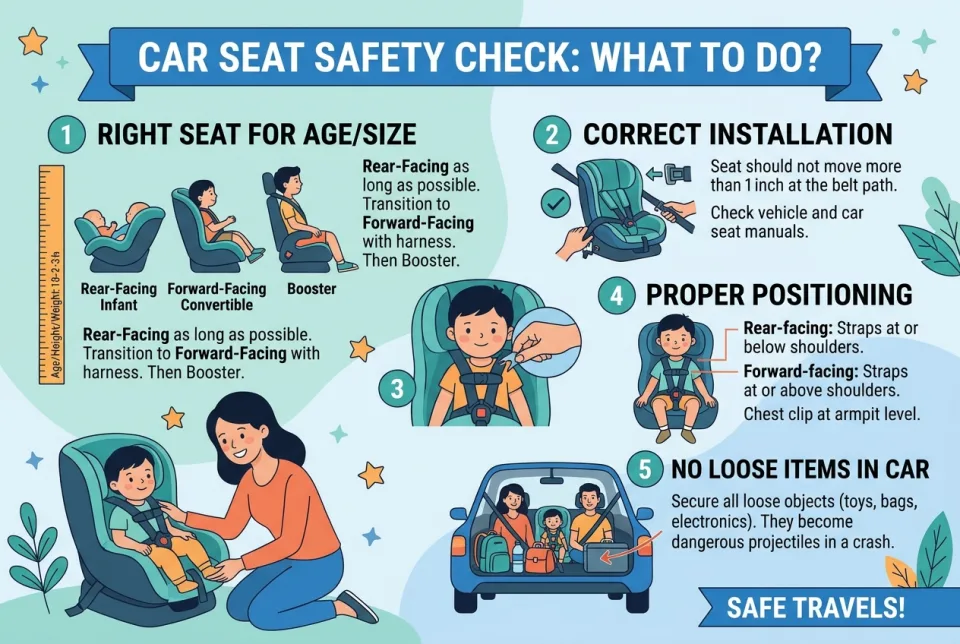
Quick answer
5 steps — read this before anything else
-
1
Check the seat is correct for your child's age, weight, and height, and is installed per the manufacturer's instructions.
-
2
Do the inch test: the seat should not move more than 1 inch front-to-back or side-to-side at the belt path.
-
3
Ensure the harness is snug: you should not be able to pinch excess webbing at the shoulder.
-
4
Place the chest clip at armpit level and use the top tether if forward-facing.
-
5
Get a free inspection by a certified child passenger safety technician if unsure.
Warning
An incorrectly installed or fitted car seat can fail in a crash. If you cannot confirm the seat is secure and the harness is snug, do not travel with your child in that seat until it is checked by a certified technician.
A car seat is one of the most important safety devices you will use for your child, but it only protects them if it is the right seat, installed correctly, and adjusted to fit. A few simple checks can make the difference between a secure ride and a dangerous one.
What to check before every trip
1. The right seat for your child
Car seats are designed for specific height and weight ranges. Check the label on your seat and your child's current measurements. Children should stay rear-facing as long as possible, until they reach the top height or weight limit allowed by the seat. Do not move to a forward-facing seat too early.
2. Installation: the inch test
With the car seat installed, grab it at the belt path (where the seat belt or lower anchor strap passes through) and give it a firm pull. It should not move more than 1 inch (2.5 cm) front-to-back or side-to-side. If it does, tighten the installation. For forward-facing seats, always use the top tether if your vehicle has an anchor point.
3. Harness fit
The harness should be snug enough that you cannot pinch any excess webbing at the shoulder. Place the chest clip at armpit level. For rear-facing seats, the harness straps should come from at or below the shoulders; for forward-facing, at or above. Remove bulky clothing like thick coats before tightening the harness, as they can create dangerous slack in a crash.
4. Seat angle and position
Rear-facing seats need the correct recline angle to keep your child's head and airway safe. Most seats have an angle indicator. The safest place for a car seat is usually the back seat, and never in front of an active airbag.
5. Expiration and history
Car seats have an expiration date (often 6-10 years from manufacture). Do not use a seat that is expired, has been in a moderate or severe crash, or has missing parts. Check the label and manual.
What NOT to do
- Do not add aftermarket products like thick seat cushions, head supports, or strap covers that did not come with the seat, as they can interfere with the harness.
- Do not use a used seat with an unknown history or without a manual.
- Do not install a rear-facing seat in front of an active airbag.
- Do not use the lower anchors and the seat belt at the same time unless the manufacturer explicitly allows it.
- Do not let your child wear a bulky coat under the harness without checking the fit.
When to get help
If you are unsure about any part of the installation or fit, look for a certified child passenger safety technician in your area. Many fire departments, hospitals, and community organizations offer free car seat checks. You can also check the seat manufacturer's manual and videos.
How to keep it safe over time
Recheck the seat after any adjustment, after someone else has used the car, and as your child grows. A quick monthly check of the harness tightness and installation is a good habit.
Taking a few minutes to verify these points gives you confidence that your child is as protected as possible on every journey.
Sources & references
Spotted an error? Report it — we correct factual mistakes promptly.
Frequently asked questions
Read next
What age can kids stay home alone legally?
There is no single legal age for leaving a child home alone in most places. The law focuses on whether the child is mature enough and the situation is safe.
Winter coat under the car seat: the hidden danger
A bulky coat under a car seat can interfere with seat belts and child car seats, and it can become a projectile in a crash. Learn the safe way to handle winter coats in the car.
Lightning storm safety: what to do?
Lightning can strike anywhere and is dangerous. Learn how to protect yourself indoors and outdoors during a thunderstorm.
Toddler swallowed a button battery: what to do?
A swallowed button battery is a medical emergency that can cause severe internal burns within about two hours. Act immediately: do not wait for symptoms and do not try to make your child vomit.
Related handy tools
Checklists, decision guides, scenarios and quizzes for the same situation.