Child swallowed a small object: what to do?
Most small objects pass through without harm, but some can cause serious injury. Learn when to act fast and when to watch and wait.
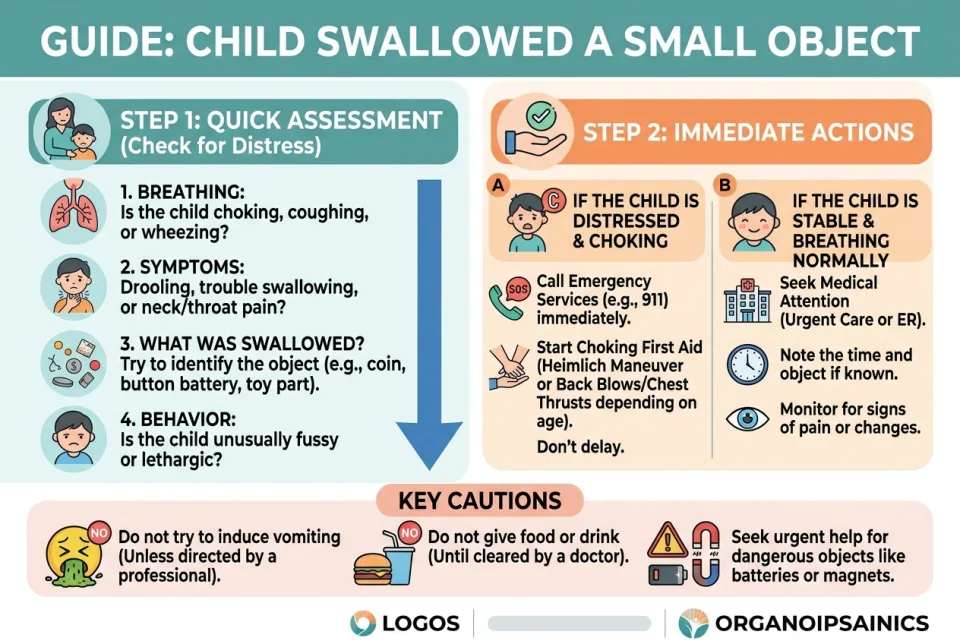
Quick answer
5 steps — read this before anything else
-
1
Check for breathing difficulty, choking, or severe pain: if present, call emergency services immediately.
-
2
If the child is breathing normally, do not try to make them vomit or reach into the throat.
-
3
Note what was swallowed, when, and the child's symptoms.
-
4
Call your doctor or poison control for guidance, especially for dangerous objects.
-
5
Watch for warning signs like drooling, vomiting, or abdominal pain.
Warning
Button batteries and magnets are medical emergencies. If your child swallowed one, seek emergency care immediately, even if they seem fine.
Important — please read
This content is general educational and informational only, and is not a substitute for professional medical advice, diagnosis or treatment. Always seek the advice of a qualified health provider with any questions you may have about a medical condition. Never disregard or delay seeking professional medical care because of something you read here. In an emergency or life-threatening situation, call your local emergency services (police, fire or ambulance) immediately.
Young children often put small objects in their mouths, and most swallowed items pass through the digestive tract without problems. However, some objects can get stuck or cause serious injury. The right response depends on what was swallowed and how your child is acting.
What is happening
A swallowed object travels down the food pipe (esophagus) into the stomach and then through the intestines. Most small, smooth objects pass within a few days. But certain objects, like button batteries, magnets, and sharp items, can cause severe damage if they lodge in the esophagus or intestines.
Emergency warning
Call your local emergency number immediately if your child has any of these signs:
- Difficulty breathing, noisy breathing, or choking
- Severe drooling or inability to swallow
- Severe chest or abdominal pain
- Vomiting blood or having bloody stools
- Sudden refusal to eat or drink
These could mean the object is blocking the airway or has caused internal injury.
What to do first
- Stay calm and assess your child. If they are coughing forcefully or breathing normally, let them try to clear the object on their own. Do not intervene unless they cannot breathe.
- Identify the object. Try to find out what was swallowed, how many, and when. This helps doctors decide on treatment.
- Do not try to make your child vomit. Vomiting can cause more harm, especially with sharp objects or batteries.
- Do not reach into the throat with your fingers unless the object is visible and easily removable; blind finger sweeps can push it further.
- Call your doctor or a poison control center for advice. They can tell you whether to watch at home or seek immediate care.
What NOT to do
- Do not give your child food or drink to "push it down" unless advised by a medical professional.
- Do not ignore the incident even if your child seems fine; some objects cause delayed damage.
- Do not use laxatives or enemas without medical advice.
- Do not assume a small object is harmless; button batteries and magnets are especially dangerous.
When to seek professional care
Seek medical attention right away if your child swallowed:
- A button battery (coin battery)
- More than one magnet, or a magnet and a metal object
- A sharp object (pin, needle, glass, bone)
- A large object or one that could get stuck (e.g., a coin larger than a quarter in a young child)
- Any object and has ongoing symptoms like drooling, vomiting, or pain
For other objects, call your doctor for guidance. They may recommend watching for symptoms or getting an X-ray.
What to monitor
If your child is sent home to wait, watch for these signs over the next few days:
- Abdominal pain, especially if it gets worse
- Vomiting, especially green or bloody
- Refusal to eat or drink
- Blood in the stool
- Fever
- Drooling or trouble swallowing
If any of these occur, call your doctor or seek emergency care.
How to prevent it
Keep small objects out of reach, especially button batteries, magnets, coins, and small toys. Check toys for loose parts and follow age recommendations. Supervise young children during play.
Remember: this is general information, not a substitute for professional medical advice. In an emergency, call your local emergency services immediately.
Sources & references
Spotted an error? Report it — we correct factual mistakes promptly.
Read next
What to Do in Case of Premature Labor
Premature labor occurs when contractions begin before 37 weeks of pregnancy. Learn the critical signs and immediate safety steps to take.
What to Do If You Suspect a Miscarriage
A miscarriage requires prompt medical evaluation and gentle physical and emotional care. Learn the immediate steps to take and when to seek urgent emergency assistance.
Child sleepwalking at night: what to do?
Sleepwalking in children is common and usually harmless. Learn how to keep your child safe during an episode and when to talk to a doctor.
Signs of a broken arm in a child: what to do?
Learn how to recognize a possible broken arm in a child, provide safe first aid, and know when to seek emergency care.
Related handy tools
Checklists, decision guides, scenarios and quizzes for the same situation.