Put the wrong fuel in the car: what to do?
Putting the wrong fuel in your car can cause serious damage if you start the engine. Here is what to do, what not to do, and how to prevent it.
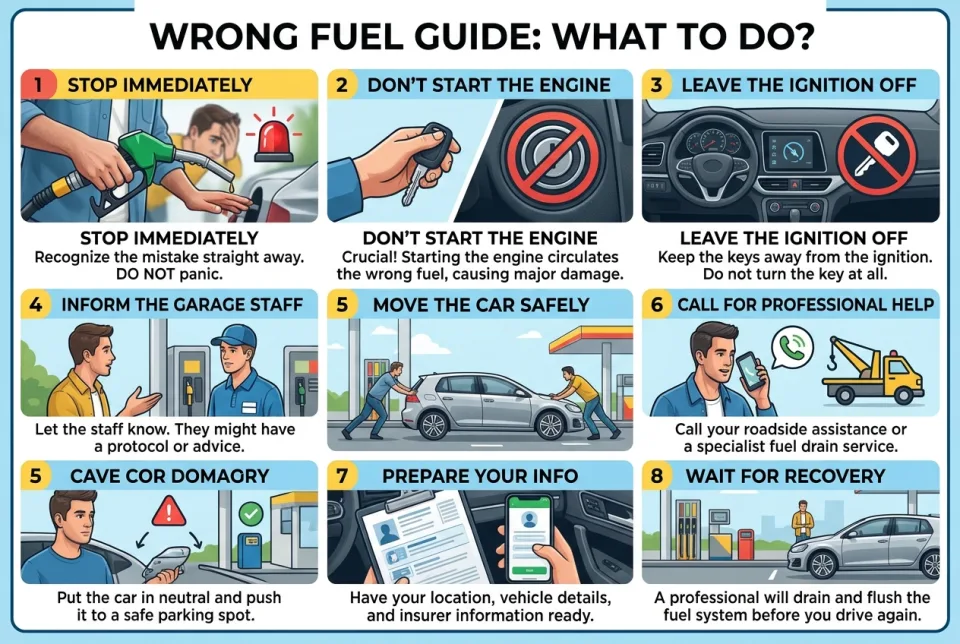
Quick answer
5 steps — read this before anything else
-
1
Do not start the engine or turn on the ignition.
-
2
Put the car in neutral and push it to a safe spot.
-
3
Call a professional fuel drain service or your breakdown provider.
-
4
Have the fuel system flushed and refilled with the correct fuel.
-
5
Keep the receipt and note the fuel type for any warranty or insurance claim.
Warning
Do not start the engine or turn on the ignition if you have put the wrong fuel in. Starting the engine can cause severe damage to the fuel system and engine.
Putting the wrong fuel in your car is a common mistake, but acting quickly and correctly can prevent costly damage. The key is to avoid starting the engine, which circulates the wrong fuel through the system.
What is happening
If you put petrol in a diesel car, the petrol acts as a solvent and can damage the fuel pump and injectors, leading to metal particles circulating in the fuel system. If you put diesel in a petrol car, the diesel may cause the engine to run poorly or not at all, and can clog fuel filters and injectors. In both cases, the risk of damage increases significantly once the engine is started.
Emergency warning
If you have already started the engine and notice problems such as rough running, excessive smoke, or the engine stopping, do not continue driving. Pull over safely and turn off the engine. Call for professional help. Do not attempt to restart the engine.
What to do first
- Do not start the engine or turn on the ignition. This is the most important step. Even turning the key to the accessory position can prime the fuel pump.
- Put the car in neutral and push it to a safe location away from traffic, if possible. If you cannot move the car, turn on hazard lights and stay safe.
- Call a professional fuel drain service or your breakdown provider. They will drain the tank and flush the fuel system.
- Have the fuel system flushed and refilled with the correct fuel. Do not attempt to siphon the fuel yourself; it is dangerous and illegal in many places.
- Keep the receipt and note the fuel type for any warranty or insurance claim.
What NOT to do
- Do not start the engine or turn on the ignition.
- Do not drive the car, even a short distance.
- Do not try to siphon the fuel yourself.
- Do not add additives or try to dilute the wrong fuel.
- Do not ignore the mistake and hope for the best.
When to call for help
Call a professional immediately if you realize you have put the wrong fuel in. If you have already started the engine and experience problems, call for help and do not restart. If you are on a busy road, ensure your safety first and call emergency services if there is an immediate danger.
What to monitor
After the fuel system has been drained and flushed, monitor the car for any unusual noises, smoke, or performance issues. If you notice anything, contact a mechanic.
How to prevent it
- Pay attention at the pump: check the nozzle and the fuel type before filling.
- Use reminders such as a sticker on the fuel cap or dashboard.
- If you are driving a rental or unfamiliar car, double-check the fuel type.
In summary, the most important action is to not start the engine. Call a professional to drain and flush the system, and your car should be fine.
This is general information and not a substitute for professional advice. In an emergency, call local emergency services.
Spotted an error? Report it — we correct factual mistakes promptly.
Read next
Driving in snow without chains: what to do?
If you must drive in snow without chains, slow down, increase following distance, and use gentle inputs. Learn how to stay safe and when to turn back.
Windshield wipers stopped working in the rain: what to do?
When wipers fail in the rain, your visibility can vanish in seconds. Learn how to react safely, get off the road, and prevent this from happening again.
Headlights stopped working at night: what to do?
Driving with no headlights at night is extremely dangerous. Learn how to stop safely, make yourself visible, and get help without causing a crash.
Blinding sun glare while driving: what to do?
Sudden sun glare can erase your view of the road in seconds. Slow down, protect your eyes, and never stop in a live lane to wait it out.
Related handy tools
Checklists, decision guides, scenarios and quizzes for the same situation.