Driving in snow without chains: what to do?
If you must drive in snow without chains, slow down, increase following distance, and use gentle inputs. Learn how to stay safe and when to turn back.
Quick answer
5 steps — read this before anything else
-
1
Slow down well below the speed limit and increase your following distance to at least 8-10 seconds.
-
2
Accelerate, brake, and steer smoothly and gently to maintain traction.
-
3
Clear all snow and ice from windows, lights, and the roof before driving.
-
4
If conditions worsen, pull over safely or turn back; do not push through.
-
5
Carry emergency supplies: warm clothes, blanket, flashlight, food, water, and a charged phone.
Warning
Snow and ice greatly increase stopping distances and skid risk. If you are stranded or conditions become dangerous, call local emergency services immediately.
Driving in snow without chains is possible if you adjust your driving to the conditions and use caution. Chains are not always required or available, but snow and ice demand a different approach. This guide explains how to drive safely without chains and when it is better to avoid driving altogether.
What is happening
Snow reduces tire grip, increasing stopping distances and the risk of skids. Without chains, your vehicle relies on tire tread and careful driving to maintain traction. The key is to drive smoothly and slowly, and to recognize when conditions exceed your vehicle's capabilities.
Emergency warning
If you are stranded, stuck, or conditions become dangerous, call local emergency services immediately. Do not wait until you are in a life-threatening situation. In many regions, emergency numbers are 911 (North America), 112 (Europe), or 999 (UK). Know the number for the area you are driving in.
Step by step: driving in snow without chains
- Prepare your vehicle: Clear all snow and ice from windows, mirrors, lights, and the roof. Check tire tread depth and pressure; worn tires are unsafe in snow. Fill the fuel tank and carry emergency supplies (blanket, warm clothes, flashlight, food, water, phone charger, small shovel, and a bag of sand or kitty litter for traction).
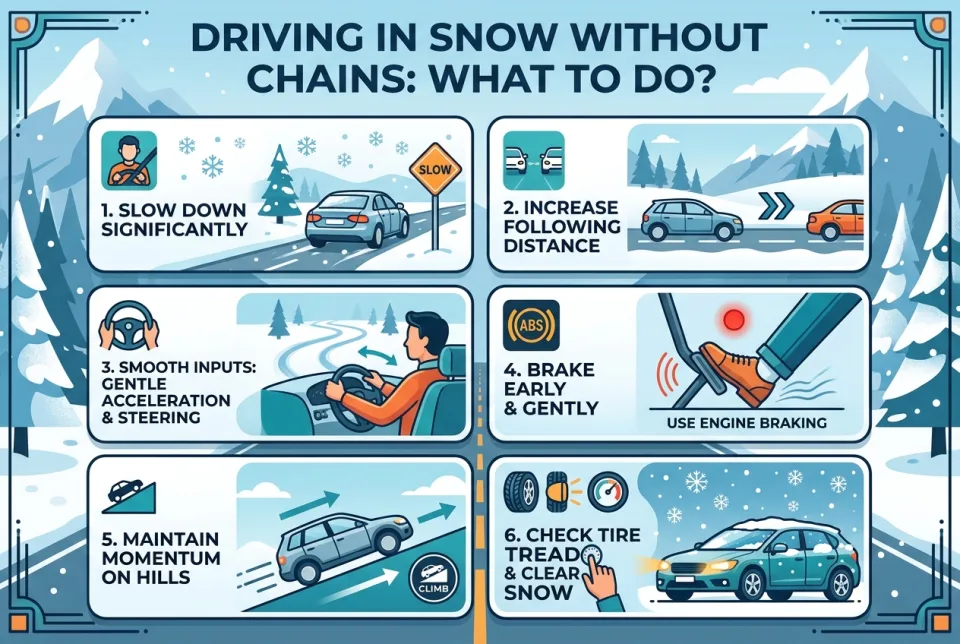
- Slow down: Reduce your speed well below the posted limit. Snow and ice can double or triple stopping distances. Drive at a pace that allows you to stop within the distance you can see.
- Increase following distance: Leave at least 8-10 seconds behind the vehicle in front. This gives you time to react if they skid or stop suddenly.
- Use gentle inputs: Accelerate, brake, and steer smoothly and gradually. Avoid sudden movements that can cause loss of traction. If your vehicle has a winter driving mode, use it.
- Brake early and gently: If you need to slow down, apply the brakes early and with light pressure. If you feel the wheels lock or the pedal pulse (ABS), maintain steady pressure and steer where you want to go.
- Handle skids: If you start to skid, look and steer where you want to go, and ease off the accelerator. Do not slam on the brakes. For rear-wheel skids, steer gently in the direction of the skid. For front-wheel skids, straighten the wheel and wait for traction to return.
- Climb hills carefully: Use a lower gear if possible and maintain a steady speed. Avoid stopping on a hill if you can; starting again on snow is difficult.
- Know when to stop: If visibility drops, snow accumulates, or you feel unsafe, pull over in a safe place (away from traffic) and wait it out. Do not drive through deep snow that could high-center your vehicle.
What NOT to do
- Do not use cruise control on snowy or icy roads; it can cause loss of control.
- Do not slam on the brakes or make sudden steering movements.
- Do not tailgate or drive faster than conditions allow.
- Do not spin the wheels if you get stuck; this digs you deeper. Instead, gently rock the vehicle by alternating between drive and reverse.
- Do not ignore warning signs of fatigue or worsening weather.
When to seek professional help
If you are involved in a collision, your vehicle is stuck, or you are stranded, call for professional assistance. Do not attempt to walk for help in a snowstorm unless you can see a safe shelter nearby; it is easy to become disoriented.
How to prevent problems
Before winter, install winter tires (they provide much better traction than all-season tires in snow) and keep an emergency kit in your vehicle. Check weather forecasts and road conditions before traveling, and avoid driving in severe snow if possible.
Remember: the safest choice in heavy snow is often not to drive at all. If you must, drive slowly, smoothly, and be prepared to stop or turn back.
This is general information and not a substitute for professional driving advice. In an emergency, call local emergency services immediately.
Sources & references
Spotted an error? Report it — we correct factual mistakes promptly.
Read next
What Should You Do If Your Car Shakes While Driving?
A shaking car can signal anything from a minor tire issue to a dangerous mechanical failure. Learn how to respond safely and what to check.
What to Do When Driving an Electric Vehicle in Areas with Limited Charging Infrastructure
Learn how to plan routes, manage EV range, and handle low-battery situations safely in regions with sparse charging options.
What to Do If Your Car Gets Stuck in the Snow
Learn how to safely free a vehicle stuck in snow using momentum, traction aids, and proper digging techniques, while protecting yourself from carbon monoxide and hypothermia.
Accident in a rental car abroad: what to do?
A step-by-step guide to handling a rental car accident in a foreign country, from securing the scene to notifying the rental company and your insurer.
Related handy tools
Checklists, decision guides, scenarios and quizzes for the same situation.