Blinding sun glare while driving: what to do?
Sudden sun glare can erase your view of the road in seconds. Slow down, protect your eyes, and never stop in a live lane to wait it out.
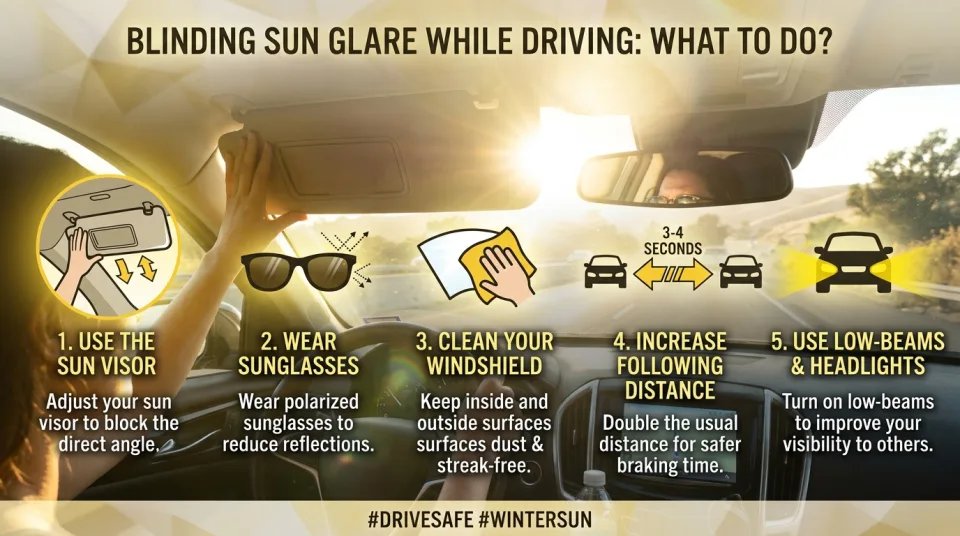
Quick answer
5 steps — read this before anything else
-
1
Slow down gradually and increase your following distance.
-
2
Use your sun visor and keep your windshield clean, inside and out.
-
3
Never brake hard or stop in a live traffic lane because of glare.
-
4
If you cannot see the road, pull over safely and wait it out.
-
5
Never use tinted or dark glasses that are not legal for night or low-light driving.
Warning
Never stop in a live traffic lane or on a blind curve because of sun glare. Other drivers may be blinded too, and a stopped car is a serious collision risk.
Sun glare is one of the most common causes of temporary blindness behind the wheel, and it is worst just after sunrise and just before sunset, when the sun sits low and directly in your line of sight. The problem is not only brightness: a dirty or scratched windshield, a smeared dashboard, and a low sun angle can scatter light across your whole field of view. The goal is to keep control of the car while your eyes recover.
What to do first
- Ease off the accelerator. Reduce speed smoothly so you have more time to react to anything you cannot yet see.
- Increase your following distance. Leave a much bigger gap than usual so a sudden stop ahead does not catch you out.
- Use the sun visor and flip it down. Adjust it to block the sun without covering your view of the road or mirrors.
- Look toward the road edge, not into the sun. Use the white line or lane marking on the right as a guide, and avoid staring at the bright source.
- Keep both hands on the wheel and avoid sudden inputs. Glare reduces your depth perception, so small, smooth corrections are safer.
If you genuinely cannot see
If the glare is so bad that you cannot see the road, other vehicles, or pedestrians, do not keep driving blind. Signal, check your mirrors, and pull off the road at a safe spot such as a parking area, lay-by, or side street. Turn on your hazard lights only once you are safely off the travel lane. Wait a few minutes for the sun angle to change or for conditions to improve, then rejoin traffic when you can see clearly.
What NOT to do
- Do not slam on the brakes. Drivers behind you may not see you either.
- Do not stop in a live lane, on a shoulder next to fast traffic, or on a blind curve.
- Do not use dark or tinted sunglasses at dawn, dusk, or night, and never use them if they are not legal for driving where you are.
- Do not look directly at the sun, even briefly, to judge distance.
- Do not rely on the visor alone if your windshield is dirty or fogged.
What to monitor
Watch for brake lights and shadows ahead, pedestrians and cyclists who may be hidden in glare, and your own fatigue. Squinting and eye strain tire you faster, so take a break if you notice your attention drifting. If you wear prescription glasses, keep them clean, and consider a spare pair in the car.
How to prevent it
- Clean the windshield inside and out, and replace worn wiper blades. A hazy film on the inside glass makes glare far worse.
- Keep the dashboard clear of shiny objects that reflect light into the glass.
- Plan long drives to avoid heading directly into a low sun where possible, and allow extra time at sunrise and sunset.
- Keep a pair of polarised sunglasses in the car for daytime driving.
If glare catches you, the safest response is always the same: slow down, widen your gap, and pull over rather than push on blind. This is general driving safety information, not a substitute for professional advice or your local traffic laws.
Sources & references
Spotted an error? Report it — we correct factual mistakes promptly.
Read next
What Should You Do If Your Car Shakes While Driving?
A shaking car can signal anything from a minor tire issue to a dangerous mechanical failure. Learn how to respond safely and what to check.
What to Do When Driving an Electric Vehicle in Areas with Limited Charging Infrastructure
Learn how to plan routes, manage EV range, and handle low-battery situations safely in regions with sparse charging options.
What to Do If Your Car Gets Stuck in the Snow
Learn how to safely free a vehicle stuck in snow using momentum, traction aids, and proper digging techniques, while protecting yourself from carbon monoxide and hypothermia.
What to Do If You Have a Car Accident
Knowing the exact steps to take immediately following a vehicle collision helps protect lives, prevents secondary hazards, and ensures proper documentation.
Related handy tools
Checklists, decision guides, scenarios and quizzes for the same situation.