Poison prevention at home: the forgotten places
Most poisonings happen at home, often from products stored in unexpected places. Learn where the forgotten risks are and how to fix them.
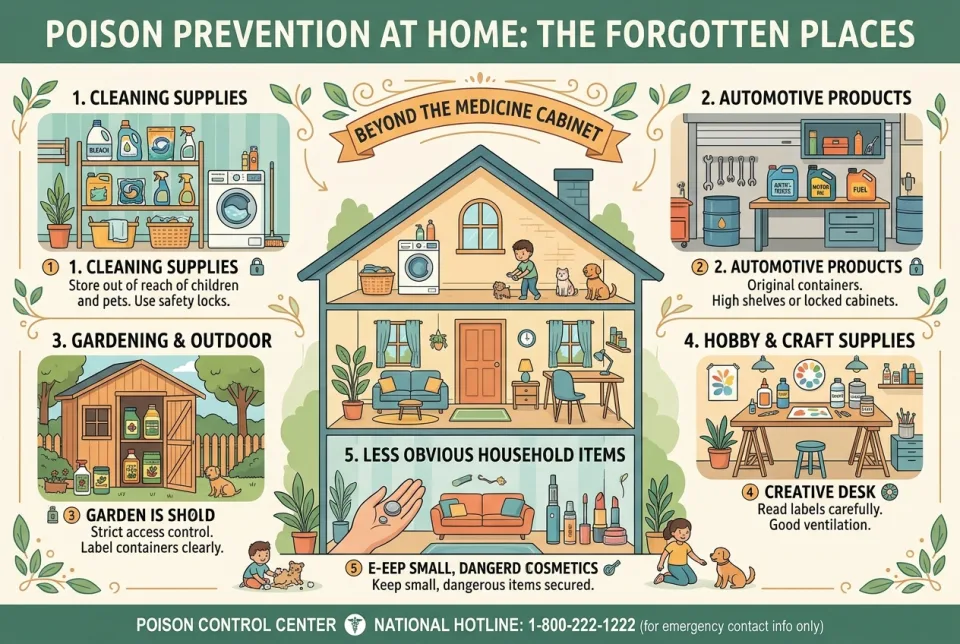
Quick answer
5 steps — read this before anything else
-
1
Store all medicines, cleaning products, and chemicals up high and out of sight, ideally in a locked cabinet.
-
2
Keep products in their original containers and never transfer them to food or drink containers.
-
3
Install child-resistant latches on cabinets and drawers that contain hazardous products.
-
4
Check forgotten spots like the garage, laundry room, and purse for potential poisons.
-
5
Save the Poison Control number (1-800-222-1222 in the US) in your phone and post it visibly.
Warning
If you suspect poisoning, call Poison Control (1-800-222-1222 in the US) or emergency services immediately. Do not wait for symptoms.
When we think of poison prevention, we often picture the kitchen or bathroom cabinet. But many poisonings happen because hazardous products are stored in unexpected or forgotten places. This guide highlights those overlooked spots and gives you practical steps to reduce the risk.
What is happening
Common household items such as medicines, cleaning supplies, and automotive fluids can be dangerous if swallowed, inhaled, or splashed on the skin or eyes. Children are naturally curious, and adults can also make mistakes when products are not clearly labeled or are stored in unusual containers. The good news: most poisonings are preventable with simple changes.
Emergency warning
If you suspect someone has been poisoned, call your local poison control center or emergency services immediately. In the US, call Poison Control at 1-800-222-1222. Do not wait for symptoms to appear. If the person is unconscious, having trouble breathing, or seizing, call emergency services right away.
Forgotten places to check
- Laundry room: Detergent pods, bleach, and stain removers are often within easy reach. Keep them in a locked cabinet.
- Garage and shed: Antifreeze, pesticides, and fertilizers are extremely toxic. Store them in their original containers, locked away, and never in food or drink bottles.
- Bedside table and purse: Pain relievers, sleep aids, and other medicines can be dangerous if found by children. Use child-resistant containers and keep them out of sight.
- Under the sink: Even if latched, children can sometimes get in. Consider moving hazardous products to a higher, locked cabinet.
- Pet areas: Pet medicines and flea treatments can be toxic to children. Store them separately from human medicines.
- Garden and outdoor areas: Mushrooms, berries, and plants can be poisonous. Teach children not to eat anything from the yard without asking.
Step by step
- Do a room-by-room audit. Look for products that could be harmful if swallowed, inhaled, or touched.
- Secure hazardous products. Move them to a locked cabinet or high shelf, out of reach and sight of children.
- Keep products in original containers. Never transfer to food or drink containers, and never mix different products.
- Install child-resistant latches on cabinets and drawers that contain medicines or chemicals.
- Safely dispose of expired or unused medicines and chemicals. Follow local guidelines for disposal.
- Post the Poison Control number visibly and save it in your phone.
What NOT to do
- Do not store food or drinks near chemicals or cleaning products.
- Do not leave medicines on counters or bedside tables where children can reach them.
- Do not assume child-resistant packaging is child-proof; it is only child-resistant.
- Do not induce vomiting unless instructed by a medical professional.
- Do not rely on smell or taste to identify a poison; some dangerous substances have no warning signs.
When to seek professional care
Call poison control or emergency services if you have any concern about exposure, even if the person seems fine. Symptoms can be delayed. If the person has swallowed something potentially toxic, has trouble breathing, is drowsy, or has burns around the mouth, seek emergency care immediately.
How to prevent it
Make poison prevention a habit: store all hazardous products locked up and out of sight, keep the Poison Control number handy, and teach children not to touch or eat anything without asking an adult. Regularly check forgotten spots like the garage, laundry room, and purse, and involve everyone in the household in keeping these areas safe.
This is general information and not a substitute for professional medical advice. In an emergency, call your local emergency services.
Sources & references
Spotted an error? Report it — we correct factual mistakes promptly.
Read next
What age can kids stay home alone legally?
There is no single legal age for leaving a child home alone in most places. The law focuses on whether the child is mature enough and the situation is safe.
Car seat safety check: what to do?
A proper car seat check takes minutes and prevents serious injury. Learn the key checks for installation, harness fit, and when to replace a seat.
Baby choking under one year old: the correct technique
A choking baby needs immediate back blows and chest thrusts, not abdominal thrusts. Learn the correct technique for infants under one year.
Child gets a fever at night: what to do?
A step-by-step guide for parents on how to safely manage a child's fever at night, including when to call for help and what to avoid.
Related handy tools
Checklists, decision guides, scenarios and quizzes for the same situation.