Baby choking under one year old: the correct technique
A choking baby needs immediate back blows and chest thrusts, not abdominal thrusts. Learn the correct technique for infants under one year.
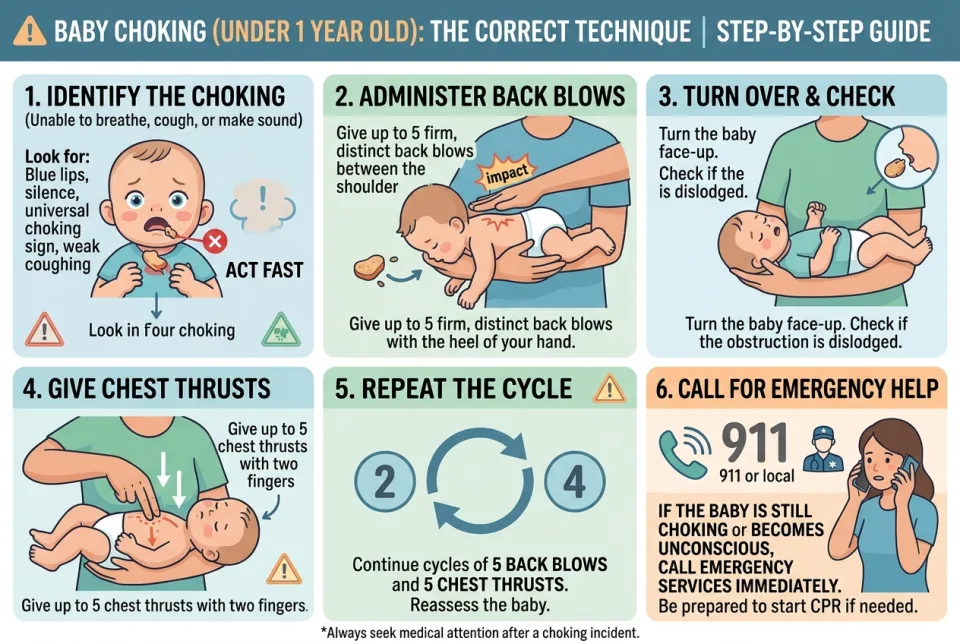
Quick answer
5 steps — read this before anything else
-
1
Call emergency services immediately if the baby is not breathing, is turning blue, or is unconscious.
-
2
Give up to 5 firm back blows between the shoulder blades with the heel of your hand.
-
3
If the object is not cleared, give up to 5 chest thrusts with two fingers on the lower breastbone.
-
4
Alternate 5 back blows and 5 chest thrusts until the object comes out or help arrives.
-
5
Never use abdominal thrusts (Heimlich maneuver) on a baby under one year.
Warning
Never use abdominal thrusts (Heimlich maneuver) on a baby under one year old. It can cause serious injury. Use back blows and chest thrusts instead.
Important — please read
This content is general educational and informational only, and is not a substitute for professional medical advice, diagnosis or treatment. Always seek the advice of a qualified health provider with any questions you may have about a medical condition. Never disregard or delay seeking professional medical care because of something you read here. In an emergency or life-threatening situation, call your local emergency services (police, fire or ambulance) immediately.
Choking is a medical emergency. If a baby under one year old is coughing forcefully, crying, or breathing, let them cough. If they cannot breathe, cry, or make noise, act immediately. This guide follows accepted first-aid guidance for infants.
Emergency warning
Call your local emergency services immediately if the baby is not breathing, is turning blue, or becomes unconscious. Start the steps below while waiting for help.
What to do first
Check if the baby is choking. If they can cough, encourage coughing. If they cannot breathe, cry, or make noise, begin the technique below.
Step by step: back blows and chest thrusts
- Position the baby: Lay the baby face down along your forearm, with their head lower than their chest. Support the head and jaw with your hand.
- Give 5 back blows: Use the heel of your hand to give up to 5 firm blows between the shoulder blades. Check after each blow if the object has come out.
- Turn the baby over: Place your free arm along the baby's back and support the head. Turn the baby face up, keeping the head lower than the chest.
- Give 5 chest thrusts: Place two fingers on the lower half of the breastbone (sternum). Give up to 5 quick, downward thrusts. Check after each thrust.
- Repeat: Continue alternating 5 back blows and 5 chest thrusts until the object is cleared or help arrives.
- If the baby becomes unconscious: Call emergency services if not already done. Begin infant CPR if you are trained, or follow the dispatcher's instructions.
What NOT to do
- Do not use abdominal thrusts (the Heimlich maneuver) on a baby under one year. It can cause serious injury.
- Do not put your fingers in the baby's mouth unless you can clearly see the object. Blind finger sweeps can push it deeper.
- Do not shake the baby or hold them upside down.
- Do not give food or water to try to push the object down.
When to call for help
Call emergency services immediately if the baby is not breathing, is turning blue, or becomes unconscious. Even if the object is cleared, seek medical attention afterward to make sure the baby is safe.
What to monitor
After the object is cleared, watch for difficulty breathing, persistent coughing, or noisy breathing. These may mean part of the object is still in the airway. Seek medical care if you notice any of these signs.
How to prevent choking
- Keep small objects like coins, buttons, and balloons out of reach.
- Cut food into small pieces and avoid hard foods like whole grapes, nuts, and popcorn for babies.
- Always supervise the baby during meals and play.
- Learn infant first aid and CPR from a certified course.
Act quickly and calmly. If the baby is not breathing, call emergency services and start the steps above. This is general information and not a substitute for professional medical advice. In an emergency, call your local emergency services.
Sources & references
Spotted an error? Report it — we correct factual mistakes promptly.
Read next
What Should I Do If I Have a Difficult Relationship With My Step-Parent?
Step-family relationships can be complicated. This guide offers practical steps to reduce conflict, protect your wellbeing, and decide when to seek outside help.
What Should I Do When My Family's Expectations Feel Overly High?
When family expectations feel excessive, it can strain your mental health and relationships. Learn practical steps to set boundaries, communicate effectively, and protect your well-being.
What to Do If Your Water Breaks Early
If your water breaks before 37 weeks or before labor begins, immediately contact your midwife or emergency services and follow essential safety steps.
What to Do in Case of Premature Labor
Premature labor occurs when contractions begin before 37 weeks of pregnancy. Learn the critical signs and immediate safety steps to take.
Related handy tools
Checklists, decision guides, scenarios and quizzes for the same situation.