Dead car battery: what to do?
A dead car battery can leave you stranded. Learn how to safely jump-start your car, avoid dangerous mistakes, and know when to call for help.
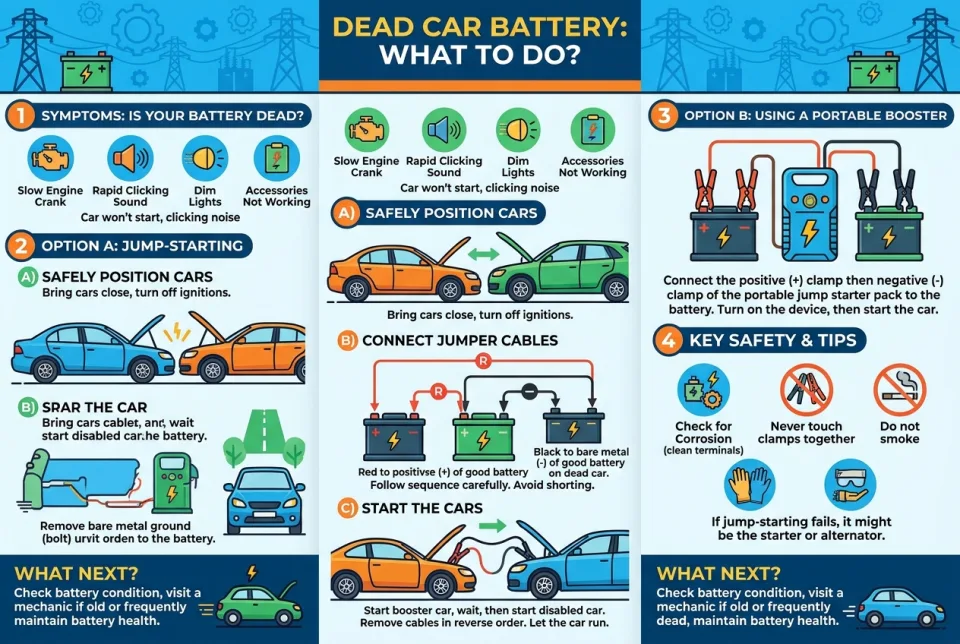
Quick answer
5 steps — read this before anything else
-
1
Turn off the ignition and all accessories.
-
2
Check for visible damage or leaks; do not attempt a jump-start if the battery is cracked or leaking.
-
3
If safe, use jumper cables and a good Samaritan or jump pack, following the correct order.
-
4
If unsuccessful or unsure, call a roadside assistance service.
-
5
After starting, drive for at least 20-30 minutes to recharge.
Warning
Car batteries can explode if jump-started incorrectly. Never smoke or create sparks near a battery, and always follow the correct cable connection order.
A dead car battery is a common problem, but it can be dangerous if handled incorrectly. This guide explains how to jump-start your car safely, what to avoid, and when to seek professional help.
What is happening
When you turn the key (or press the start button) and hear a clicking sound or nothing at all, and the lights are dim or dead, the battery is likely discharged. This can happen due to age, leaving lights on, extreme temperatures, or a faulty charging system.
Emergency warning
If you are in a dangerous location (e.g., on a busy highway, in a tunnel, or extreme weather), call emergency services or roadside assistance immediately. Do not attempt to jump-start in traffic. Move to a safe spot if possible.
What to do first
- Ensure safety: Turn off the ignition and all accessories (lights, radio, A/C). Set the parking brake. If you are on a road, turn on hazard lights and use a warning triangle if available.
- Check the battery: Look for cracks, leaks, or corrosion. If the battery is damaged or leaking, do not attempt a jump-start. Call a professional.
- Get a jump-start: You need jumper cables and a working vehicle or a portable jump starter. Park the working vehicle close enough for the cables to reach, but not touching. Turn off both vehicles.
- Connect the cables in this order:
- Red clamp to the positive (+) terminal of the dead battery.
- Other red clamp to the positive (+) terminal of the good battery.
- Black clamp to the negative (-) terminal of the good battery.
- Other black clamp to an unpainted metal surface on the dead car's engine block (not to the battery).
- Start the working vehicle and let it run for a few minutes. Then try to start the dead vehicle. If it starts, remove the cables in reverse order.
- Drive the vehicle for at least 20-30 minutes to recharge the battery.
What NOT to do
- Do not smoke or use open flames near the battery; it can emit explosive hydrogen gas.
- Do not connect the black clamp to the dead battery's negative terminal; this can cause sparks and explosion.
- Do not attempt to jump-start a frozen, cracked, or leaking battery.
- Do not touch the clamps together or let them touch metal while connected.
- Do not try to push-start a car with an automatic transmission (unless specified in the manual).
When to call for help
Call a professional if:
- The battery is damaged, leaking, or frozen.
- You are unsure about the procedure or do not have the right equipment.
- The car still does not start after a jump-start.
- You notice a rotten egg smell (sulfur) or see smoke.
What to monitor
After a jump-start, watch for signs of a failing battery or alternator: dim lights, slow cranking, or repeated dead batteries. If the battery dies again soon, have the charging system checked.
How to prevent it
- Turn off lights and accessories when leaving the car.
- Test your battery regularly, especially before winter.
- Keep jumper cables or a portable jump starter in your trunk.
- Replace batteries every 3-5 years or as recommended.
If you are ever in doubt, call a professional. Safety first.
This is general information and not a substitute for professional automotive advice. In an emergency, call local emergency services.
Spotted an error? Report it — we correct factual mistakes promptly.
Read next
Accident in a rental car abroad: what to do?
A step-by-step guide to handling a rental car accident in a foreign country, from securing the scene to notifying the rental company and your insurer.
Key fob battery dead: how to start the car?
When your key fob battery dies, you can often still start your car using the hidden key or backup slot. Learn the steps to get moving again.
Car smells of burning rubber: what to do?
A burning rubber smell in your car can signal a serious hazard like an overheating engine, a slipping belt, or an electrical fault. Learn how to respond safely and when to get professional help.
Headlights stopped working at night: what to do?
Driving with no headlights at night is extremely dangerous. Learn how to stop safely, make yourself visible, and get help without causing a crash.
Related handy tools
Checklists, decision guides, scenarios and quizzes for the same situation.